
Activities
Getting to Know Catalonia MOOC
The main goal of the MOOC Getting to Know Catalonia: An Introduction to the Catalan Language, Culture and Society is to present the Catalan nation to everyone who is interested in it and introduce them to the main facets and aspects of our country. As a result, this MOOC is taught by a multidisciplinary team of lecturers, specialised in the different fields of knowledge that are dealt with.
TRAILER of the MOOC
The MOOC consists of three modules, each of them divided into two or three units on a similar theme. Thus, the first module is about language, art and culture. The first unit of this first module sets forth the history, evolution and characteristics of the Catalan language, while the second and third unites address literature and the main artistic and cultural expressions. The second module is about the history, politics and media of Catalonia, and its respective units spotlight the origins of the Catalan nation, which date back one thousand years, and the Catalan media. Lastly, the third module focuses on the economy and the main drivers of knowledge, and is made up of units on the economy and society and the welfare state.
The MOOC was developed in collaboration with the CLIK at UPF, and two editions have been held to date. The first was in April 2018 and the second in January 2020. Both editions of the MOOC were held on the FutureLearn platform.
You will find more information in this link.
Pompeu Fabra Route
The Pompeu Fabra Chair has promoted the Pompeu Fabra Route since its beginnings, in 2015. The route, designed by the lecturers David Paloma and Mònica Montserrat, is a guided tour connecting various sites that were important in the life and work of Pompeu Fabra in Barcelona, Prada, Badalona and Sant Feliu de Codines, and starting in 2018 also in Bilbao, on the occasion of Pompeu Fabra Year.
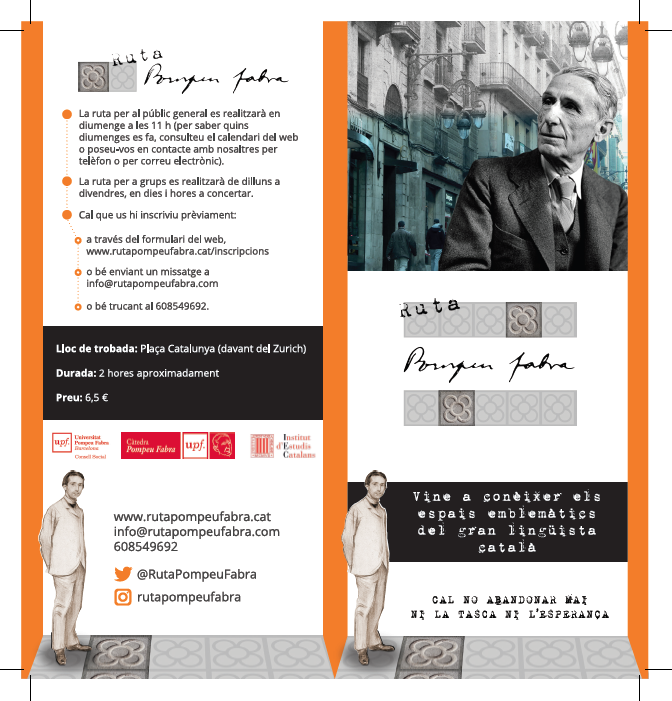
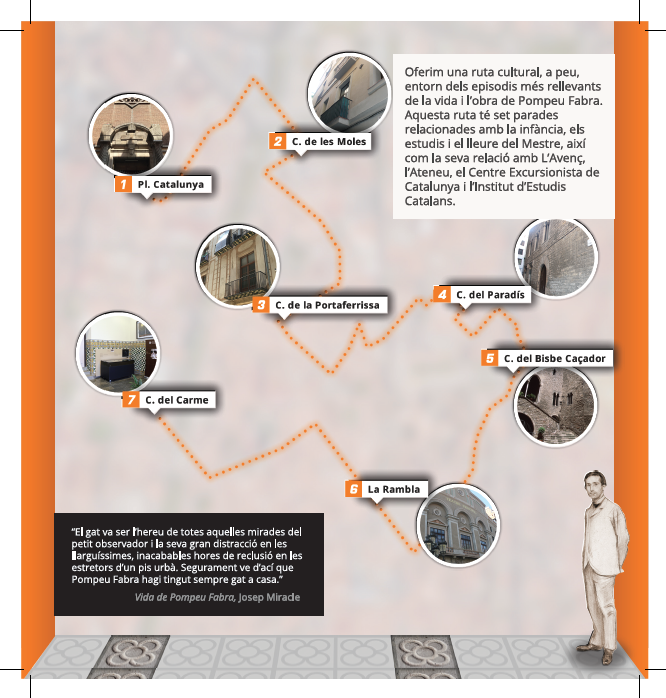
For further information, you can visit the Pompeu Fabra Route website.
Pompeu Fabra Portal
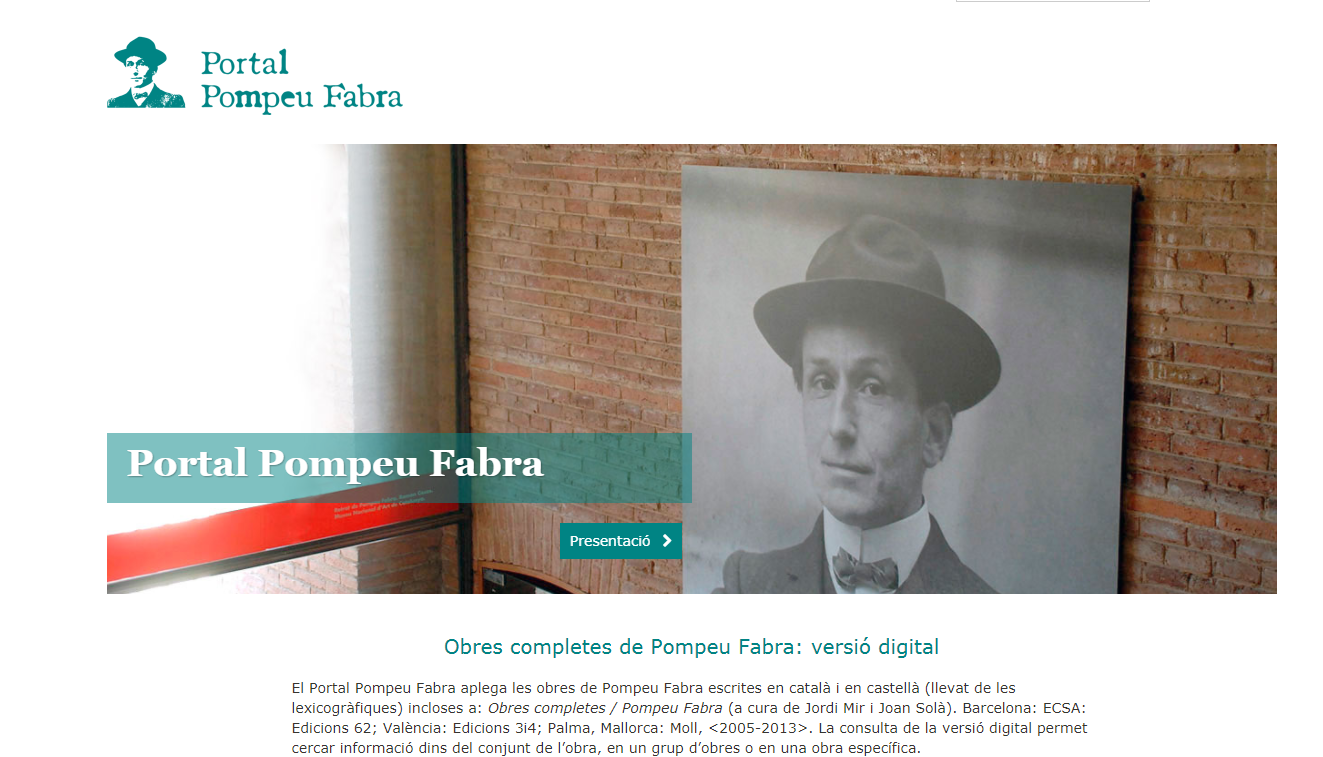
The Pompeu Fabra Portal is a joint initiative by Pompeu Fabra University and the Institute of Catalan Studies on the proposal of the Pompeu Fabra Chair, and was launched in 2018 within the framework of Pompeu Fabra Year. The creation of the Portal was made possible by funding from the Ministry of Culture of the Generalitat of Catalonia.
The Portal includes Fabra’s complete works in digital format, and allows searches with a string of characters (one or more words) within the whole of his work, a group of works in the same category, or one particular work.
The Complete works were digitised at the Institute of Catalan Studies under the directorship of M. Teresa Cabré, President of the Philology Section, and the coordination of Lluís de Yzaguirre i Maura, with the collaboration of Ester Pedreño. The Computing Service of the IEC also participated. The design of the Portal was by Pompeu Fabra University.
You can access the Pompeu Fabra Portal via this link.
Pompeu Fabra comic
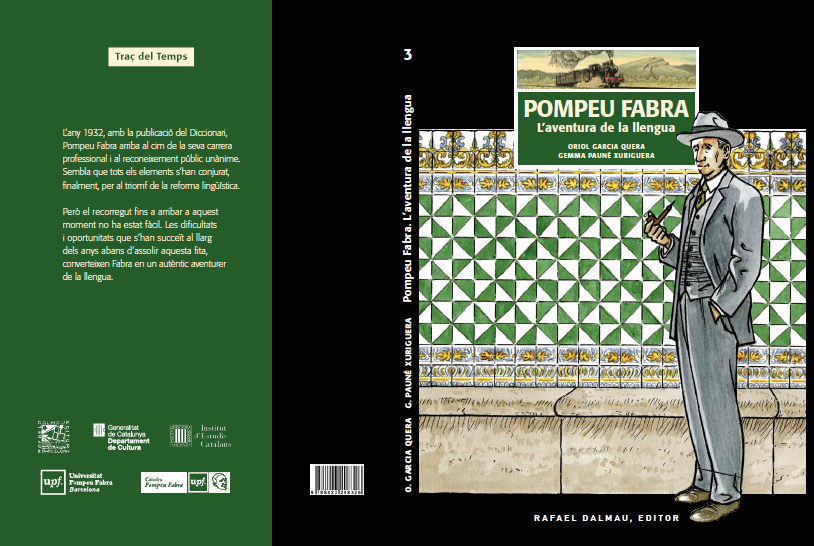
In collaboration with the Institute of Catalan Studies and with funding from the Department of Culture of the Generalitat of Catalonia, the CPF produced a comic about the life and work of Pompeu Fabra entitled Pompeu Fabra: The Adventure of the Language. It was published within the framework of Pompeu Fabra Year, to commemorate the 150th anniversary of “the Maestro’s” birth and also the centenary of the publication of the Catalan Grammar.
The script and text of the comic are by Gemma Pauné, while the illustrations are by Oriol Garcia Quera. It was published jointly by Rafael Dalmau Editors and the Institute of Catalan Studies, and is the third work to be published in the collection Traç del temps.
Estudi: "Els discursos mediàtics sobre multilingüisme a Catalunya"
Els discursos mediàtics sobre multilingüisme a Catalunya.
Proposta d’anàlisi
Aquest estudi està finançat per la Càtedra Pompeu Fabra.
Data d'inici: juliol del 2021
Durada: 11 mesos
Investigadors
Vicent Climent-Ferrando (investigador principal), Càtedra UNESCO de Polítiques Lingüístiques per al Multilingüisme i GEDIT-UPF
Albert Morales Moreno, Universitat de Ginebra
Maria Sabaté-Dalmau, Universitat de Lleida
Resum
El debat lingüístic a Catalunya i a l’estat espanyol apareix periòdicament als mitjans de comunicació, sovint en un marc de polèmica i confrontació (vegeu el volum 32 de Treballs de Sociolingüística Catalana, 2021, sobre la conflictivització del model educatiu català). Un dels darrers debats el trobem molt recentment, al mes de març del 2021. El Congrés dels Diputats debatia la Proposició no de Llei sobre la realitat plurilingüe i la igualtat lingüística de l’Estat. Els principals mitjans de comunicació se’n feien ressò de manera molt diversa:
“Entitats en defensa de les llengües cooficials reclamen al Congrés que hi hagi igualtat lingüística a l’Estat” (El Punt Avui, març del 2021)
“El Congrés dona suport a la reciprocitat però tanca la porta a la igualtat lingüística a l’Estat” (Ara, març del 2021)
Podemos y nacionalistas piden mismos derechos para las lenguas cooficiales (La Vanguardia, març 2021)
El PSOE negocia con Bildu un “encaje jurídico” que permita imponer las lenguas propias en la Administración” (El Mundo, març del 2021)
El PSOE y sus socios se enzarzan en el Congreso por el uso de las lenguas cooficiales (El País, març del 2021)
Ofensiva de Podemos y Bildu contra el castellano (La Razón, març del 2021)
El PSOE apoya parte de la polémica propuesta de Bildu y Podemos que quiere hundir el castellano (ABC, març del 2021)
Aquest és el darrer exemple d’una tendència cada vegada més observada de la problematització discursiva del multilingüisme propi de l’Estat, vehiculada a través dels mitjans de comunicació, que actuen com a altaveu d’una conflictivització basada en el cherry-picking; és a dir, mitjançant la magnificació d’algun acte o fet concret de discrepàncies o disjuncions banals i que tenen com a efecte una polarització creixent de la societat en els debats lingüístics.
Són alguns dels exemples més recents sobre els discursos dominants a les nostres societats. Resulta paradoxal que, simultàniament, sentim sovint el terme “multilingüisme”, al qual se li assignen valor, formes i conceptualitzacions diferents, sempre positives quan s’usa com a sinònim de l’anglès, com a llengua lligada als discursos de progrés econòmic, social i laboral. Uns discursos adreçats a legitimar polítiques d’incorporació progressiva de l’anglès a cada cop més àmbits, com ara a l’escolarització obligatòria o a l’àmbit universitari.
Aquests discursos presenten una clara dimensió ideològica: formen part d’un sistema de creences, valors i normes que contribueixen a legitimar certes representacions en detriment d’altres i que posicionen certs actors en detriment d’altres –són postulats polítics que tenen conseqüències immediates per a tots els agents (institucionals i cívics) relacionats amb la gestió de les polítiques i planificacions lingüístiques, que conflueixen en pràctiques d’estratificació i diferenciació social de la població catalana per motius de llengua. Creen uns marcs conceptuals concrets d’inclusió/exclusió de llengües i les categoritzen d’una manera o d’una altra. Sostinguts en el temps i vehiculats sistemàticament a través dels mitjans i de les xarxes de comunicació de masses, aquests marcs acaben creant un habitus particular, usant terminologia de Bourdieu (1981), una manera concreta de pensar, definir i conceptualitzar les llengües.
És crucial poder analitzar aquests marcs conceptuals, els valors, les normes, les representacions i les creences que s’assignen a les diferents llengües del nostre entorn –el català, però també el castellà, l’anglès i les llengües de la immigració present en el nostre territori– per poder tenir dades concretes, tant quantitatives com qualitatives, per saber de què parlem quan parlem de “multilingüisme” i dels seus diferents significats socials, amb l’objectiu de desentortolligar les finalitats polítiques entorn de l’activació d’aquests discursos.
Partim de la base que el multilingüisme és una forma de capital simbòlic (Bourdieu 1991) i un recurs que es distribueix de manera desigual en la societat i el significat del qual es construeix discursivament a partir de contextos polítics, socials o històrics concrets. Volem analitzar, per tant, la construcció discursiva del multilingüisme en la nostra societat actual, ja que això ens permetrà conèixer les ideologies lingüístiques associades a cada llengua, definides com la “forma de valorar les llengües tot afirmant que una llengua –o una varietat– és millor o pitjor que una altra (Bell, 2014), i com a “índex” de les normes que regulen els nostres comportaments sociolingüístics (és a dir, com a vehicle per entendre què està legitimat i què no, en públic, quant a tries, usos i orientacions vers el multilingüisme) (Kroskrity et al., 1998).
Els mitjans de comunicació representen una font d’informació clau com a agents principals en la conceptualització i la transmissió de les ideologies lingüístiques. L’anàlisi dels mitjans de comunicació o “mediatisation” (Androutsopoulos 2014) ens ofereix una perspectiva molt útil a l’hora de conceptualitzar el vincle entre els mitjans de comunicació i les estratègies discursives que aquests fan servir per emmarcar els debats d’una determinada manera.
Amb la investigació del què i del com es diu sobre multilingüisme als mitjans de comunicació, el nostre objectiu principal és analitzar i categoritzar les ideologies lingüístiques que es transmeten, com influeixen aquestes ideologies en la conceptualització del multilingüisme i quins mecanismes es fan servir per evidenciar-les en els principals mitjans de comunicació, durant el període 2015-2021. Analitzar la dimensió ideològica del discursos sobre el multilingüisme ens proporcionarà dades concretes sobre la conceptualització mediàtica, ens ajudarà a tenir una radiografia acurada de la realitat i permetrà al món acadèmic, polític i universitari conèixer aquesta realitat per poder prendre accions específiques en matèria de gestió del multilingüisme.