The Vision of God
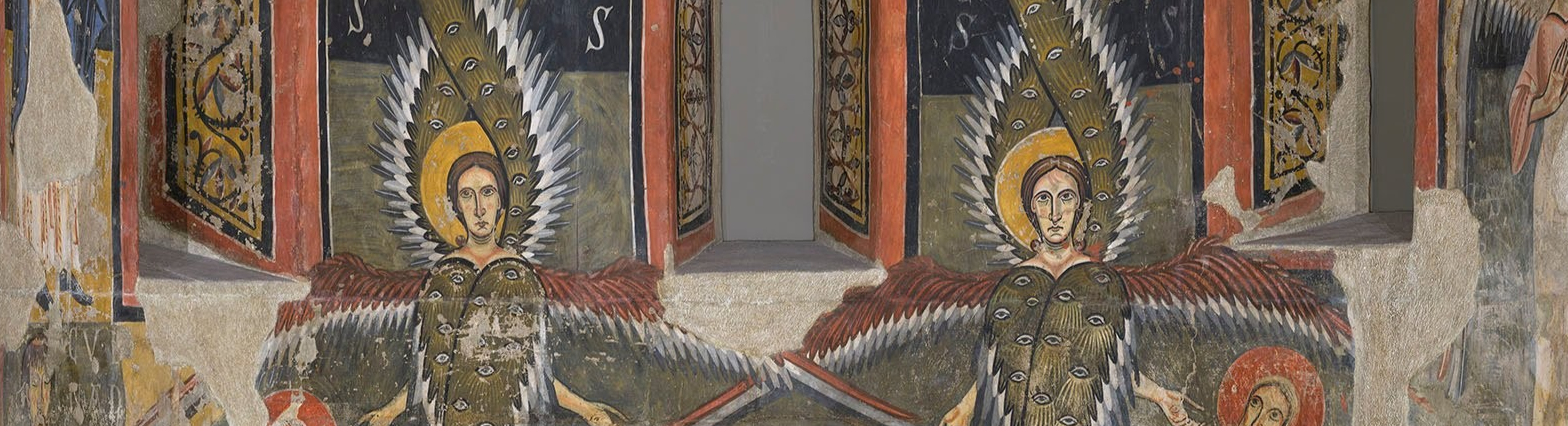
Nicholas of Cusa
The Vision of God
Cardinal Nicholas of Cusa wrote "De visione Dei" in 1453, in response to a request sent to him by the Benedictine monks of Tegernsee through their abbot, Gaspar Aindorffer. The monks asked him which one had preeminence in the vision of God, the cognitive element or the affective element. To accompany this brief treatise on mystical theology, Cusanus included in his response the reproduction of an all-seeing portrait, which he called the "icon of God." It is the likeness upon which the meaning of the work rests.
The portrait, which, due to the pictorial technique, seems to follow the viewer's gaze with its eyes, suggested the following reflection to the cardinal in the preface of "The Vision of God":
"And while one realizes that that face does not avoid anyone, they will see that the gaze takes care of each one, with as much love as if that person were the only one experiencing being seen and as if it cared for no one else, to the point that they cannot even conceive that the image cares for anyone other than themselves. Likewise, they will realize that the face takes great care of both the smallest and the largest creatures, and of the entire universe."
More resources
Nicholas of Cusa, The Vision of God
Chapter X: How God is seen beyond the Coincidence of Contradictories and how Seeing is Being
I stand before this image of Thy face, my God, and while I look upon it with the eyes of sense, I strive with my inner eyes to behold the truth which is figured forth in this picture, and it seemeth to me, Lord, that Thy glance speaketh. For with Thee speech and sight are one, since in reality they are not different in Thee, who art Very Absolute Simplicity. Thence I prove clearly that Thou seest at the same time all things and each thing.
When I preach, I speak alike and at the same time to the whole congregation in church, and to the individuals present in church; I preach one sermon only, and in that one sermon I speak to individuals. And what the church is to me that, Lord, the whole world is to Thee, with the individual creatures which exist or can exist. Then, if Thou speakest to individuals, Thou seest those things to which Thou speakest. Thou, Lord, who art the sovran comfort of them that hope in Thee, inspirest me to praise Thee from myself. For Thou hast given me a face according as Thou didst will, and it is seen by all to whom I preach, individually and at the same time. Thus my one face is seen by individuals, and my one speech is wholly heard by individuals. I, however, cannot separately hear all who speak together, but I must hear one after another; nor can I separately see all at once, but one after another. But if such a faculty were in me as that to be heard were one with hearing, and to be seen with seeing, and in like manner to speak with hearing (even as it is with Thee, Lord, who art the sovran Power), then indeed I could hear and see all and each at one and the same time. And just as I could speak to individuals simultaneously, so, in the same instant in which I were speaking, I could see and hear the answers of all and each.
Whence I begin, Lord, to behold Thee in the door of the coincidence of opposites, which the angel guardeth that is set over the entrance into Paradise. For Thou art there where speech, sight, hearing, taste, touch, reason, knowledge, and understanding are the same, and where seeing is one with being seen, and hearing with being heard, and tasting with being tasted, and touching with being touched, and speaking with hearing, and creating with speaking.
If I were to see as I am seen I should not be a creature. And if Thou, God, didst not see as Thou art seen Thou wouldest not be God Almighty. Thou art to be seen of all creatures, and Thou seest all; in that Thou seest all, Thou art seen of all; for otherwise creatures could not exist, since they exist by Thy seeing. If they saw not Thee who seest them, they would not receive from Thee being; the being of the creature is Thy seeing and the being seen of Thee alike. Thou speakest by Thy Word to all things that are, and callest into being those that are not: Thou callest them to hear Thee, and when they hear Thee then they are. When Thou speakest Thou speakest unto all, and all things hear Thee to which Thou speakest. Thou speakest to the earth and callest it to human nature, and the earth heareth Thee and by this its hearing man is made. Thou speakest to that which is nothing as though it were something, and Thou callest nothing to be something, and that which is nothing heareth Thee because that which was nothing becometh something.
O infinite Power, Thy concept is Thy speech! Thou conceivest the heaven, and it existeth as Thou conceivest it; Thou conceivest the earth, and it existeth as Thou conceivest it; while Thou conceivest, Thou dost see and speak and work, and do all else that can be named. Marvellous art Thou, my God, Thou conceivest once, Thou speakest once! How, then, do not all things come into being simultaneously, but many of them successively? How do such diverse things spring from one only concept? Thou dost enlighten me while I am on the threshold of the door, showing me that Thy concept is pure and simple eternity itself. 'Tis impossible that aught should be made after eternity pure and simple. For infinite duration, which is eternity’s self, includeth all succession, and all which seemeth to us to be in succession existeth not posterior to Thy concept, which is eternity. For Thy one and only concept, which is also Thy Word, enfoldeth all and each, while Thine eternal Word cannot be manifold, nor diverse, nor changeable, nor mutable, because it is simple eternity.
Thus, Lord, I perceive that naught existeth posterior to Thy concept, but that all things exist because Thou dost conceive them. Thou conceivest in eternity, but in eternity succession is without succession, ’tis eternity’s self, 'tis Thy very Word, O Lord God. Thou hast no sooner conceived aught that appeareth to us in time than it is. For in eternity in which Thou conceivest, all succession in time coincideth in the same Now of eternity. There is no past nor future where future and past are one with present. The reason why things in this world exist as earlier and later is that Thou didst not earlier conceive such things to exist: hadst Thou earlier conceived them they would have existed earlier. But he in whose thought earlier and later can occur, in such a way that he conceives one thing first and then another, is not almighty. Thus, because Thou art God Almighty, Thou dwellest within the wall of Paradise, and this wall is that coincidence where later is one with earlier, where the end is one with the beginning, where Alpha and Omega are the same.
So then, things alway exist because Thou biddest them exist, and they do not exist earlier because Thou dost not bid them earlier. When I read that Adam existed so many years ago, and that to-day such an one is born, it seemeth impossible that Adam existed then because Thou didst then will it, and likewise that the other is born to-day because Thou hast now willed it, and that nevertheless Thou didst not earlier will Adam to exist than the one born to-day. But that which seemeth impossible is necessity itself, for NOW and THEN are posterior to Thy Word. This is why for him that approacheth Thee, they meet in the wall surrounding the place where Thou abidest in coincidence. For NOW and THEN coincide in the circle of the wall of Paradise. But, O my God, the Absolute and Eternal, it is beyond the Present and the Past that Thou dost exist and utter speech!
Transl. Emma Gurney Salter
Sources
Nicolaus Cusanus. Opera Omnia VI (De visione Dei) (ed. Heide Dorothea Riemann). Hamburg: Felix Meiner, 2000.
Nicholas of Cusa. The Vision of God (tr. Emma Gurney Salter). London / Toronto / New York: J.M. Dent & Sons / Dutton & co, 2007 (1928).
Nicolás de Cusa. La visión de Dios (tr. Ángel Luis González). Pamplona: Ediciones Universidad de Navarra, 2021 (1994).
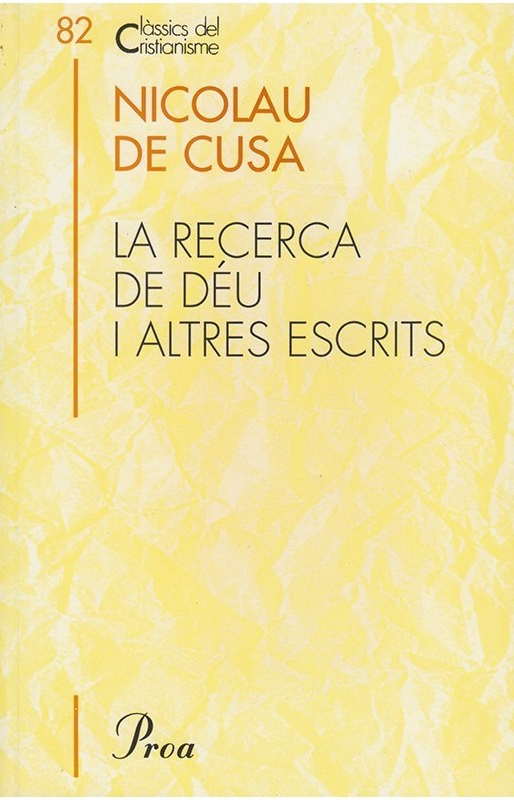
Nicolau de Cusa. La recerca de Déu i altres escrits (tr. Josep Manuel Udina). Barcelona: Proa, 2000.
At the Haas Collection