
Student information
Academic calendar and schedule
Academic calendar
As students receive a large amount of practical training given in small groups, the teaching activity at the Faculty is carried out both in the morning and in the afternoon, although most of the teaching is during the morning. The high proportion of laboratory activities and the sequencing of theoretical classes on the basis of didactic considerations make it impossible to maintain a regular weekly schedule. However, students are informed in advance of all schedules.
Consult one or more selected topics.
The schedule is subject to change. Don’t forget to check the schedule often. Changes, if necessary, will be updated to personal schedule.
TIMETABLE
|
FIRST TERM 25-26 |
SECOND TERM -COURSE 25-26 |
THIRD TERM- COURSE 25-26 |
|
| FIRST COURSE | |||
| SECOND COURSE | |||
| THIRD COURSE | |||
| FOURTH COURSE |
Assessment criteria
Assessment 2025-2026
Progressió i permanència
Continuïtat d'estudis a temps complet
Per poder continuar els mateixos estudis iniciats a la Universitat Pompeu Fabra, els estudiants de primer curs han de superar durant el primer any acadèmic dels estudis el 50% dels crèdits de què consta el curs.
Crèdits a superar: 30
Progressió d'estudis a temps complet
Accés a segon curs
Cal superar com a mínim el 50% dels crèdits corresponents a primer curs.
Crèdits a superar: 30
Accés a tercer curs
Cal superar com a mínim el 50% dels crèdits corresponents a segon curs i el 90% de primer curs.
Crèdits a superar de segon: 30
Crèdits a superar de primer: 54
Accés a quart curs
Cal superar com a mínim el 50% dels crèdits corresponents a tercer curs, el 90% de segon i tot primer curs.
Crèdits a superar de tercer: 30
Crèdits a superar de segon: 54
Continuïtat d'estudis a temps parcial
Per poder continuar els mateixos estudis iniciats a la Universitat Pompeu Fabra, els estudiants de primer curs han de superar durant els dos primers anys acadèmics dels estudis el 50% dels crèdits de què consta el curs.
Crèdits a superar: 30
Progressió d'estudis a temps parcial
Per accedir al segon curs, els estudiants hauran d'haver superat com a mínim el 50% dels crèdits corresponents a primer curs.
Crèdits a superar: 30
Per accedir a un curs posterior al segon, els estudiants han d'haver superat com a mínim el 50% dels crèdits corresponents al curs precedent i el 90% dels crèdits de dos cursos precendents.
Internships. Agreement
Aquesta informació fa referència a la gestió dels convenis de pràctiques següents:
- Pràctiques extracurriculars realitzades durant el curs i/o durant l'estiu (BH i MED)
- Pràctiques dins del marc del TFG (BH i MED)
- Pràctiques dins del programa de mobilitat (BH i MED)
- Pràctiques dins del rotatori extern (MED)
- Pràctiques tutelades (BH)
- Pràctiques realitzades dins d'un grup de recerca de DCEXS (BH i MED)
Totes les pràctiques hauran de tenir un conveni que es formalitzarà un cop l'estudiant hagi estat acceptat per l'entitat col·laboradora.
Cal formalitzar el conveni entre la Universitat, l'entitat i l'estudiant abans de començar les pràctiques.
Els convenis són gestionats per la secretaria de la Facultat, conjuntament amb el Servei de Carreres Professionals de la UPF.
| Nou! A partir de l'1 de gener de 2024, previsiblement, serà obligatòria la inclusió dels estudiants que facin pràctiques no remunerades al règim de cotització de la Seguretat Social ( link amb informació per a l'estudiant // link amb informació per a l'entitat col·laboradora). |
El procediment que per formalitzar el conveni de pràctiques és diferent en funció del tipus de pràctiques que es realitzi:
|
Formalització del conveni de pràctiques |
|
|
Passes a seguir per formalitzar el conveni en cas de voler realitzar alguna d'aquestes pràctiques: - Pràctiques dins d'un grup de recerca de DCEXS |
Passes a seguir per formalitzar el conveni en cas de voler realitzar alguna d'aquestes pràctiques: - Pràctiques extracurriculars (durant el curs i/oa l'estiu) - Pràctiques dins del marc del TFG (BH i MED) - Pràctiques dins del programa de mobilitat (BH i MED) - Pràctiques del rotatori extern (MED) - Pràctiques tutelades (BH) |
+ Informació: [email protected]
Sylabus 2020
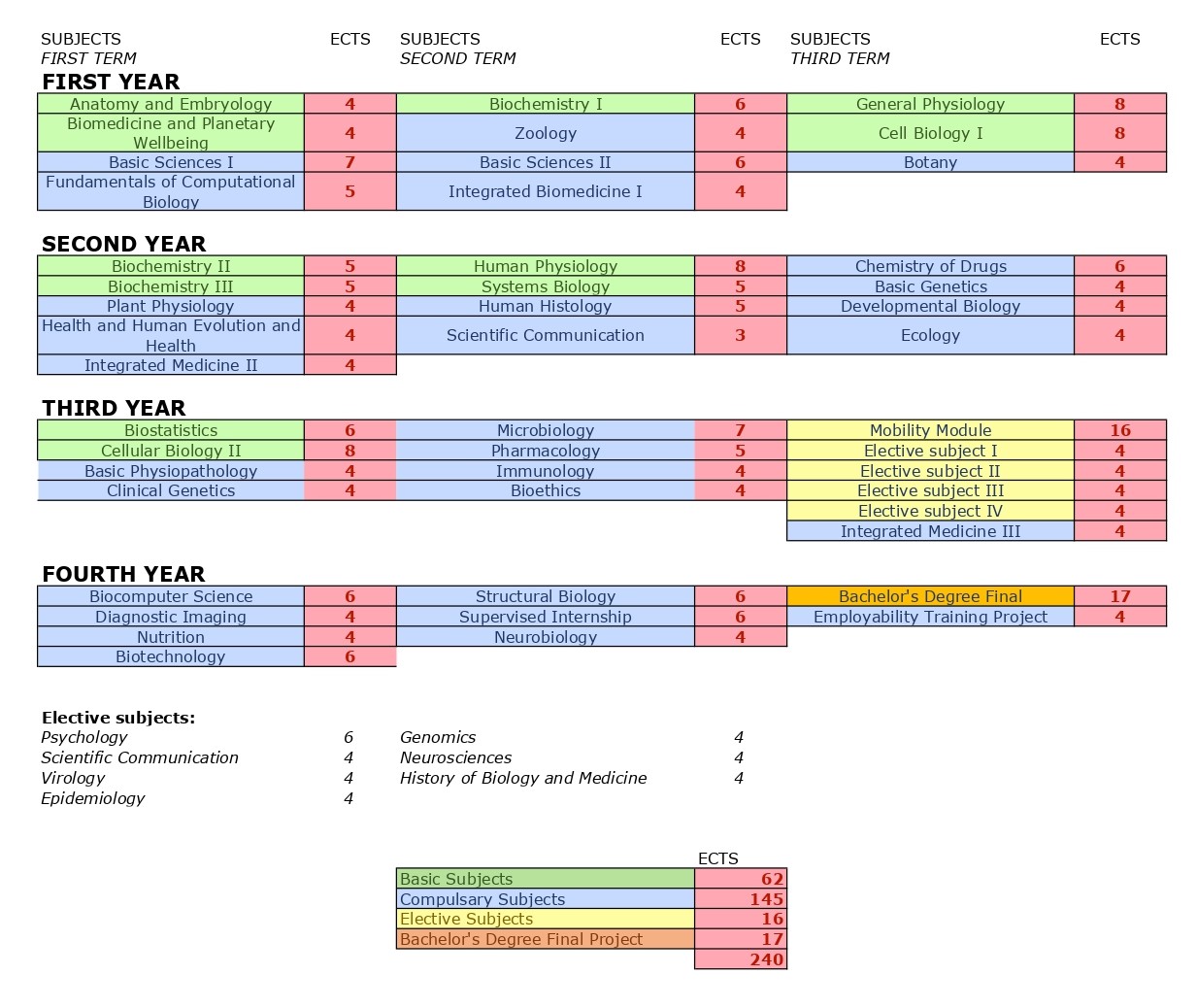
PRIMER ANY
|
Termini |
Assignatura |
Camp |
Tipus |
Crèdits ECTS |
|
1 st |
Biomedicina i benestar planetari |
Programa de formació propi |
B |
4 |
|
1 st |
Anatomia i Embriologia |
Anatomia i |
B |
4 |
|
1 st |
Ciències bàsiques I |
|
O |
7 |
|
1 |
Fonaments de biologia computacional |
|
O |
5 |
|
2 nd |
Bioquímica I |
Bioquímica |
B |
6 |
|
2 nd |
Ciències Bàsiques II |
|
O |
6 |
|
2 nd |
Biomedicina integrada I |
|
O |
4 |
|
2 nd |
Zoologia |
|
O |
4 |
|
3 rd |
Fisiologia General |
Fisiologia |
B |
8 |
|
3 rd |
Biologia Cel·lular I |
Biologia |
B |
8 |
|
3 rd |
Botànica |
O |
4 |
SEGON ANY
|
Termini |
Assignatura |
Camp |
Tipus |
Crèdits ECTS |
|
1 st |
Bioquímica II |
Bioquímica |
B |
5 |
|
1 st |
Bioquímica III |
Bioquímica |
B |
5 |
|
1 st |
Fisiologia de les plantes |
|
O |
4 |
|
1 st |
Health and Human Evolution |
|
O |
4 |
|
1st |
Integrated Biomedicine II |
|
O |
4 |
|
2nd |
Human Physiology |
Physiology |
B |
8 |
|
2nd |
Systems Biology |
|
|
|
|
2nd |
Human Histology |
O |
5 |
|
|
3rd |
Basic Genetics |
O |
4 |
|
|
3rd |
Developmental Biology |
O |
4 |
|
|
3rd |
Medical Chemistry |
O |
6 |
|
|
3rd |
Ecology |
O |
4 |
THIRD YEAR
|
Term |
Subject |
Field |
Type |
ECTS credits |
|
1st |
Biostatistics |
Statistics |
B |
6 |
|
1st |
Cellular Biology II |
Biology |
B |
8 |
|
1st |
Clinical Genetics |
|
O |
4 |
|
1st |
Basic Physiopathology |
|
O |
4 |
|
2nd |
Immunology |
O |
4 |
|
|
2nd |
Microbiology |
O |
7 |
|
|
2nd |
Pharmacology |
O |
5 |
|
|
2nd |
Bioethics |
|
O |
4 |
|
3rd |
Integrated Biomedicine III |
|
O |
4 |
|
3rd |
Mobility or optional subjects module |
O |
16 |
|
|
3rd |
History of Biology and Medicine |
Op |
4 |
|
|
3rd |
Scientific Communication |
Op |
4 |
|
|
3rd |
Neurosciences |
Op |
4 |
|
|
3rd |
Virology |
Op |
4 |
|
|
3rd |
Genomics |
Op |
4 |
|
|
3rd |
Epidemiology |
Op |
4 |
|
|
3rd |
Psychology |
Op |
6 |
FOURTH YEAR
|
Term |
Subject |
Type |
ECTS credits |
|
1st |
Diagnostic Imaging |
O |
4 |
|
1st |
Biocomputer Science |
O |
6 |
|
1st |
Nutrition |
O |
4 |
|
1st |
Biotechnology |
O |
6 |
|
2nd |
Neurobiology |
O |
4 |
|
2nd |
Structural Biology |
O |
6 |
|
2nd |
Supervised Internship |
O |
6 |
|
3rd |
Employability Training Program |
O |
4 |
|
3rd |
End-of-Degree Dissertation |
O |
17 |
Sylabus 2008
|
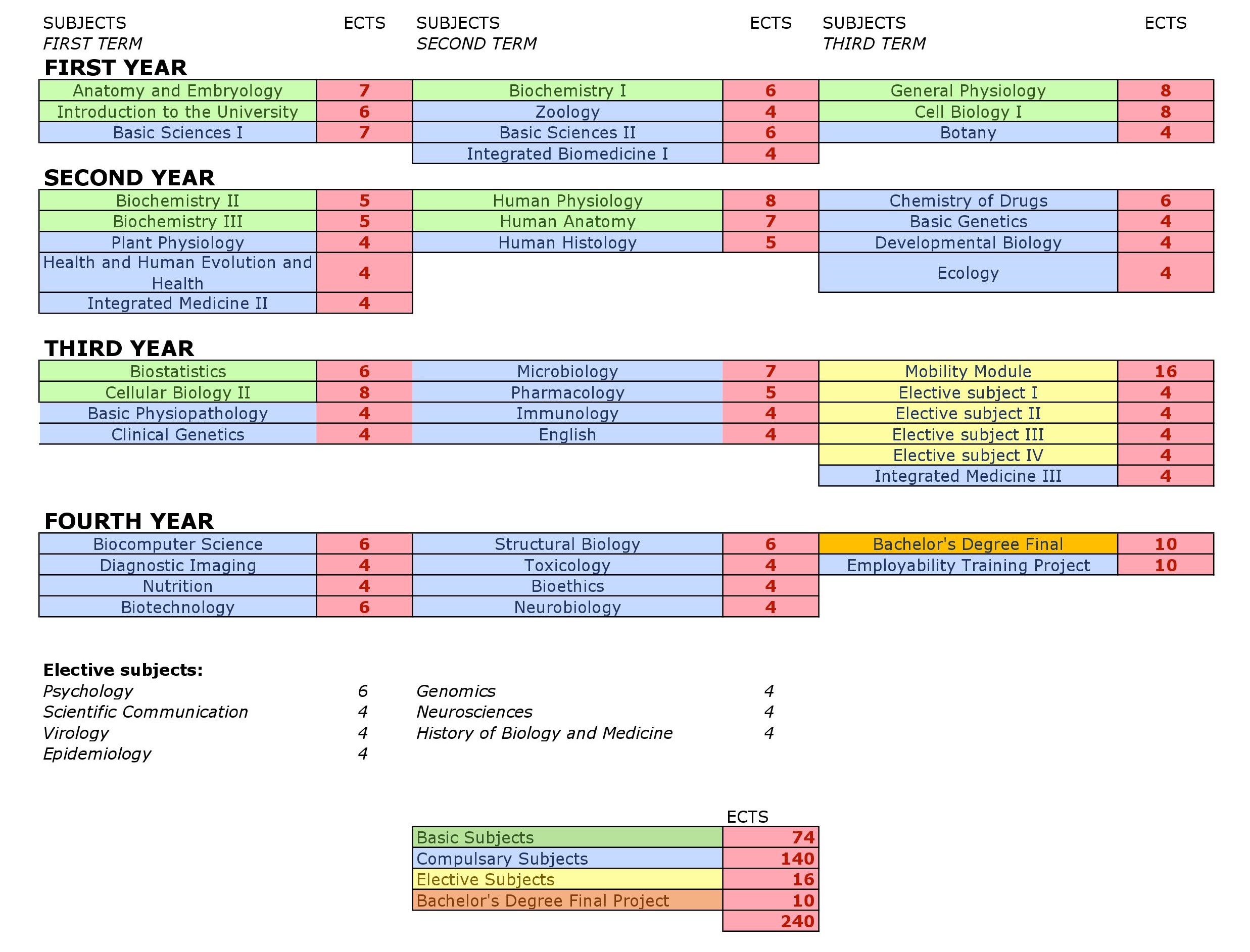
FIRST YEAR |
|||||
|
Term |
Subject |
Field |
Type of Subject |
ECTS credits |
Description of the subject |
|
1st |
Introduction to the University |
Own training programme |
B |
6 |
Knowledge of UPF and the educational project of the Faculty of Health and Life Sciences. Use of information sources and information technologies. To understand the social determinants of health and the role of the health systems. |
|
1st |
Anatomy and Embryology |
Anatomy and |
B |
7 |
Assumption of the fundaments of human embryology. Knowledge and analysis of the structure of the healthy human organism and its organs and apparatuses. |
|
2nd |
Biochemistry I |
Biochemistry |
B |
6 |
Identification of the different types of biomolecules and understanding their chemistry. |
|
3rd |
General Physiology |
Physiology |
B |
8 |
Knowledge and analysis of the function of the healthy human organism and its organs and apparatuses. |
|
3rd |
Cellular Biology I |
Biology |
B |
8 |
To understand the structure and the function of the main cell components and be able to analyse them by means of basic techniques. |
|
1st |
Basic Sciences I |
O |
7 |
Analysis and interpretation of the reality with the tools of physics. |
|
|
2nd |
Basic Sciences II |
O |
6 |
Analysis and interpretation of the reality with the tools of chemistry. |
|
|
2nd |
Integrated Biomedicine I |
O |
4 |
Area of horizontal and vertical integration between competencies of the degree and the fomentation of generic competencies. |
|
|
2nd |
Zoology |
O |
4 |
Knowledge of major animal groups, their physiology and their relationship with humans, and the methods used in the research into these aspects. |
|
|
3rd |
Botany |
O |
4 |
Knowledge of the major plant groups, their physiology and metabolism. |
|
|
SECOND YEAR |
|||||
|
Term |
Subject |
Field |
Type of Subject |
ECTS credits |
Description of the subject |
|
2nd |
Human Anatomy |
Human anatomy |
B |
7 |
Knowledge and analysis of the structures of the healthy human organism and its organs and apparatuses. |
|
2nd |
Human Physiology |
Physiology |
B |
8 |
Knowledge and analysis of the function of the healthy human organism and its organs and apparatuses. |
|
1st |
Biochemistry II |
Biochemistry |
B |
10 |
To understand DNA as a material of genetic transmission and of the processes of replication in model organisms. |
|
2nd |
Human Histology |
O |
5 |
Knowledge and analysis of the structure of the healthy human organism and its organs and apparatuses. |
|
|
1st |
Health and Human Evolution |
O |
4 |
Knowledge of the models of evolution within and between species, and of the computer tools necessary in order to study molecular evolution. Knowledge of the evolutionary history of human lineage, from their relations with other primates until the appearance of anatomically modern humans and their adaptation to different environments. |
|
|
1st |
Integrated Biomedicine II |
O |
4 |
Area of horizontal and vertical integration between competencies of the degree and the fomentation of generic competencies. |
|
|
1st |
Vegetable Physiology |
O |
4 |
Knowledge of the major plant groups, their physiology and metabolism. |
|
|
3rd |
Basic Genetics |
O |
4 |
Knowledge of the basic principles of genetics. |
|
|
3rd |
Developmental Biology |
O |
4 |
To understand the molecular bases of embryonic development of vertebrate organisms. |
|
|
3rd |
Medical Chemistry |
O |
6 |
Examination of the structural patterns of biomolecules and drugs and of their relationship with the biological function. |
|
|
3rd |
Ecology |
O |
4 |
Integration of the different components of the functioning of an ecosystem: the physical environment, relations between populations, changes in space and time and the interaction of humans with the environment. |
|
|
THIRD YEAR |
|||||
|
Term |
Subject |
Field |
Type of Subject |
ECTS credits |
Description of the subject |
|
1st |
Biostatistics |
Statistics |
B |
6 |
Knowledge and use of the most common statistical techniques. |
|
1st |
Cellular Biology II |
Biology |
B |
8 |
Knowledge of the stages of the process of gene expression and of the molecules that take part therein. |
|
2nd |
Immunology |
O |
4 |
Description of the main characteristics and functions of the cellular and molecular components that constitute the immune system in mammals. |
|
|
2nd |
Microbiology |
O |
7 |
Description of the main microorganisms and their impact on human life. |
|
|
2nd |
Pharmacology |
O |
5 |
Identification of the means of action of the main drugs and their ability to change biological activity. |
|
|
3rd |
Integrated Biomedicine III |
O |
4 |
Area of horizontal and vertical integration between competencies of the degree and the fomentation of generic competencies. |
|
|
1st |
Clinical Genetics |
O |
4 |
Knowledge of the genetic bases of human pathology. |
|
|
1st |
Basic Physiopathology |
O |
4 |
Knowledge and analysis of the most frequent disorders in the structure and of the function of the human organism. |
|
|
2nd |
English |
O |
4 |
Ability to be taught in English as the vehicular language of the subject (emphasis on oral ability). |
|
|
3rd |
Mobility or optional subjects module |
O |
16 |
||
|
Students must obtain 16 ECTS credits in a mobility programme or in optional subjects from among the following: |
|||||
|
3rd |
History of Biology and Medicine |
Op |
4 |
Basic knowledge of the history of biology and medicine. |
|
|
3rd |
Scientific Communication |
Op |
4 |
To understand a general overview of the relations between scientific activity and society, as well as of the conveyance of science to the population. |
|
|
3rd |
Neurosciences |
Op |
4 |
Knowledge of the latest advances in some leading fields of the neurosciences. Studying in greater depth the ideas and the methods used to understand the development, the origin and the repair of neural functions. |
|
|
3rd |
Virology |
Op |
4 |
Knowledge at molecular level of the clinically most important human viruses. |
|
|
3rd |
Genomics |
Op |
4 |
Basic knowledge of the structure, dynamics and evolution of genomes, with special emphasis on the human genome. |
|
|
3rd |
Epidemiology |
Op |
4 |
Knowledge of the frequency and distribution of diseases, their causes and determinants and of the social and health interventions necessary to maintain or restore health. |
|
|
3rd |
Psychology |
Op |
6 |
To understand the basic processes of human behaviour, of their individual differences, of abnormal behaviour and treatment techniques. |
|
|
FOURTH YEAR |
|||||
|
Term |
Subject |
Field |
Type of Subject |
ECTS credits |
Description of the subject |
|
1st |
Image Diagnosis |
O |
4 |
To learn of the methods of experimental analysis of biological systems via image. |
|
|
1st |
Biocomputer Science |
O |
6 |
To understand and develop algorithms with computer languages. |
|
|
2nd |
Neurobiology |
O |
4 |
To examine the biology of human conduct. |
|
|
1st |
Nutrition |
O |
4 |
To consider the human diet as a means to building and conserving the structure of the organism as well as to enable its physiological function from the energy of foodstuffs. |
|
|
2nd |
Structural Biology |
O |
6 |
To examine the structural patterns of biomolecules and drugs and the relation with their biological function. |
|
|
2nd |
Toxicology |
O |
4 |
Knowledge of the underlying mechanisms on a biochemical, molecular and cellular scale through which toxins exercise their adverse effects on man. |
|
|
1st |
Biotechnology |
O |
6 |
Knowledge of the tools and systems of biotechnological and pharmaceutical production. |
|
|
2nd |
Bioethics |
O |
4 |
To understand bioethical principles. |
|
|
3rd |
Employability Training Program |
O |
10 |
Practical abilities in a field of application of human biology, especially in biomedical research, in analytical laboratories or in the health industry. |
|
|
3rd |
End-of-Degree Dissertation |
O |
10 |
Design and execution of research work, preferably related with a professional external internship. |
|
Procedures and information
Aids to students to accomplish institutional and educational activities
Ajuts per a la realització d’activitats institucionals i formatives dels estudiants de grau de la Facultat de Ciències de la Salut i de la Vida
- Academic year 2022-23: Second call for applications: February 1 to 15. Resolució del rector (febrer 2023)
- Academic year 2023-24: First call for applications: October 1 to 15. Rector's Resolution (October 2023)
- Academic year 2023-24: Second call for applications: February 1 to 15. Rector's Resolution (February 2024)
- Academic year 2024-25: First call for applications: October 1 to 15. Rector's Resolution (October 2024)
- Academic year 2024-25: Second call for applications: February 1 to 15. Rector's Resolution (February 2025)
- Academic year 2025-26: First call for applications: October 1 to 15. Rector's Resolution (October 2025)
Convocatòria fins octubre del 2022