
How has the European Parliament’s relative power in EU legislative negotiations changed since the Lisbon Treaty? This article provides the first systematic comparison of legislative power before and after Lisbon by estimating the relative influence of the European Parliament, Council of the EU, and European Commission across 417 controversial policy issues negotiated between 1998 and 2024. It tests two contrasting expectations: one derived from liberal intergovernmentalism, which holds that the Treaty should have changed little about the balance of power; and an institutionalist perspective which allows for more substantial and potentially unexpected shifts following institutional change. The results provide clear support for the latter proposition. The Parliament’s inferred weight more than doubles after Lisbon, the Commission’s declines sharply, and the Council’s dominance diminishes. Notably, these changes occur even for policy areas already governed by co-decision before Lisbon, indicating that the Treaty’s effects cannot be attributed solely to official rule changes.
BACES Barcelona Center for European Studies
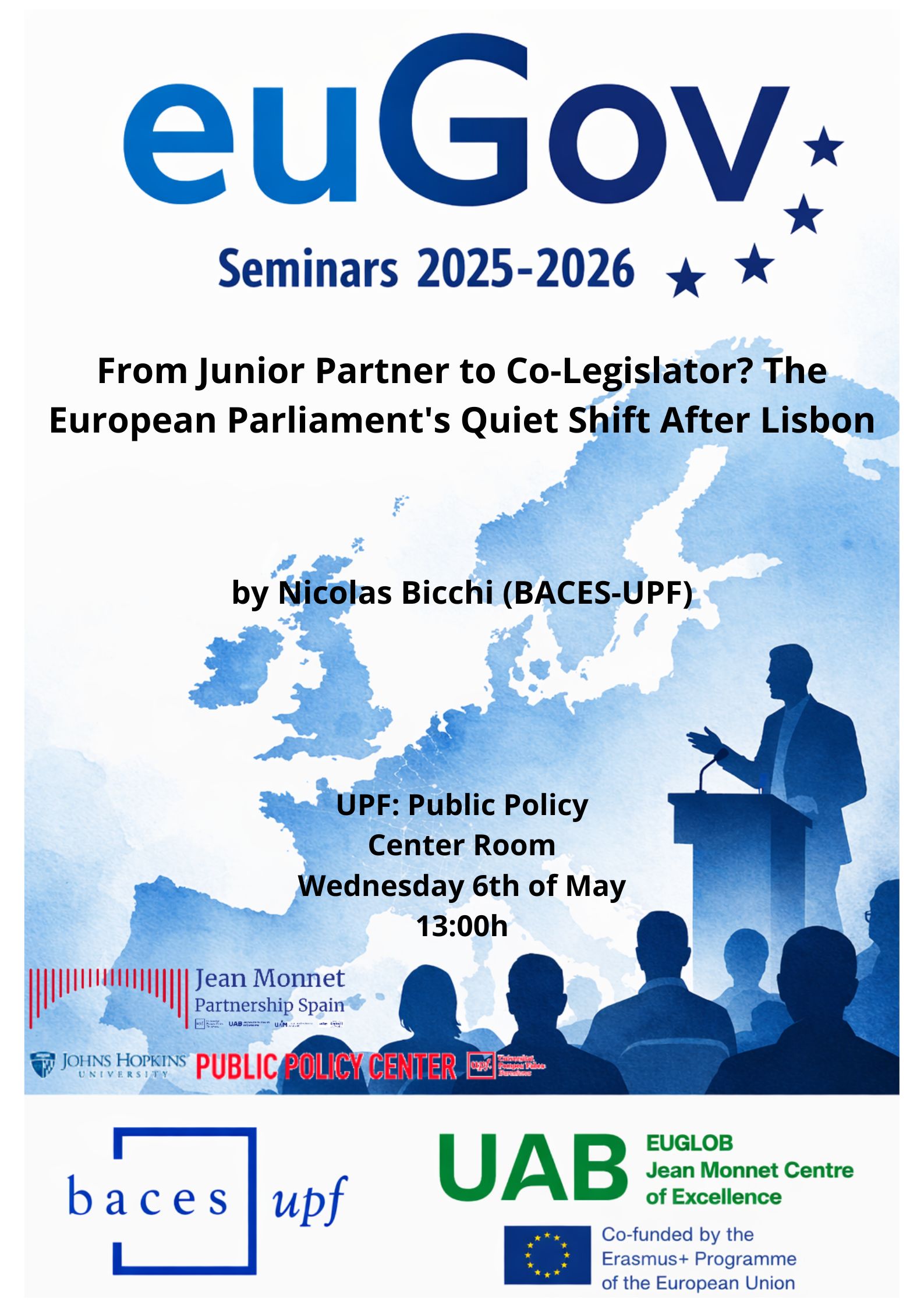
euGov Seminars - "From Junior Partner to Co-Legislator? The European Parliament's Quiet Shift After Lisbon”
euGov Seminars - "From Junior Partner to Co-Legislator? The European Parliament's Quiet Shift After Lisbon”
Content
Target Audience
This seminar is open to students in related fields, such as Political Science, International Relations, and Global Studies, as well as to faculty members and researchers with an interest in the European Union, particularly in relation to its institutions and the whole integration process.
About the Speaker
Nicolas Bicchi is a PhD student in the department of political & social sciences of the Pompeu Fabra University in Barcelona, under the supervision of Prof. Javier Arregui. His main research areas are legislative bargaining and elite behaviour in the European Union’s institutions and the effect of automation on the European political landscape. He holds a BA in Journalism from the University of Leeds and a Research Master’s in International Relations from the Barcelona Institute of International Studies (IBEI).