The future leaders of Europe are trained at UPF through the Europaeum Scholars Programme
The future leaders of Europe are trained at UPF through the Europaeum Scholars Programme
At a time when Europe seems disoriented in the midst of the new world order that is being reshaped, research and the training of future leaders with a multidisciplinary outlook and knowledge of the main contemporary problems and challenges is essential to uphold the strength, values and joint project of the European Union.
This is precisely one of the goals of Europaeum, a network of seventeen leading European universities (including UPF) that connects students from different disciplines, cultures and countries: they meet regularly in multidisciplinary groups to discuss issues and solve topical problems.
The flagship of Europaeum is the Scholars Programme, an innovative academic and professional development programme for doctoral students that focuses on policy-making in Europe, which meets four times a year, for a few days, at one of the network’s seventeen member universities.
Students were able to connect their doctoral research with the world of politics, gain knowledge concerning the complexity of public policymaking and learn to teamwork
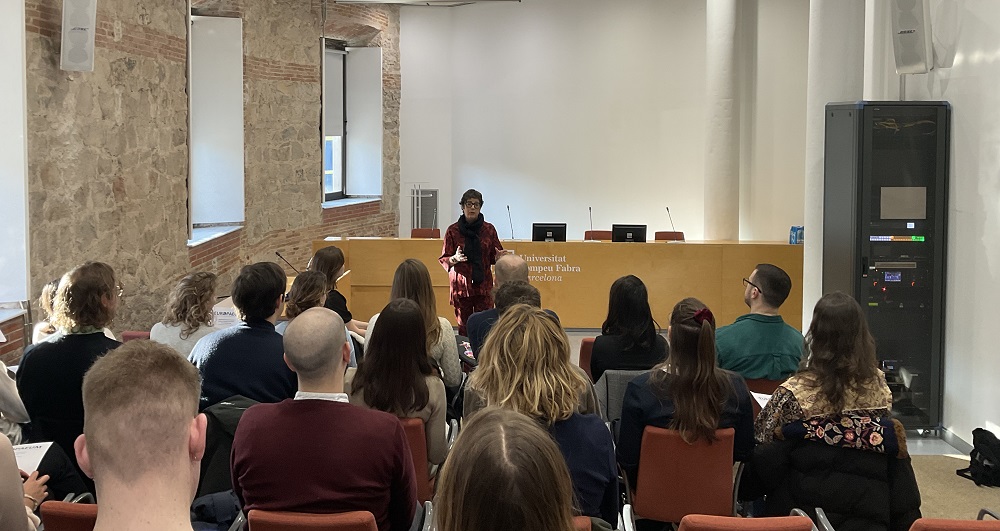
During the week of 17 to 21 February 2025, UPF hosted one of its modules: 29 pre-doctoral researchers from the 17 participating institutions took part (two of whom are linked to UPF) “to learn more about the link between technology and policies in Europe, and how technology and AI are affecting people’s lives”, explains Mireia Artigot Golobardes, coordinator of the module at the University and a teaching fellow at Europaeum.
The aim of the meeting, which was inaugurated on 17 February by Helena Ramalhinho, UPF vice-rector for Internationalization, was to “prepare young academics to debate topics such as the uses and regulation of big data, AI, digital twins and the digital euro, with experts from UPF, the University of St. Andrews and the University of Luxembourg, as well as with European policymakers and other key stakeholders”, comments Tracey Sowerby, a professor at the University of Oxford and director of the Scholars Programme.
Over the five days, the pre-doctoral students present at UPF, who enjoy a grant to cover all the expenses of the programme (accommodation, travel, food and registration), with sessions that took place on the Ciutadella campus, connected their doctoral research with the world of politics, acquired knowledge regarding the complexity of public policymaking, and learned to teamwork.
The experience of the two UPF predoctoral researchers who are following the Scholars programme
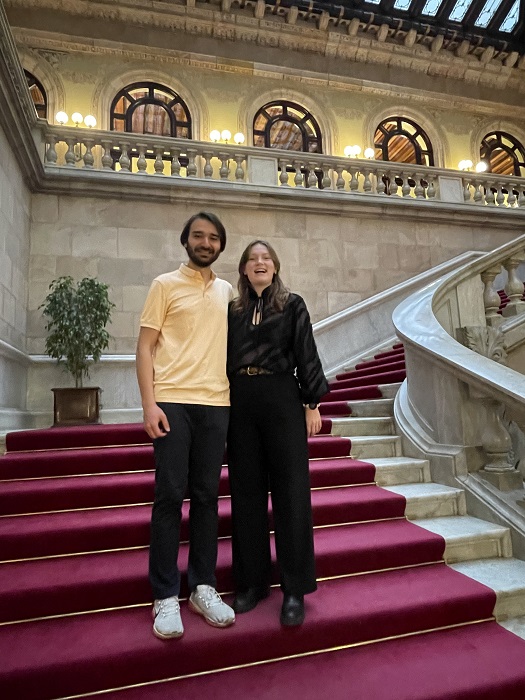
Ömer Şahin, master’s degree in Research in Political Science at UPF, is a doctoral student at the Department of Political and Social Sciences and is linked to the UPF Sociodemography Research Group (DemoSoc). Babette De Naeyer, master’s degree in European and Global Law from UPF, is a doctoral student with the Department of Law, and is a member of the Research Group on Constitutional, European and Supranational Integration Law. They have been following their respective doctoral programmes (in Political and Social Sciences and in Law) at Pompeu Fabra since 2022 and joined the fourth cohort of the Scholars programme in March 2024.
Their respective doctoral theses, which they are improving thanks to Scholars, focus, in the case of Ömer, on over-education in labour markets between countries with various levels of economic development within the OECD, and in the case of Babette, on the impact of the Internet and social networks on citizens’ right to freedom of expression. In addition, both are part of the same interdisciplinary team that is kept throughout the two years of the programme: it is conducting a study on disinformation in the digital environment, focusing on false news, both news created and disseminated by mistake (misinformation) and that created deliberately (disinformation).
“As the pace of the information space increases, it becomes harder for each of us to keep track of which information is correct and which is not. But news affects our lives, we take individual and collective decisions based on what reaches us, and on what we believe to be true. I think it is essential to strive for a cleaner news space, and we hope that we can have a positive, albeit minor impact”, Ömer Şahin asserts.
Babette de Nayer, meanwhile, comments that “the project we are working on seeks to support local journalism to combat the wave of disinformation that is flooding European democracies”.
Making headway in the doctoral thesis through participating in Scholars
The work they are carrying out within the Europaeum Scholars Programme is helping them to progress with their thesis projects: “Thanks to the “literature study” I did to prepare our team research project at Scholars, I have read a lot about the problem of disinformation and related legal challenges. My thesis deals with freedom of expression and social media, and I am now writing a chapter and an article on disinformation. Without my colleagues’ input and the conversations held with Europaeum experts, this section would not have been possible”, Babette de Naeyer remarks.
For his part, Ömer Şahin says “I am working on labour markets and my research has direct political implications. Thus, in my particular case, the ability to engage different stakeholders helps me better understand my field, and to be able to offer feasible political solutions to problems is a very important, crucial advantage to improve the value of my final product, which is my thesis”.
An interdisciplinary programme with a broad perspective, which creates a suggestive space for discussion
Concerning the Scholars programme, both highlight its interdisciplinarity and transdisciplinarity: “As a doctoral student you tend to live within your very specific research bubble and overlook the other disciplines that exist. Thanks to the Scholars programme, I am in contact with lots of other types of research and other very relevant and enriching topics”, Babette points out.
Ömer, meanwhile, affirms “I like the fact that the participants are doctoral students from many different universities and backgrounds. We have historians, economists, political scientists, law students, etc. In addition, the professionals and experts we talk to are also from different fields. This creates a discussion space to delve deep into the issues facing Europe. I’m always amazed by people’s different perspectives, and this is a very open experience”. And he adds: “The Europaeum programme offers a very detailed view of the world of policymaking from all angles. The difference between researching for a PhD and drafting a policy that changes people’s lives is fascinating”.
AI and digitalization, one of Europe’s main future challenges
Regarding his experience on the specific UPF module, Ömer has gained a very good insight into how AI is affecting different stakeholders, and their perspectives. “It’s crucial to understand that different people will perceive AI differently, and they all see different risks and opportunities from me as a doctoral student. If I had to highlight one thing, it would be this opportunity to understand how all stakeholders see this technology”. Babette is especially appreciative of the fact that “we have learned about the challenges of digitalization in Europe, the opportunities to be more competitive and the regulatory problems in the sector”.
Apart from the most academic part of the programme, the two doctoral students highlight the good group atmosphere and conviviality during these days spent in Barcelona, as well as some of the trips they made, including a visit to the Parliament of Catalonia.
Scholars, a programme “to make Europe a better place”
The Europaeum Scholars Programme is a two-year course on politics and leadership (7-8 intensive modules in all, of 3 to 5 days, held at the network’s universities) for the most talented, energetic and committed doctoral candidates in the Europaeum network, who are expected to mark the difference in Europe. It is multidisciplinary, multi-university and multilocational and focuses on contemporary European policy.
Entry is through an open competition for a maximum of 36 places every two years. The modules include seminars, debates and workshops with leading academics and professionals; training in professional skills; and essential teamwork: during the two years, the fellows work in small multidisciplinary groups on a project designed and led entirely by themselves to “make Europe a better place”: the final proposals are evaluated by a group of experts and presented at an international conference.