
The UPF Chamber Orchestra, an oddity in the university sphere
The UPF Chamber Orchestra, an oddity in the university sphere
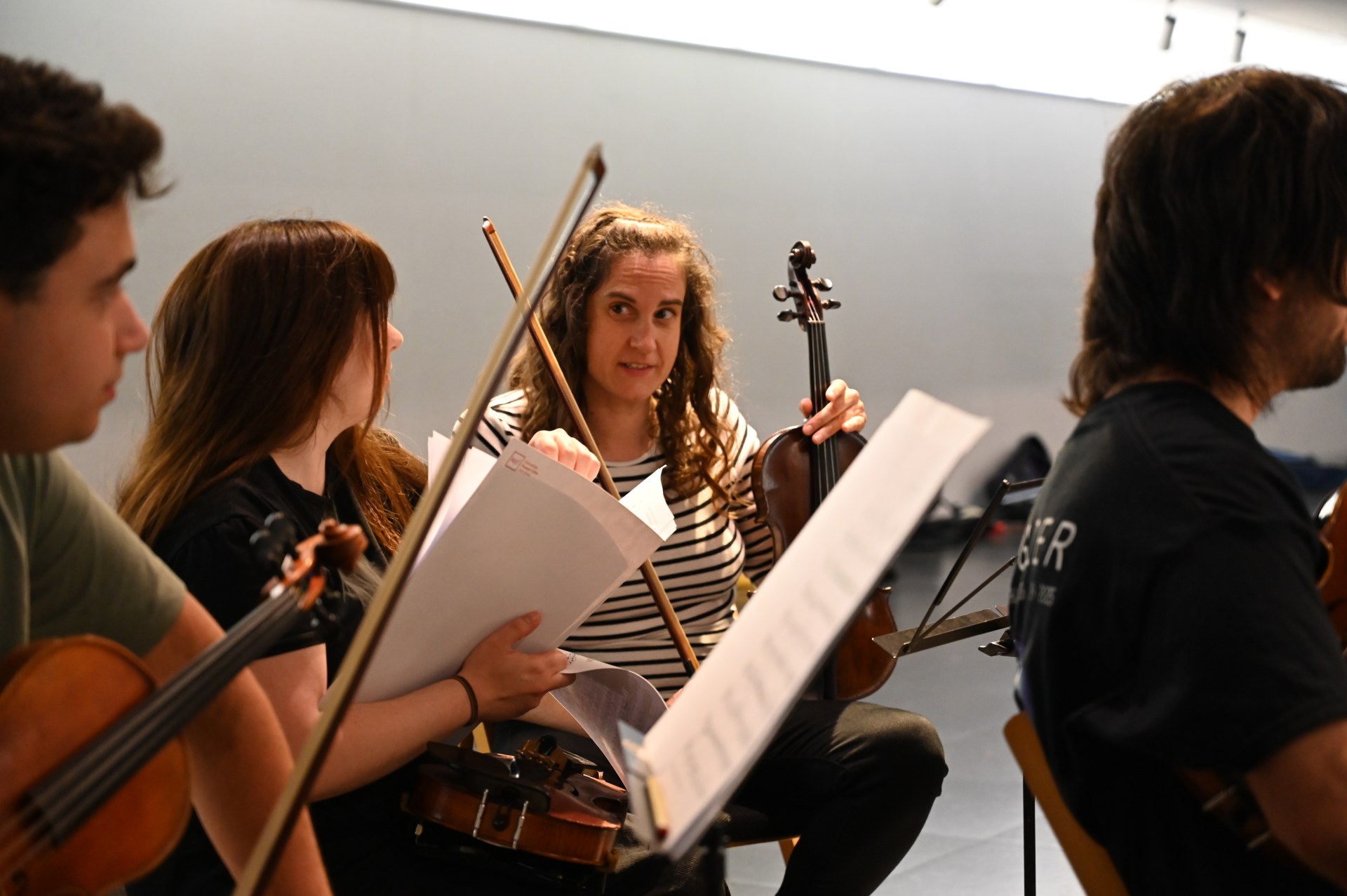
When Marta Fort joined the Pompeu Fabra University (UPF) Chamber Orchestra, Sara and Víctor had not yet been born. “I’ve always needed music”, she asserts. When she was just eleven years old, she was already playing in local orchestras and she soon began studying the violin at a music school. A UPF graduate in Biology, she began her university career in 2003-2004. “The first few months in Barcelona I was so overwhelmed by my studies that I didn’t even know that the Pompeu had an orchestra”, she recalls.
In the third term, now juggling fewer subjects, she saw a poster on the information boards: they were looking for violinists. “I thought it was a sign”, she smiles. She phoned and said: “I play the violin and I’ve seen the posters”. She got confirmation that she had been accepted on the same day. “Two days later there was a concert and I hadn’t played for half a year”, she stresses. However, she did not hesitate. She is still there, and is the longest-serving active member of the orchestra (she only took a break last year for maternity leave). “One of the reasons I like coming is because it keeps me alive musically”, she adds.
Marta, a member of the UPF Chamber Orchestra for more than twenty years: “One of the reasons I like coming is because it keeps me alive musically
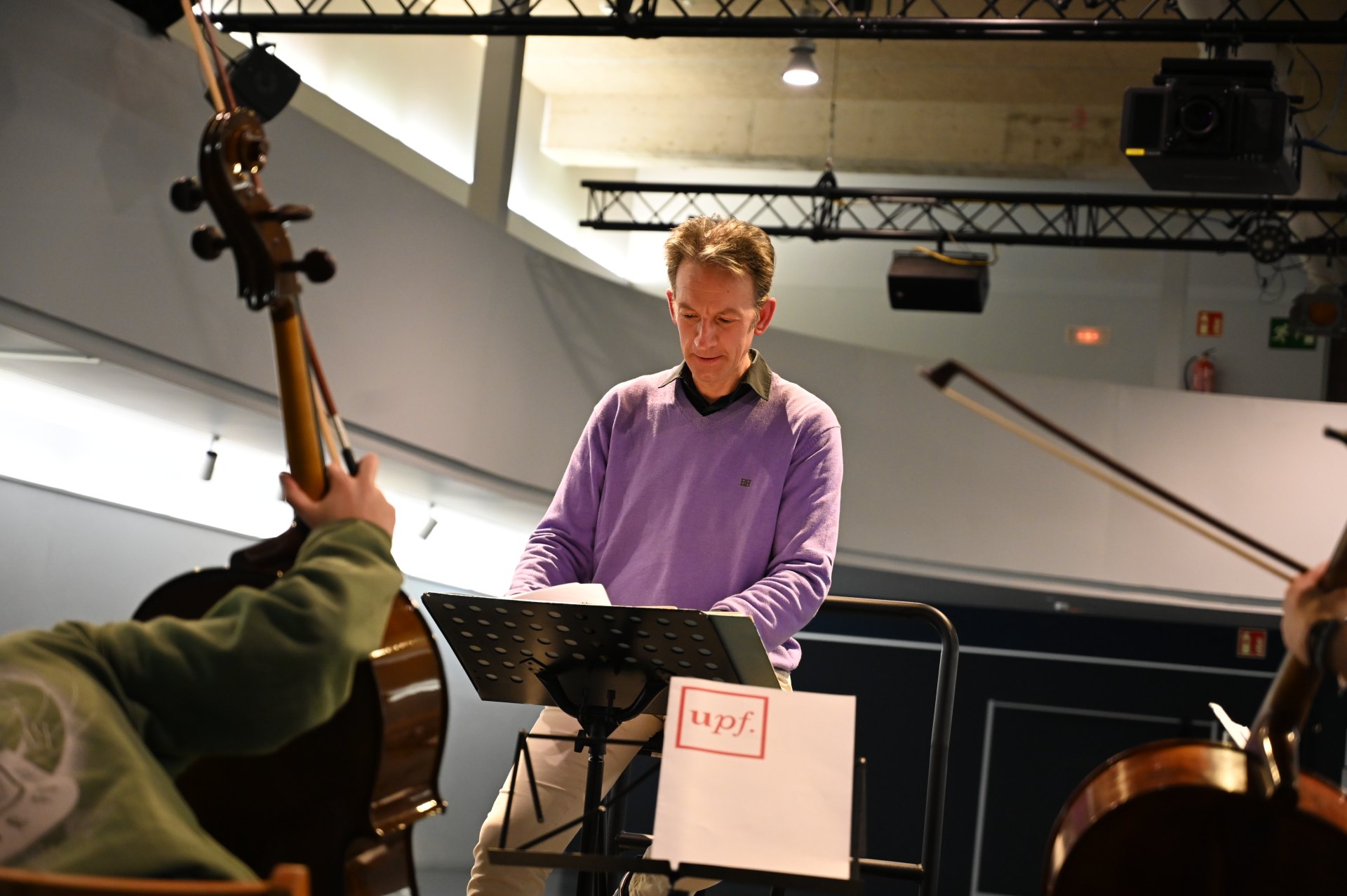
“Marta is an exceptional case”, confesses the Chamber Orchestra director, Diego Miguel-Urzanqui. Since 1998, Miguel-Urzanqui has forged a solid musical trajectory that has taken him to stages in Europe, Africa, Asia and the United States. He also serves as a guest conductor at the Rencontre Internationale de Guitare Classique de Nice (France). He is currently in charge of the artistic and musical direction of the Chamber Orchestra, as well as the rehearsals, which are held every Monday evening in Aranyó hall on the UPF Poblenou campus.
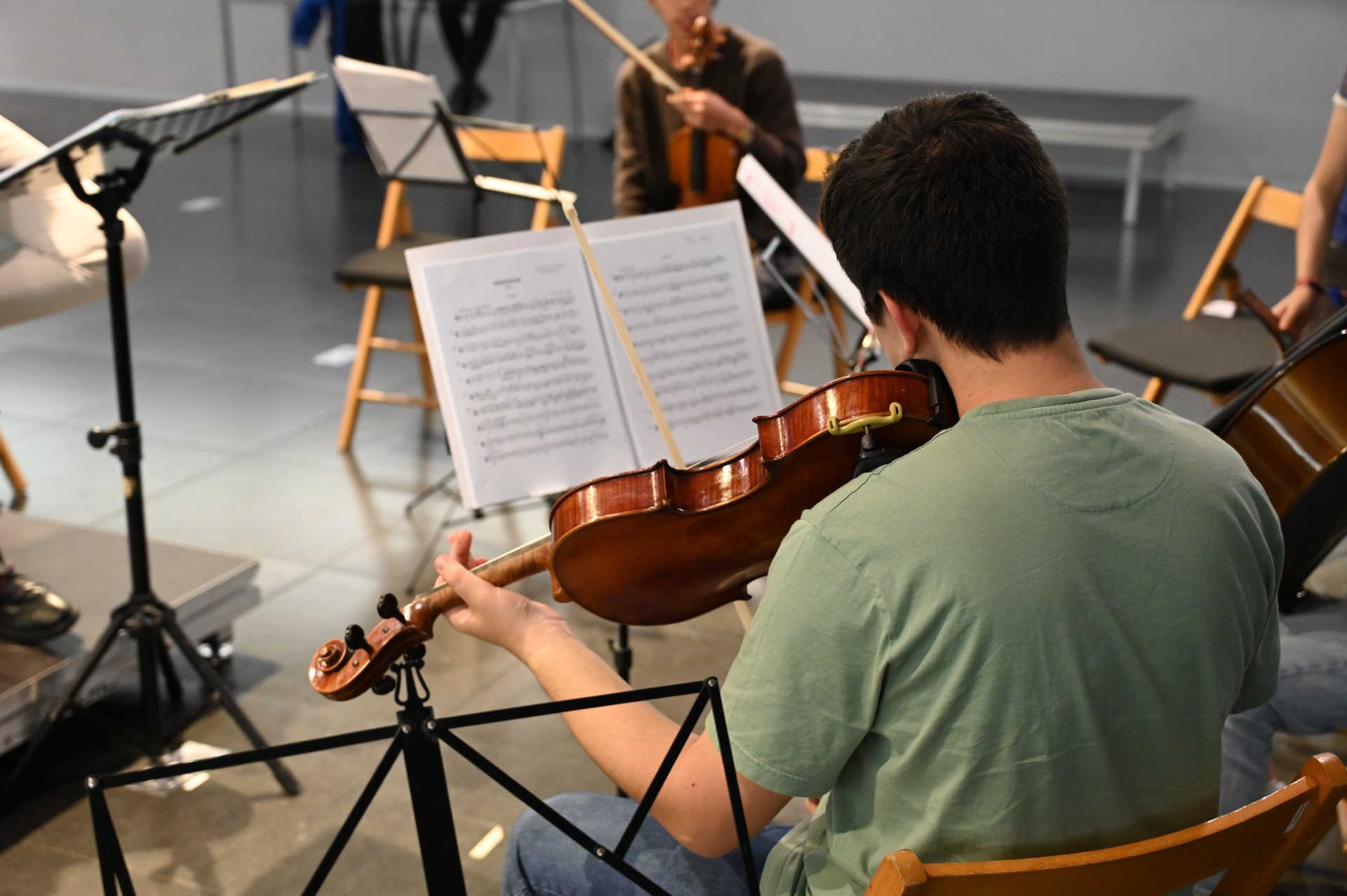
In this large, oval space, Víctor Ortiz and Sara López, both UPF undergraduate students, take their respective viola and cello out of their cases. They sit in a semicircle with their fellow musicians while they tune their instruments and prepare the scores they are to practise in this session. To join the orchestra, you must pass an admission test and the only indispensable prerequisite is to have completed, at least, grau professional (intermediate level) - or equivalent - of an orchestral instrument, in addition to committing to attend rehearsals and concerts throughout the academic year.

Sara, a student of the bachelor’s degree in Journalism since the 2023-2024 academic year, is taking part for the second consecutive year. Unlike Marta, she found out about the orchestra by searching on Google. “When I enrolled, I wanted to continue with music because it has always given me a lot and it fascinates me”, she explains. She recalls, chuckling, that her entrance test “left a little bit to be desired”, but she passed.
For her, the orchestra is much more than an extracurricular activity. “It helps me disconnect, but it also asks a lot of me”, she states. When she finishes studying, she often spends her free time going over the scores and practising on her cello. “The university schedules are demanding, but if you really want to, you can combine them”, she assures.
Diego Miguel-Urzanqui, conductor of the Chamber Orchestra: “Not only do they dedicate themselves 100% to their university studies but they also take on an activity that requires study and concentration
Miguel-Urzanqui confirms this admiringly: “She said it rather poetically, but it’s really a very special profile. Not only do they dedicate themselves 100% to their university studies but they also take on an activity that requires study and concentration. To play in an orchestra, even if you are an amateur, you must use the same tools as a professional musician”. This requirement and commitment are, in the conductor’s opinion, two of the keys to the orchestra’s success.
Victor has joined this year. A student of the bachelor’s degree in Computational Audiovisual Engineering, he completed intermediate level music studies at Santa Coloma de Gramenet Municipal Music School. For him, one of the great values of belonging to the orchestra is its social aspect: “It’s a way to meet people with similar interests and similar outlooks. In fact, it was one of the main reasons I signed up. And I think that, in general, there is a very good atmosphere among us”.
The orchestra, a living project thanks to the students
Marta, Sara and Víctor’s stories are three examples from the more than 300 students who have played with the orchestra over the last three decades. Although most come from UPF, others have also come from universities such as the UAB, the UB, Blanquerna, the UPC, Higher Music Schools such as the ESMUC or the Conservatori Superior del Liceu, and even from international centres taking advantage of their Erasmus stay to join.
The project started in 1994 as an instrumental ensemble, conducted by Alicia Coduras, with the goal of being a space open to any member of the university community who played an instrument, whatever their level. “This ensemble was a group of instrumentalists that played works specially arranged for the context of each academic year”, Miguel-Urzanqui points out. The format was kept under Xavier Casademunt (1999-2001). When Miguel-Urzanqui took over as conductor, the initial spirit was preserved until the 2006-2007 academic year, a turning point: the Chamber Orchestra.
The Chamber Orchestra was initially founded, as an Instrumental Ensemble, in 1994 under the direction of Alicia Coduras, as a space for the musicians of the University
“We had more and more string players, and often duplicate wind instruments: lots of flutes, clarinets, saxophones... It was unfeasible. The repertoire was very limited. So we said: ‘why don’t we form a chamber orchestra?’”, he recalls. They opted for a more stable structure, consistent with the available resources focusing on the specific repertoire of this kind of set-up with strings and wind.
“Now, most of our musicians have passed grau professional (intermediate level) which, considering the current regulations, they usually complete at the end of their second year of high school. This does not mean that they are professional musicians, but they have achieved a very demanding level”, Miguel-Urzanqui outlines.
A unique musical training space
“In Spain, you either devote yourself to music professionally or you might have to stop playing when you start university”, Miguel-Urzanqui laments. “However, in countries like Germany, France, Switzerland and Austria, it is usual to pursue demanding amateur musical activities throughout life”. This model, he says, has also begun to take root within Spain, but unevenly and only recently.
“It is not common for a public university to have an orchestra with this level of continuity and rigour. Most amateur musical formations and many universities are choral, because it’s easier to find singers and no instruments or specific training are required”, he asserts. Nevertheless, the UPF Chamber Orchestra has managed to keep going for more than thirty years, combining musical rigour with its inclusive, pedagogical nature.
Diego Miguel-Urzanqui, conductor of the Chamber Orchestra: “It is not common for a public university to have an orchestra with this level of continuity and rigour"
According to its conductor, one of the keys to its longevity is the conviction that to play music there must be a dignified space within the university. “This isn’t about filling empty time slots. We are offering training to young people who have dedicated a significant part of their lives to music. It is a serious but inclusive activity, which allows them to continue growing musically even if they are studying a degree that is not related to music”, Miguel-Urzanqui concludes.
In this sense, the orchestra is not only a continuity, but also a school of community life. “In an orchestra, it’s not just you. You have to listen, respond, adapt. You can’t play as if you were the only one playing”.
2024-2025 season: seven concerts and a commitment to training
The 2024-2025 academic year has been intense for the UPF Chamber Orchestra, with a total of seven concerts spread over two terms. The first part, known as Anniversary Trumpets, featured the soloists Joan Alós and Marta Torres, from the Escola Superior de Música de Catalunya (ESMUC), as guest soloists at the concerts open to the public. The performances were held in Aranyó hall on the Poblenou campus, in the Church of Sant Medir (Barcelona) and at the Brians 1 Penitentiary Centre, as part of the XI Music Conference, a meeting space. This latter experience, which takes place every February, brings classical music closer to the inmates who share a weekend with the members of the orchestra in an environment of coexistence and active listening.
During the second semester, the A tour of Europe programme —with guitarist Álvaro Guerra Acuña, also from the ESMUC, as a soloist— gave a further three concerts, on 29, 30 and 31 May, again in Aranyó hall as well as the Ateneo Fort Pienc Civic Centre and the La Sedeta Civic Centre (Gràcia district). The series will finish at the end of June with a chamber music concert on the Ciutadella campus, within the 4th Annual Chamber Music Programme, a repertoire that includes works by Pierné, Handel, Demillac, Falla and Fauré.
This two-stage structure —from October to February and from February to the end of May— comes in response to the particularities of UPF’s termly academic calendar, which according to Miguel-Urzanqui “makes it difficult to work continuously only term by term”.
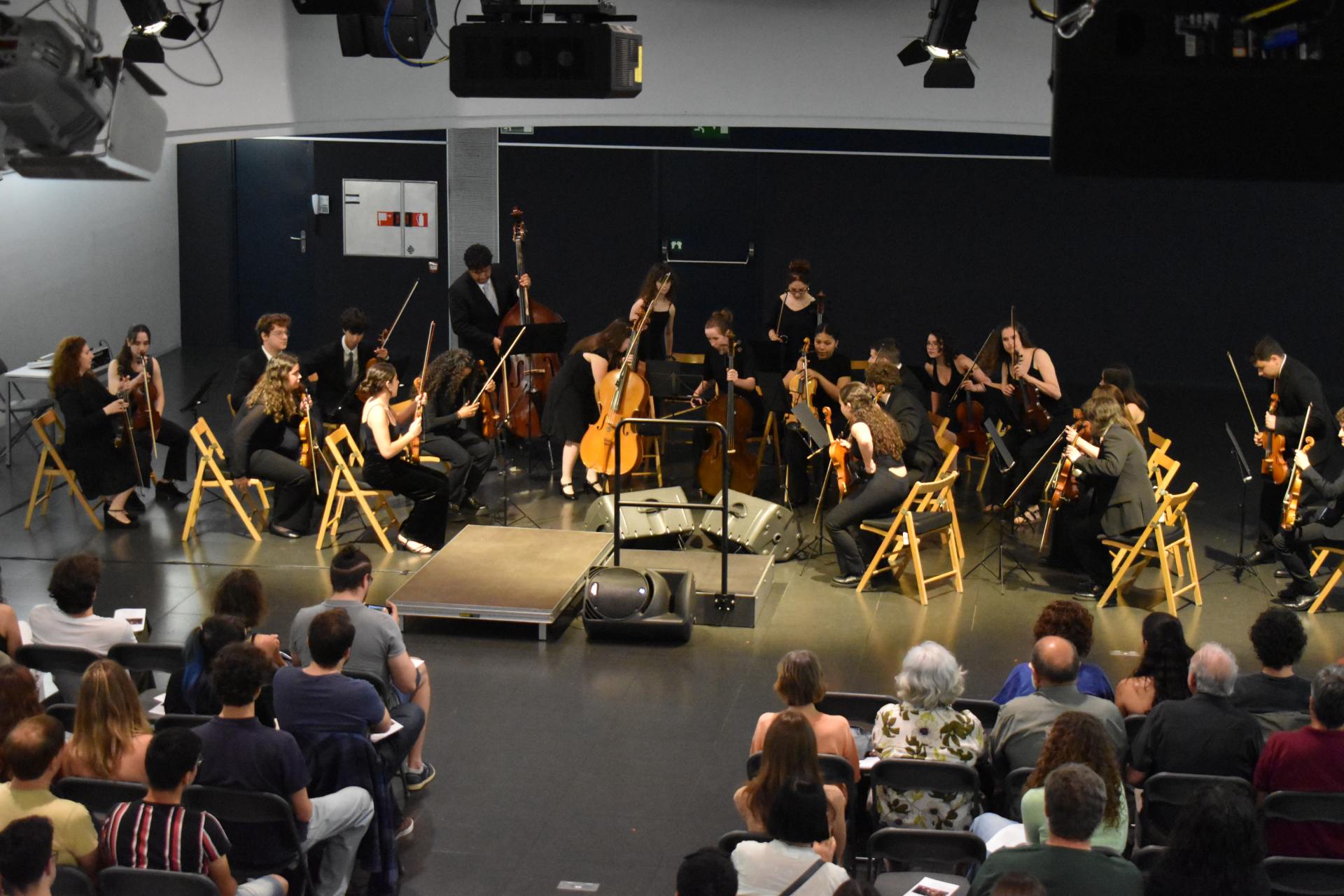
In the first concert of the second term, in Aranyó hall —located in the basement of Tangier building on the Poblenou campus— the public fills the space, expectant to enjoy a live classical music concert. Tickets are sold out. The performance begins and the string instruments (violins, double bass, cellos and violas...) bounce off the walls of the venue. The atmosphere is one of complicity and collaboration; each performer is attentive to the score, but never loses sight of the conductor, who marks the beat with great precision. The scene is the result of a joint effort and weeks of rehearsals culminating in a weekend of concerts, a sign of the group’s excellent current form.