UPF launches its first course on Catalan sign language (CSL) via the mobile phone, in open source and online
UPF launches its first course on Catalan sign language (CSL) via the mobile phone, in open source and online
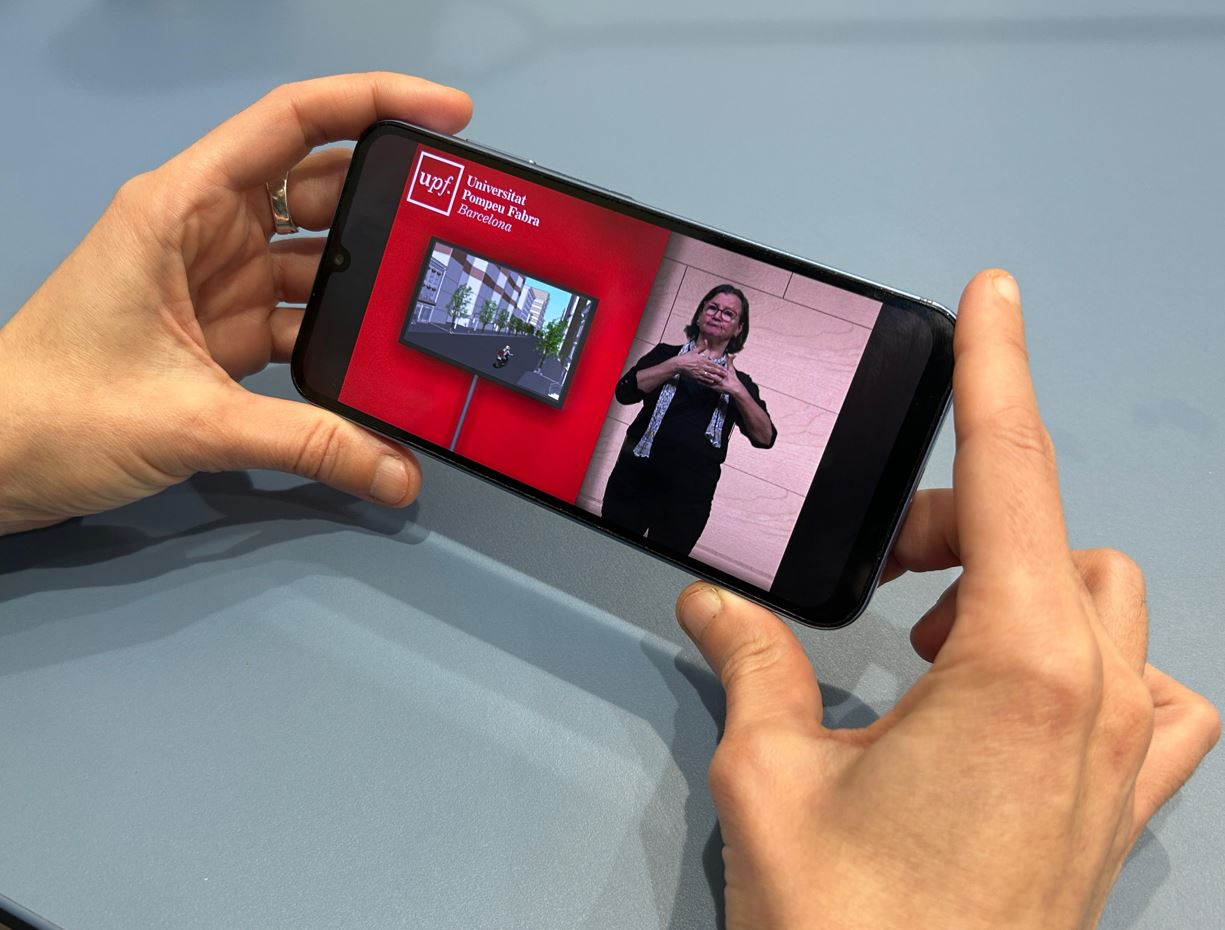
Pompeu Fabra University (UPF) is initiating pioneering training around the world to learn Catalan sign language via the mobile phone, in open source and online, starting this January. The training is free of charge in MOOC (Massive Online Open Course) format, titled "Speak to me with your hands, I can hear with my eyes." Its first tutored edition is held since 9 January and it will finish on 20 March.
This new MOOC presents an innovative teaching strategy in sign language, based on distance learning of a language that has traditionally been taught face to face. At the same time, it offers in open source a wide range of structured multimedia resources for learning a visuogestual language. The course also aims to spread knowledge of sign language among the university community and citizens in general and raise society’s awareness about its contributions to linguistic wealth and diversity. The intention is, therefore, to promote the full integration of the deaf community into Catalan society in the long term, hence more people -also hearing people- need to learn their natural language. For this reason, the MOOC is a good example of the transfer of knowledge generated at the University to society.
Organized by the LSC-UPF Actua Study Centre of the UPF Department of Translation and Language Sciences, the MOOC enjoys the support of the Government of Catalonia through grants to the universities of Catalonia for actions to promote and use languages in the university corresponding to 2024 (INTERLINGUA).
Cristina Gelpí (LSC-UPF Actua Study Centre): “we want to encourage more people to try Catalan sign language and get hooked on it”
Participants will be able to learn the main features of sign languages, and of CSL in particular, and also gain knowledge of deaf culture. Students will be able to learn basic CSL vocabulary and gestures to understand and produce short, basic signed speech. The course consists of 20 learning units, with a total of 400 videos dedicated to the expression in CSL of different messages of day-to-day life (e.g., greetings and introductions), with supporting materials and comments in oral language. Participants will have to learn and replicate the gestures in the videos and demonstrate their knowledge by answering multiple choice tests or producing basic signed speeches, comparing them with example responses. The course web space, in responsive format, is designed to be connected to via the mobile phone, but it is also accessible using a tablet or computer.
Cristina Gelpí, co-coordinator of the LSC-UPF Actua Study, explains: “We have designed this course to be as open as possible and make it easier for as many people as possible to get to know sign language. We do not replace formal academic and non-regulated training, but we want to encourage more people to give Catalan sign language a go, get hooked on it, and continue learning. For this reason, the course is designed for mobile devices and we have used all the other means we can think of to facilitate access”. For example, training content will also be shared on social networks (LSC_Actua on Instagram, X and Facebook), in addition to being available on the website.
It is also permanently accessible online and no registration or pre-registration is required. The training can be done independently at any time, although the editions supervised by UPF teaching staff will be held during specific periods. The course, with an envisaged duration of 25 hours, will allow the learner to achieve Common European Framework of Reference basic level A1.1 knowledge of CSL.
What groups does the CSL induction MOOC target?
The MOOC is mainly aimed at the university community (students, teaching and research staff, and technical, management and administration and services staff). Other targets are CSL students of vocational training and other courses, who can take the MOOC as supplementary training; the elderly, hearing and hearing-impaired people; or deaf children, who so far dispose of very few online resources on the subject. The course also targets potentially interested international communities, such as deaf signers of other sign languages, who want to become initiated in Catalan; or interpreters of other SLs who want to learn CSL to expand their professional skills. It also addresses linguists from all over the world, since SLs are the subject of linguistic study of growing interest and CSL is a highly valued area of research. To make the course accessible to speakers of other languages, it is envisaged shortly to make versions of the basic contents in other languages (in addition to CSL and Catalan), such as Spanish and English, and work towards a multilingual consultation service model.
UPF, national and international centre of reference for sign language
The new MOOC joins the many training activities promoted by UPF in the field of CSL, of which it is a national and international centre of reference. Since 2003, it has held several postgraduate courses on the subject, the last one this academic year. Since 2008, the UPF Faculty of Translation and Language Sciences has been the only one in the State to integrate SL studies into undergraduate studies (incorporating CSL). In 2009, UPF also created the Catalan Sign Language Laboratory (LSCLab) to conduct leading research in SL linguistics and, in 2017, the LSC-UPF Actua Study Centre to promote teaching, research, outreach and social engagement with CSL. Previously, in 2016, UPF started online training in CSL, whose materials have been revised, updated and expanded to launch the new MOOC this 2025, with the aim of providing a basic knowledge of CSL to a much broader audience.
Further information at:
Website of the introduction to Catalan Sign Language MOOC
Frequently asked questions about the MOOC and answers
Example of one of the videos of the new MOOC