
The first cohort of the Erasmus Mundus joint Master in AI, coordinated by UPF, holds its graduation ceremony
The first cohort of the Erasmus Mundus joint Master in AI, coordinated by UPF, holds its graduation ceremony
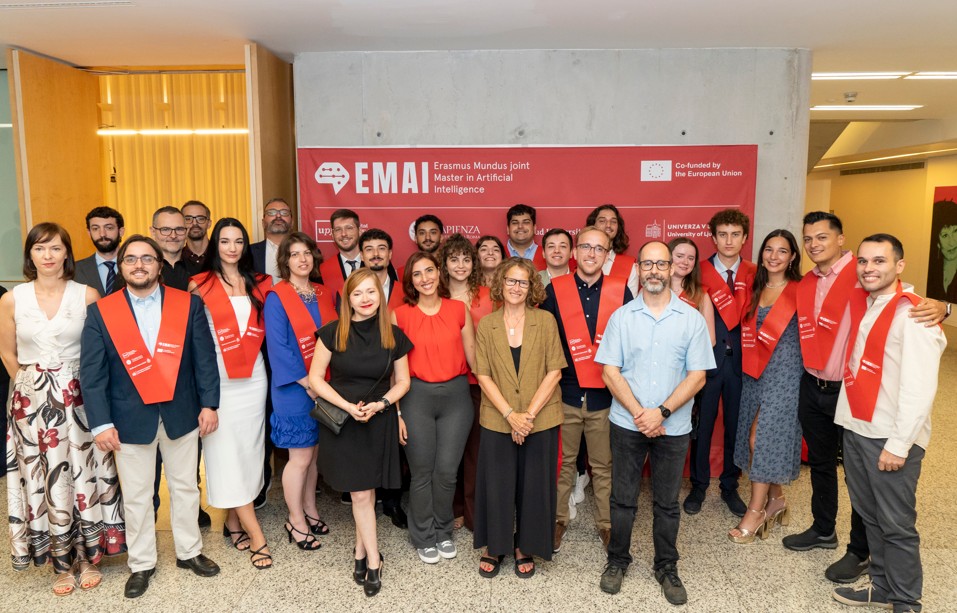
The first cohort of the Erasmus Mundus joint Master in Artificial Intelligence (EMAI), led by UPF, held its graduation ceremony on Tuesday, 2 September. It took place on the Ciutadella campus and was attended by the UPF rector, Laia de Nadal. Seventeen of the nineteen students who have graduated were able to attend. The EMAI is the first Erasmus Mundus Master coordinated by UPF. It offers high-level training in artificial intelligence (AI).
The UPF Department of Engineering, which has extensive experience and has earned a reputation in the field of AI, leads the consortium of the EMAI (Erasmus Mundus joint Master in Artificial Intelligence), which is taught jointly with three other European universities. A different speciality pertaining to the degree is taught at each of them. At UPF, the speciality of intelligent decision-making is taught; robotics is taught at Rome Sapienza (Italy); cybersecurity at Radboud -Nijmegen- (Netherlands); and data science at Ljubljana (Slovenia).
The Master was launched in the 2023-2024 academic year with students from all over the world with excellent academic records in the areas of engineering, computer science, mathematics, physics, etc. Before taking the chosen specialization, all students follow a common syllabus for the first year, which they begin at UPF. They take their entire second year at the university corresponding to their chosen speciality. Many of the students have also been able to do internships or their final project in collaboration with 17 partners associated with EMAI, including the prestigious Centre for Artificial Intelligence at University College London (UCL).
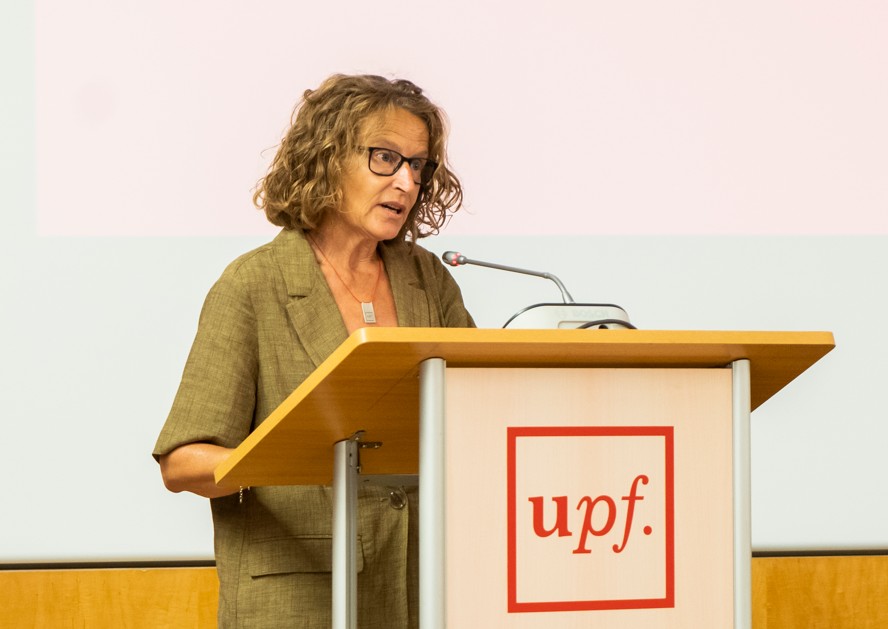
Laia de Nadal, UPF rector: “The EMAI is an example for many masters as it gathers students from all over the world proving that Europe can achieve great success when working together”
Now, two years after starting the Master, the graduation ceremony for the first cohort, presented by UPF student Verónica Orozco, has been held. Seven of the students have specialized in intelligent decision-making, five in cybersecurity, four in data science and three in robotics. The UPF rector, Laia de Nadal, delivered the diploma to some of the students.
The rector highlighted that: “The EMAI is an example for many masters as it gathers students from all over the world proving that Europe can achieve great success when working together”. She also congratulated the Department of Engineering for taking up the difficult challenge of leading the Erasmus Mundus and thanked the three other participating universities.
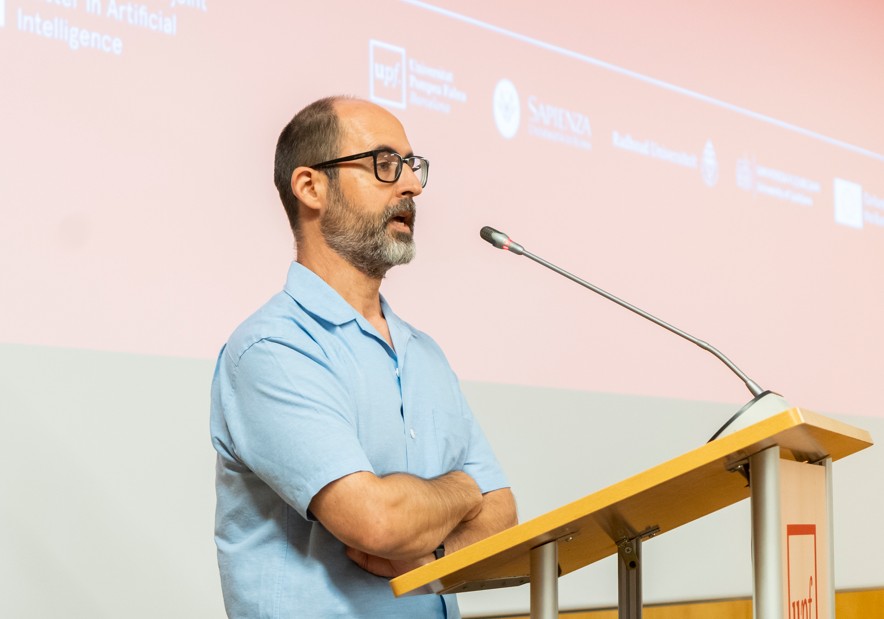
The general coordinator of the Master, Vicenç Gómez (UPF), drew attention to the hard work involved in leading the first Erasmus Mundus coordinated by the university
The general coordinator of the Master, Vicenç Gómez, drew attention to the hard work involved in leading the first Erasmus Mundus coordinated by the university, such as selecting the best students from among more than a thousand annual applications. For Gómez, this graduation “is the culmination of a project that was conceived more than five years ago, capitalizing on collaborations and other existing master programmes, and marks the beginning of the EMAI community of alumni, which will be key to consolidating the programme as an international benchmark of excellence in education and research in artificial intelligence”. The academic directors of the Master from the other participating universities also welcomed the students: Zoran Bosnić (Ljubljana), Lucia Cavallaro (Radboud) and Massimo Mecella (Roma Sapienza).
The solid training in AI and the Master’s intercultural atmosphere, two of the aspects most highly valued by the students
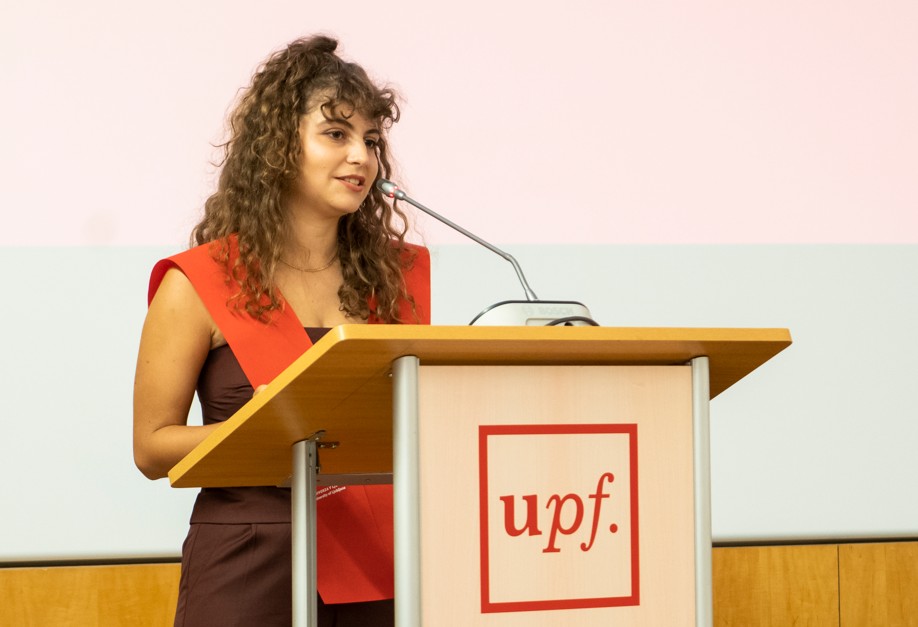
The graduates come from 12 different states: Spain, Italy, Germany, Macedonia, Romania, Bulgaria, Costa Rica, Ireland, the Netherlands, Portugal, the United Kingdom, Turkey and Cyprus. During the ceremony, student Leonida Lumburovska, who spoke on behalf of her fellow students, highlighted the social relationships that are forged throughout the Master: “The EMAI is not just about hard work and the hours dedicated to it, but also about companionship, solidarity, empathy, etc. We turned our group of students into a single team”.
After the delivery of the diplomas, the event ended with the traditional university anthem Gaudeamus Igitur, followed by a space for the exchange of experiences while refreshments were served. When asked for their appraisal of the Master, five EMAI students agreed that it completely met their initial expectations.
Andreas Pattichis, a 24-year-old from Cyprus who took the speciality in intelligent decision-making, notes: “I really appreciate the flexibility of the programme; it has allowed me, for example, to choose my speciality and customize the itinerary according to my goals”. Pattichis highlights “the combination of theory and practice” and being able to apply “the knowledge acquired in different real social areas”.
Adrian Gheorghiu, a 25-year-old Romanian who specialized in cybersecurity, explains that he did his final project at the head office in Eindhoven (Netherlands) of the company NXP, where he investigated deep learning methods to improve automotive radars. This field has aroused a great deal of interest in him and, with a view to the future, he plans to do a PhD related to the automotive industry.
Another of the graduates, Nikolay Kormushev, a 24-year-old Bulgarian with a background in data science, asserts: “I think the Master has made me a firmer candidate for many more jobs in the industry or for entry to a doctoral programme”. His final project has also provided him with the “knowledge to innovate and make new discoveries”.
He and the other graduates interviewed would recommend the Master to other students. In this regard, 24-year-old British robotics specialist, Honor Duthie, adds: “I would especially recommend the Master to students who want to try something different, who are interested in the less conventional side of technology”.
Antonio Alberto Carpes Martínez, a 24-year-old Spaniard specializing in robotics, also reflects on the ethical aspects of AI, which have been the subject of debate during the EMAI Summer Schools. “I think that, as professionals of AI, it’s important to remember that we are working with machines but that, in the end, the recipients of what we do are people. We must always bear the human aspect in mind in everything we do to really develop things that are better for society”. He also highlights the intercultural atmosphere of the Master: “It doesn’t just affect you academically or professionally, but it also really changes the way you perceive yourself and the society which you live in, and your soft-skills are reinforced”, he concludes.
Lecture by Francesco Fabbri, a researcher at Spotify and UPF alumni
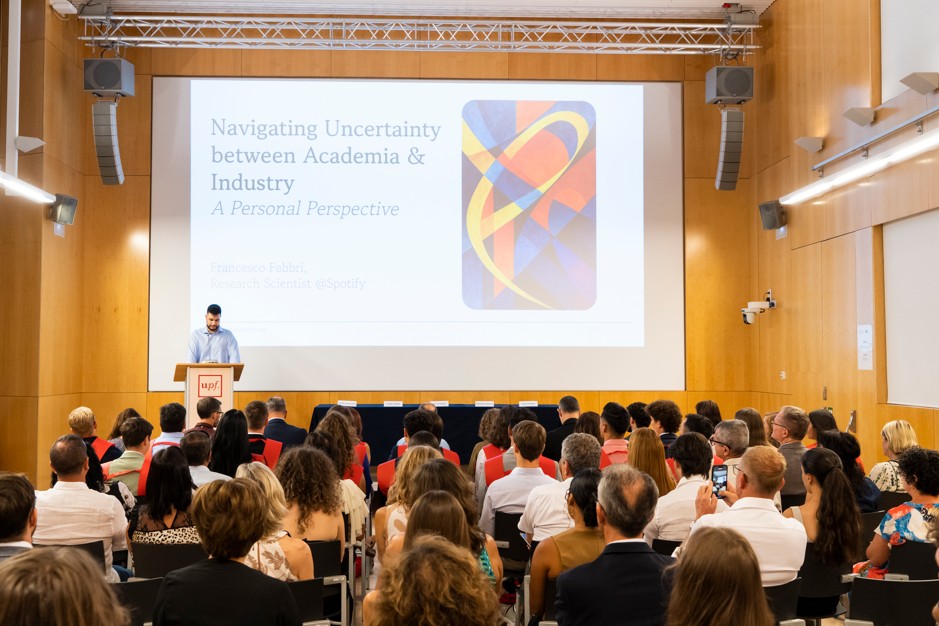
In addition to celebrating their graduation, the students also had the opportunity to hear a presentation by Francesco Fabbri, a researcher in Machine Learning at Spotify and an alumni of UPF. Fabbri looked back on his professional and academic career, which led him to do his doctoral thesis in Computer Science at UPF, completed in 2022, and took him immediately afterwards to Spotify. “You realize that you are moving forward when you see you are surrounded by more and more talent”, he stated. He also advised the students to remember the importance of networking and remaining open.
Welcome to the new EMAI students
The day before the graduation ceremony, Monday, 1 September, the welcome ceremony was also held for the 36 students who will start the 2025-2026 Master, selected from more than 1,300 candidates from around the world. The welcome event was attended by the vice-rectors for Internationalization and Knowledge Transfer, Helena Ramalinho and Vanesa Daza, respectively, the EMAI coordinator, Vicenç Gómez (UPF), and representatives of the other three participating universities. UPF alumni, Joan Serrà, currently a researcher in Machine Learning at Sony AI, also gave a talk.
In addition to this year’s 36 new students, a further 25 will be taking their second year of the EMAI. Thus, this year the Master will have a total of 61 students.