
Facultat Menor d'Economia at UPF: a successful case of teaching innovation through academic and emotional peer support
Facultat Menor d'Economia at UPF: a successful case of teaching innovation through academic and emotional peer support
Facultat Menor d'Economia at UPF: a successful case of teaching innovation through academic and emotional peer support
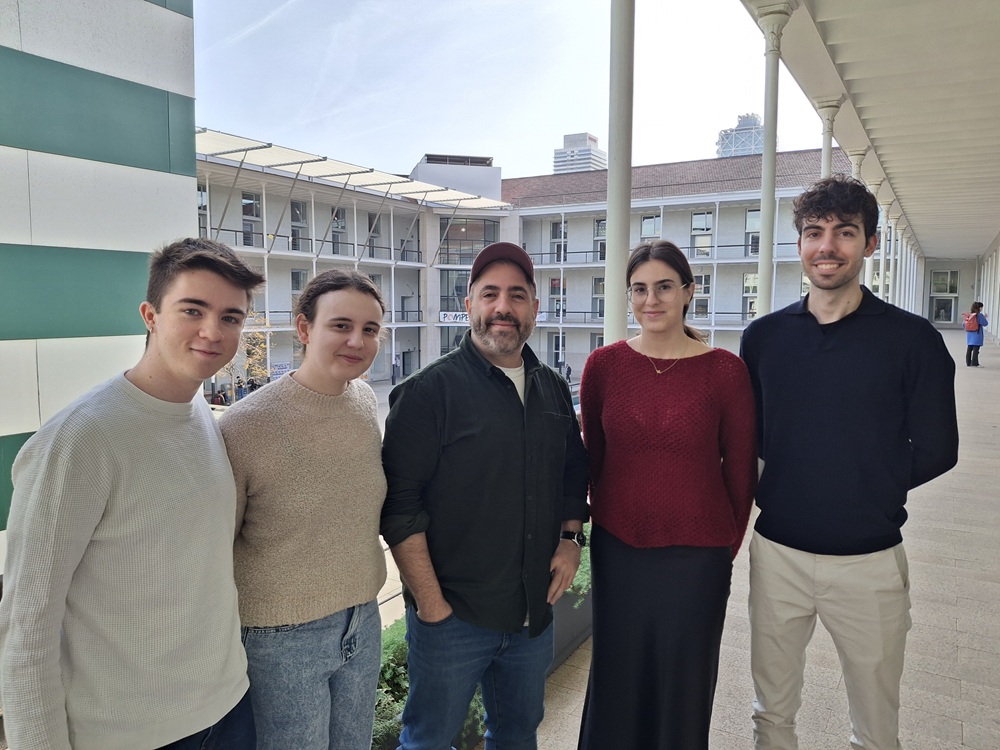
“As a student, you don’t always realize that the same concept can be viewed from a thousand different angles. In Facultat Menor d'Economia, we aim to provide a 360º perspective on concepts that the lecturer has already covered in class. That’s why we’re a complement, because we aim to provide a new perspective along with the connection that comes from being fellow students.” With these words, Margalida Pascual Pujadas, a third-year student from the double bachelor’s degree programme in Law and Economics, describes her role as a mentor in the Facultat Menor d'Economia (FME), where she delivers tutoring sessions for the first-year courses Mathematics I and Introduction to Microeconomics.
Margalida Pascual, together with six other third- and fourth-year students with outstanding academic records from various bachelor’s degree and double degree programmes in UPF’s Faculty of Economics and Business – Jordi Niebla González, Tomàs Girbau Xalabarder, Arnau Miàs Anglada, Ester Badia Izcara, David Porras Morales and Víctor Bonet Obon – constitute the seven mentors for the 2025-2026 academic year of the FME, which is now in its second edition.
The mentoring carried out by the seven students is part of the paid curricular academic placements for which they were selected and trained: each mentor provides an average of ten hours a week of support classes across various subjects. These sessions are free-of-charge, intended for students in years one and two – which usually present the greatest academic difficulties and challenges – of the Faculty’s bachelor’s degree and double degree programmes and designed to help them consolidate knowledge, answer questions and follow regular classes with greater confidence.
A project inspired in Latin American practices
The Facultat Menor d'Economia is an innovative academic support programme developed and integrated within the Teaching Innovation Unit of UPF’s Faculty of Economics and Business, in coordination with its leaders and teaching staff. The aim of the project is to improve the students’ academic performance, promote educational equity and offer practical and individual support.
Isaac Baley: “As a student at ITAM, I used the peer tutoring service they had there, and the idea appealed to me. It’s a concept I've developed over the years”
Isaac Baley Gaytán, a lecturer in the Department of Economics and Business and the Barcelona School of Economics (BSE) and coordinator of the Teaching Innovation Unit, is the heart and soul of this initiative: “As a student at the Autonomous Technological Institute of Mexico (ITAM), I used the peer tutoring service they had there, and the idea appealed to me. It’s a concept I’ve developed over the years, through conversations with other lecturers during my travels to Latin American countries, such as Colombia.” According to Baley, while such programmes are not quite so common in Europe, there are some similar initiatives in Catalonia, such as UPC’s Aula Lliure. All of these operate “as part of a student support ecosystem, although UPF’s model is undoubtedly a unique and distinctive initiative, fully embedded within the Faculty of Economics and Business.”
A recognized and highly regarded teaching innovation initiative
The Facultat Menor d'Economia is one of three initiatives recently recognized with a distinction for excellence under UPF’s Teaching Innovation Recognition and Support Programme, promoted by the University’s Center for Learning Innovation and Knowledge (CLIK), within the 2025-2026 Recognition category. Last year, during the second term, the FME ran as a pilot programme. Thanks to its success and the positive feedback from student participants (who gave it a score of 9 out of 10), Faculty teaching staff and the mentors themselves, the programme began running at full capacity at the start of the 2025-2026 academic year: it currently has over 1,000 active students in the WhatsApp community, which serves as the management system through which students can sign up for the weekly classes offered by the team of mentors. Attendance is systematically tracked using a spreadsheet: this year, more than 800 students have taken part in the sessions.
The FME represents a new paradigm in student-centred academic support: it combines collaborative leadership, accessible digital platforms and a strong commitment to equal opportunities, transforming the way universities promote excellence and shared academic success. What makes it original is not simply its format – a free, peer-led academic system – but also the institutional benefits it brings: it motivates students, fosters social inclusion, democratizes knowledge and offers mentors professional development opportunities.
The Facultat Menor d'Economia represents a new paradigm in student-centred academic support: it combines collaborative leadership, accessible digital platforms and a strong commitment to equal opportunities
Support for classroom learning, with a growing number of participants over the term
The programme complements the lectures and seminars of the various degree programmes, a natural reinforcement for the Faculty’s academic life and a tool that supports the work done in the classroom. “We generally focus on the more numerical, quantitative subjects, although we can provide materials and answer questions on any subject if requested. Our aim is to complement, not replace, as it doesn’t make sense to repeat a class that has already been taught. I want them to understand that everything we do numerically, as in Mathematics I, for example, can also be represented graphically. I think it’s important to understand this more visual interpretation,” explains Margalida.
Margalida Pujadas: “We generally focus on the more numerical, quantitative subjects, although we can provide materials and answer questions on any subject if requested”
The mentors provide academic support in coordination with the teaching and research staff (PDI) from the Department of Economics and Business responsible for the respective courses, who encourage students in their classes to attend the FME for additional support and guidance whenever they have questions or want to explore a concept in greater detail: “At the beginning of the term, we always hold a meeting with the lecturer in charge of the course, who brings us up to speed on the content being covered. This helps ensure that, during the support sessions, we don’t cover any topic until it has been taught in class. We provide tools and resources, explain things in our own way, answer questions and solve exercises. There are a thousand ways to explain things and still get to the same place,” explains Jordi Niebla, mentor for the subjects Mathematics I and Data Analysis.
The classes, which last between 60 and 120 minutes, are typically held in a pre-booked room in the Library and usually draw between 20 and 30 students. However, this figure is not static, since “as the term progresses and the workload builds up, both the number of students and their level of interest increase. “At the beginning of the term, we might have around ten students sign up, but by weeks eight or nine, especially for exam review sessions, attendance can surge to as many as a hundred, at which point a large room needs to be booked. We have to adapt to this cycle, even though the sessions are designed for smaller groups; otherwise, the peer tutoring model wouldn’t grow,” Jordi stresses.

Improved academic performance and continuous feedback
Isaac Baley points out that, based on the surveys conducted so far, the Facultat Menor d'Economia does not result in increased classroom absenteeism (in last year’s pilot test, 80% reported attending classes regularly, and this year, the percentage is similar). Although absenteeism is a real and concerning phenomenon, there is no direct correlation with support session attendance. What’s more, participants’ academic performance improves, as confirmed by data from last year, which show that students who attended FME sessions tended to achieve higher pass rates and better marks in core subjects than their peers on average.
According to Margalida, there is a good rapport between the teaching and research staff who teach the subjects and the mentors, something which benefits both the Economics Academy and the effective management of the Faculty of Economics and Business: “The lecturers don’t just give us old materials or exams to prepare the sessions. We also provide feedback to them, largely because before each session we collect a survey in which attendees report the percentage of regular classes they have attended that week. If we see that the data are a bit worrying – that students aren’t attending class for a specific reason – we make sure to let them know.” Also, “if we see that an aspect needs reinforcing or that there’s a concept or exercise which is particularly challenging, we also communicate this to the teaching staff,” she adds.
What do the participating students think of the experience?
Juan Taffetani is a first-year Bachelor’s Degree in Business Administration and Management student. He joined the peer tutoring service during the first term of the 2025-2026 academic year and, pleased with the results, decided to continue in the second term: “I really like how approachable the mentors are and how they explain things differently from the lecturers, which helps us understand things better. A class for so many people isn’t the same as an Economics Academy support session, which is more targeted and in a smaller group,” he explains. “Most sessions cover practical topics, because that’s what interests us most”, he affirms. He explains that during the first term he attended sessions on Introduction to Microeconomics and Data Analysis, both of which he passed, and is currently taking classes on Introduction to Macroeconomics.
Juan Taffetani: “Most sessions cover practical topics, because that’s what interests us most”
Anna, a first-year Economics student, seconds her classmate’s opinion and speaks highly of her experience at the Economics Academy: “I saw that it was a new initiative and thought it would help me get up to speed at the start of the year, which is usually a bit more challenging,” she says. In the first term, she attended sessions on Data Analysis and believes that this helped her pass the course. During the second term, she is attending sessions on Macroeconomics. “Sometimes a concept is just glossed over in class, leaving you with questions. At the Economics Academy, they explain it to us differently and help us understand it,” she says. She is pleased with the mentors, who she believes “prepare the classes very well and make them very dynamic; they never drag on,” she points out.
How were the mentors selected and how do they approach the sessions?
The seven Economics Academy mentors for the 2025-2026 academic year were chosen through a selection process for paid curricular academic placements, which assesses factors such as academic record and strong communication skills, among others. “As head of the Faculty’s Teaching Innovation Unit, I’m the person who interviews and coordinates them. Once selected, they are the ones who organize and manage the groups and schedules, dividing responsibilities across areas such as communication and support for international students,” explains Isaac Baley, who has also given promotional talks to lecturers to familiarize them with the programme, both within the Department of Economics and Business and through UPF’s Teaching Innovation Network.
Isaac Baley: “Once selected, they are the ones who organize and manage the groups and schedules”
The selected mentors underwent training at the CLIK, where they were given a set of tools, resources and tips to support them in their role: “We were taught, for instance, how to respond when someone asks a question you might not immediately know the answer to, explain concepts in a way that’s easy to understand, manage moments of stress and respond quickly,” Margalida points out, highlighting the cross-cutting competencies and skills developed in daily practice.
Arnau Miàs, a fourth-year International Business Economics (IBE) student and mentor for the subject Introduction to Game Theory, says that he likes to come well prepared for the support sessions: “You try to make sure you don’t overlook even the smallest detail, because you have to be able to answer any question, as there are students of all levels, and it’s particularly important that what you say never works against them. As a mentor you have two responsibilities: to teach and to show you know what you’re talking about.”
Arnau Miàs: “You try to make sure you don’t overlook even the smallest detail, because you have to be able to answer any question, as there are students of all levels”

Democratizing learning and providing emotional support to newcomers
But what led the mentors to seek this role? If there is one thing they all agree on, it’s that, for them, what matters most is that it is a free resource and equal for everyone: this engaging, accessible support within the Faculty keeps students from having to pay for external resources, which in turn helps reduce inequalities. According to Margalida, she really enjoys guiding new students: “For me, the chance to fill a more social role, providing support and building community, was one of the reasons I joined the Economics Academy. Ultimately, you’re making it so that students don’t have to pay for support, feel understood and know that if by week nine you’re struggling, it’s normal; it’s not just you, everyone goes through it.”
Jordi Niebla: “It’s really valuable to have free support and guidance, and I think it’s something that helps level the playing field among students”
Jordi Niebla is also of the opinion that the Facultat Menor d'Economia democratizes the learning support process: “It’s really valuable to have free support and guidance, and I think it’s something that helps level the playing field among students. Plus, having a support figure who’s virtually your age, who empathizes with you and who provides not only academic but also emotional guidance is important. You can let them know you’re there, and that you’ve been in the same situation as them.”
Isaac Baley is very satisfied with the work the mentors are doing and believes that the strong bonds they have formed both with him and the course lecturers could prove highly valuable in the future. He could help them by writing letters of recommendation, for instance: “We know that these students have invested time in teaching, communicate effectively and are excellent candidates for a master’s programme, PhD or grant. It’s also very beneficial for their CV,” he adds. For Margalida, who has always been drawn to the world of universities and academia, this experience has opened her eyes to the potential of explaining concepts, as well as to the importance of questions, whether you are asking them or answering them. Arnau, for his part, enjoys teaching, and the experience he is having with the Facultat Menor d'Economia is reinforcing this passion.
The success of the Facultat Menor d'Economia has prompted the University to pursue establishing it as a permanent pillar of education and a reference model for other initiatives aimed at placing students at the centre of teaching innovation. In fact, several faculties at the University are considering adapting the model to their own disciplines and are exploring pilot programmes for first-year subjects.