
Núria Sebastián, winner of the National Research Award and neuroscientist at UPF: “Research isn’t magic, it’s investment”
Núria Sebastián, winner of the National Research Award and neuroscientist at UPF: “Research isn’t magic, it’s investment”

Núria Sebastián (Barcelona, 1958) is one of the top researchers in the field of cognitive neuroscience, specializing in the study of bilingualism from a cerebral and cognitive perspective. At Pompeu Fabra University (UPF), to which she has been linked since 2009, she leads the Speech Acquisition and Perception (SAP) Research Group in the Center for Brain and Cognition (CBC), attached to the Department of Engineering.
But when and why did she become interested in this field of study? According to the researcher, it all began in year four of her Psychology degree, a year which would determine her future. At the time, she was not particularly drawn to the clinical side of the discipline. However, the year-four subject Experimental Psychology sparked her curiosity: “How can it possibly be so easy for me to speak and understand others, yet I have no idea how this process actually works?” The theoretical models employed at the time seemed overly simplistic. This interest proved to be a turning point: she became enthralled by the mystery of how humans acquire and process language. Since then, she has conducted extensive research, which has been key to understanding how infants learn languages in bilingual environments, and authored hundreds of scientific publications on the subject.
Over the course of her career, she has served as a visiting professor and researcher at universities across the globe and advised numerous State, European and international institutions and agencies on issues of science and neuroscience. She was vice-president of the European Research Council (ERC) from 2014-2016 and is currently president of the State Research Agency’s Scientific and Technical Committee (CCT).
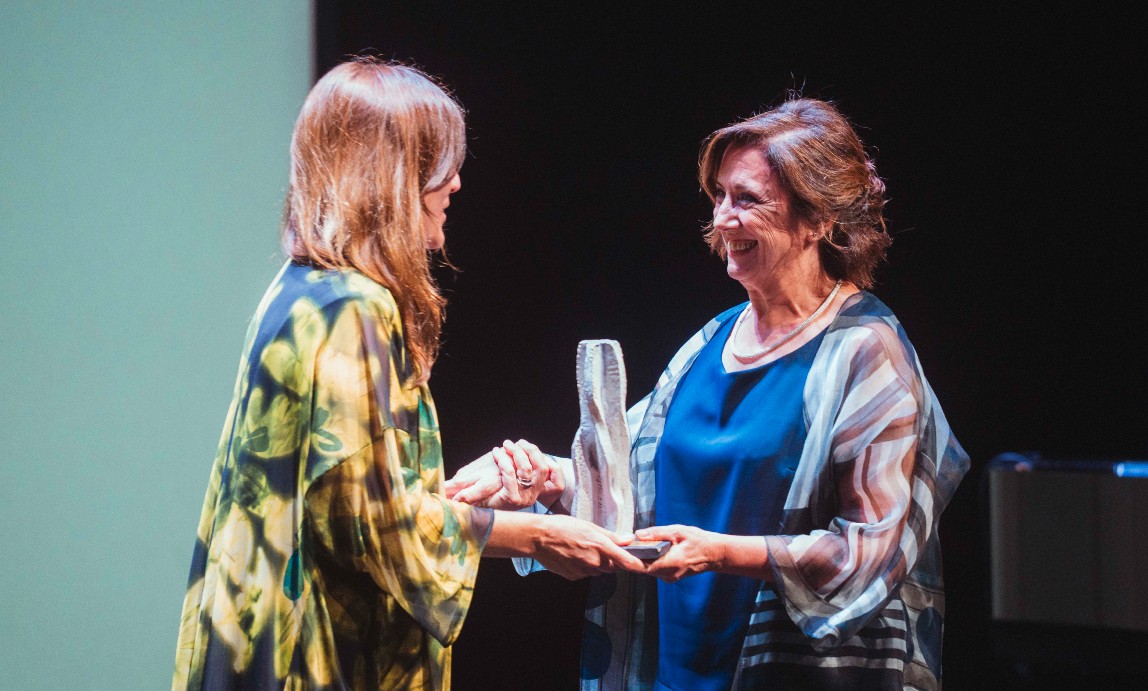
On 17 June, Núria Sebastián was granted the National Research Award by the FCRI (Catalan Foundation for Research and Innovation) and the Government of Catalonia in an event held at the National Theatre of Catalonia. After the ceremony, we had a chance to interview her.
What does it mean to you to win the Catalan National Research Award?
It’s a very special honour. And not just because of its prestige, but because it’s from my home country. It’s one of those awards you’re particularly excited to win, because it’s not every day you’re recognized as a prophet in your own land. I also feel like it’s shared with the entire Catalan research community.
“Bilingualism literally hit me in the face, because everyone here is bilingual to some extent. It was the perfect vehicle for conducting research”
What motivated you to research the effect of bilingualism on human cognition?
Part of the reason I started studying Psychology was to go against my parents’ wishes, but I soon realized that I had no interest in the clinical side of it. I was about to drop out when, in year four, I discovered Experimental Psychology. I was fascinated by the natural way in which we speak and understand each other, despite our rudimentary understanding of the mechanisms that make this possible. And bilingualism literally hit me in the face, because everyone here is bilingual to some extent. It was the perfect vehicle for conducting research.
You were the first scientist in the world to perform laboratory research on how children as young as four-months-old who are exposed to two languages process language. What do these studies entail?
The first studies, which we began in the mid-90s, involved observing how infants responded to linguistic stimuli before being able to talk.
The first was published in 1997. The aim was to analyse whether 4-5-month-olds raised in bilingual environments, in this case Catalan and Spanish, distinguished between the two languages. At the time (and still today), bilingual children were said to confuse the two languages for long periods of time. One of our procedures entailed presenting the infants with various phrases in one of the languages. Once the familiarization criterion had been met, we presented them with new phrases in either the same language or a different language. The critical factor here is that the infants decide whether they want to hear more phrases with their gaze: if they look at the screen, we continue to give them phrases; if they stop looking, the process ends. If they perceive a change, they tend to keep looking for longer, which we interpret as a sign of surprise or identifying something new. It’s an indirect way of determining what they distinguish.
We also use techniques such as electroencephalogram (EGG) tests, which detect changes in brain activity following a stimulus, or eye tracking, which enables us to accurately know where they are looking and determine variation in pupil dilation, another sign of being surprised or attentive. These are non-invasive techniques that provide highly enriching information on the perceptive and cognitive processes of infants.
“Infants as young as four months of age are able to discern between central Catalan and the Catalan from Terres de l’Ebre”
What conclusions would you highlight from the results of the tests and your research on infants?
One of the most revealing studies served to confirm that infants as young as four months of age are able to discern between central Catalan and the Catalan from Terres de l’Ebre, two highly similar dialects which differ in the proportion in which vowels appear. This is also an indication that the brain starts building its phonetic repertoire very early on, identifying which sounds are relevant in the infant’s linguistic environment. It’s incredible what children learn in their first months of life, well before they start speaking.
“In contexts such as Catalan and Spanish [...] Bilingual children can transfer knowledge of one language to the other: if they’re familiar with the world ‘gato’, for instance, and they hear ‘gat’, they can deduce the meaning based on likeness”
One fairly widespread belief is that people born in bilingual environments have an easier time learning other languages. Is that true?
That’s a common belief, and one that’s neither 100% true nor false: it depends on how it’s measured and the specific context. The initial studies on vocabulary (particularly in the United States, among populations of foreign origin) found that bilingual children knew less words. But that was because they only counted the words in English, without taking into account the words they knew in the other language. If we add up all the words, many bilingual children know as many or even more words than monolingual children.
In contexts such as Catalan and Spanish, which as languages are similar and coexist socially, the conditions are particularly favourable. Bilingual children can transfer knowledge of one language to the other: if they’re familiar with the world “gato” [cat in Spanish], for instance, and they hear “gat” [cat in Catalan], they can deduce the meaning based on likeness. This phenomenon, known as the “cognate effect”, facilitates learning. Furthermore, the fact that both languages are present in the environment (at home, school, in the media...) heightens exposure and helps make learning more robust.
Its interdisciplinary nature is what enriches the CBC, where a team of psychologists, engineers, physicists and philosophers explore common questions about the human brain
What is your role in the Center for Brain and Cognition (CBC), an interdisciplinary centre with highly diverse profiles?
That’s exactly what enriches it. Here, psychologists, physicists and philosophers explore common questions about the human brain. I bring an experimental vision focused on language acquisition and cognitive development, particularly among infants and in bilingual contexts.
For example, working with engineers has helped us design more precise recording systems and analyse complex data using computational models. While sharing the same space with philosophers and physicists forces you to reassess questions that seemed obvious and go a step further. It’s an extremely potent environment, which works like a dynamic ecosystem of ideas.
What position does Catalan research occupy on a global scale in matters of the brain and cognition?
We have a highly positive reputation and excellent researchers. However, there’s a structural problem in this field with regards to funding. In Catalonia, investment in cognitive and brain research is virtually non-existent, despite our top-level researchers and competitive projects. It’s frustrating, because research isn’t magic, it’s investment. Without resources, the only opportunities for talent are abroad.
I think the EU’s model for funding research should be a reference point. A model like the one established by the European Research Council (ERC), which trusts in the judgement of scientists and shows a commitment to excellence, provides both proven results and international prestige.
The research we are doing here, at the CBC, is internationally renowned and has secured highly coveted European funds. At the CBC, we’ve had as many as four ERC funded research projects at the same time. If you analyse this taking into account the investments made at local level, which are practically zero, the results are spectacular. The team has endured thanks to the commitment and excellence of its members.
To what extent is the advice provided by scientists in the political decision making process in research key? Is sufficient consideration given to their opinions?
No, it isn’t. Priority is often given to applied research, because it yields the most immediate results. However, we forget that all applications have a fundamental basis which may have been developed decades earlier with no clear practical purpose. A good example is the current research in Number Theory. For years it was criticized for serving no purpose. Now it is the basis of the encryption mechanisms we use to transmit information securely.
“The infant brain changes at lightning pace: as they learn (modifying the software), the machine (the hardware) transforms. Machines don’t have such plasticity. Understanding how this works is a challenge for the coming years”
How do you see the future of research in language acquisition? Which emerging fields could have the biggest influence?
Artificial intelligence can be extremely helpful, but in a support capacity. Its aim is to build intelligent machines; we have a machine, the human brain, and study how it works. In this regard, we often talk about reverse engineering. The infant brain changes at lightning pace: as they learn (modifying the software), the machine (the hardware) transforms. Machines don’t have such plasticity. Understanding how this works is a challenge for the coming years.
What has it been like to be a woman in a traditionally male scientific environment? What changes must be made?
Generally speaking, I’ve never felt discriminated against for being a woman. But I’ve always wondered whether I’d have received more help if I wasn’t a woman. I also remember a few specific episodes that would be unthinkable today, but which actually happened. In the late 80s, during a selection process, I was actually asked what such a pretty girl was doing locked away in a laboratory.
I still see subtle inequalities today: female researchers who serve as ad hoc secretaries for their male colleagues, who are rendered invisible or harbour doubts about their place. There are lots of patterns that need to be broken.
For more information on the SAP Research Group’s studies on cognition and speech in infants, visit upf.edu/web/cbclab/bebes_recerca. Through this website, any families interested in collaborating may find information on how to do so.