
Jan Eeckhout achieves an ERC Advanced Grant to study the relationship between market power and distribution
Jan Eeckhout achieves an ERC Advanced Grant to study the relationship between market power and distribution
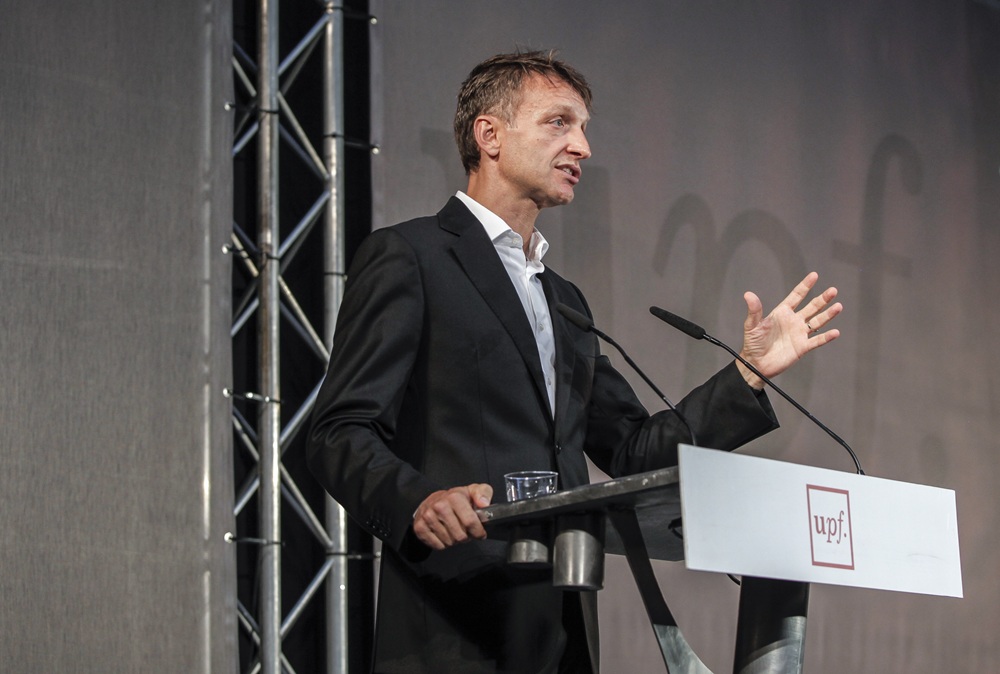
Jan Eeckhout, an ICREA research professor with the UPF Department of Economics and Business, also linked to the Barcelona School of Economics (BSE), has obtained an ERC Advanced Grant for the 2024 call of these prestigious grants convened by the European Research Council (ERC), the results of which were published on 17 June.
The project titled “Macro Market Power and Distribution (MACRO_POWR_DISTRBUTN)” will receive funding of 2,455,000 euros, with which Jan Eeckhout will analyse market power and its relationship with the distribution of economic surpluses between companies, customers and workers.
Jan Eeckhout: “I will investigate the macroeconomic mechanisms that link market power and distributional features, and I will formulate policies that improve well-being and lead to gains in efficiency and redistribution”
This is the ICREA-UPF research professor’s fourth grant from the European Research Council in his career. They have enabled him to conduct several research projects at UPF. In his early days at the University, he obtained a Starting Grant for the project “The Role of Sorting for Estimation, Market Design and Development (SORTING)” (2008-2013).
He then won three consecutive Advanced Grants, for the projects “Labor Market Risk and Skill Diversity (Risk & Diversity)” (2014-2019); “Market Power and Secular Macroeconomic Trends (MarketPower)” (2020-2025), and now “Macro Market Power and Distribution” (MACRO-POWR-DISTRBUTN) (2026-2031).
New macroeconomic mechanisms linking market power and distribution
Regarding the project MACRO_POWR_DISTRBUTN, Jan Eeckhout explains: “In this proposal, I use current macroeconomic tools that incorporate heterogeneity in the productivity of the enterprise, in market preferences and in structure. I will investigate the macroeconomic mechanisms that link market power and distributional features, and I will formulate policies that improve well-being and lead to gains in efficiency and redistribution”.
Jan Eeckhout proposes a unifying framework of market power and distribution to address three key questions: first, how the power of monopsony (labour demand monopoly) changes according to the size of the company; second, how companies’ financial frictions – that is, the difficulty to access financing, especially from banks – influence market power: companies with less market power generally have more difficulty in accessing financing, and therefore exacerbate the effect of this market power. Finally, the third question he will examine is how labour-saving technological change affects the distribution of labour share and market power.
To answer these three questions, Jan Eeckhout will use unique data coming, respectively, from Belgian VAT transactions combined with paired employer-employee data to quantify the economic mechanism whereby “markdowns” (reductions in the price and value of an asset) vary in distribution depending on the size of the company; bank data, on a representative sample of payrolls, current accounts and company credit, to quantify the impact of financial frictions; and finally, data from the United States census to quantify the distributional effects of the technological change entailed by labour saving.
181 researchers selected to advance the frontier of knowledge
Jan Eeckhout is among the 181 researchers selected by the European Research Council, from a total of 2,534 proposals submitted in this 2024 call for ERC Advanced Grants. Therefore, 11% of the initial proposals have been chosen, with a total endowment of 721 million euros.
The ERC Advanced Grant, under Horizon Europe, is one of the EU’s most prestigious and competitive funding programmes. It gives senior researchers the opportunity to carry out ambitious and curiosity-driven projects, which could lead to important scientific breakthroughs.
The new beneficiaries will conduct their projects at universities and research centres in 23 EU member states and associated countries, especially in Germany (56 grants), France (35), and the Netherlands (23). The winners include 45 Germans, 37 Italians, 26 Britons, 22 French, and 12 Spaniards, as well as researchers of a further 27 nationalities.