
The different implications and problems of green transitions, the thread of two academic meetings at UPF
The different implications and problems of green transitions, the thread of two academic meetings at UPF
The Ciutadella campus of Pompeu Fabra University hosted two events between 2 and 4 July, within the “Planetary health in 50 days” series, coordinated by the JHU-UPF Public Policy Center, linked to the UPF Department of Political and Social Sciences. Both encounters dealt with green transitions from a broad perspective, and analysed the different movements, impacts, struggles and resistance, on the one hand, and their colonial and green sacrifice aspects, from a critical perspective, on the other.
On 2 July, the Workshop on the Green Transition and Post-Growth Futures Megaprojects, Conflicts and Social Mobilization, was held, organized by the UPF Department of Political and Social Sciences and the JHU-UPF Public Policy Center, in collaboration with the University’s Centre for Studies on Planetary Wellbeing.
This meeting has arisen with the purpose of linking critical research on the impacts and planning of the green transition, with the struggles and alternatives offered by social movements in their respective regions
This meeting has arisen with the purpose of linking critical research on the impacts and planning of the green transition, with the struggles and alternatives offered by social movements in their respective regions. The event gave prominence to significant voices and cases of activism and academia, which are essential in order to understand the complex dynamics of power, resistance and alternatives at play.
It was structured in two blocks: Firstly, Ecological transition, ecosocial conflicts and energy megapojects; and secondly, Strategies, challenges and prospects for collective mobilization. In addition to the presentations, which dealt with topics such as ecosocial transformations, territorial conflicts and degrowth, and resistance to renewable energy megaprojects, it included the testimony of different members of social movements and addressed various international collective experiences in a round table.
Critically exploring the links between green colonialism and green sacrifice in the context of the green transition
Without leaving the Ciutadella campus, the second academic meeting, entitled Green colonialism and green sacrifice: critical perspectives on the politics of green transitions took place on 3 and 4 July.
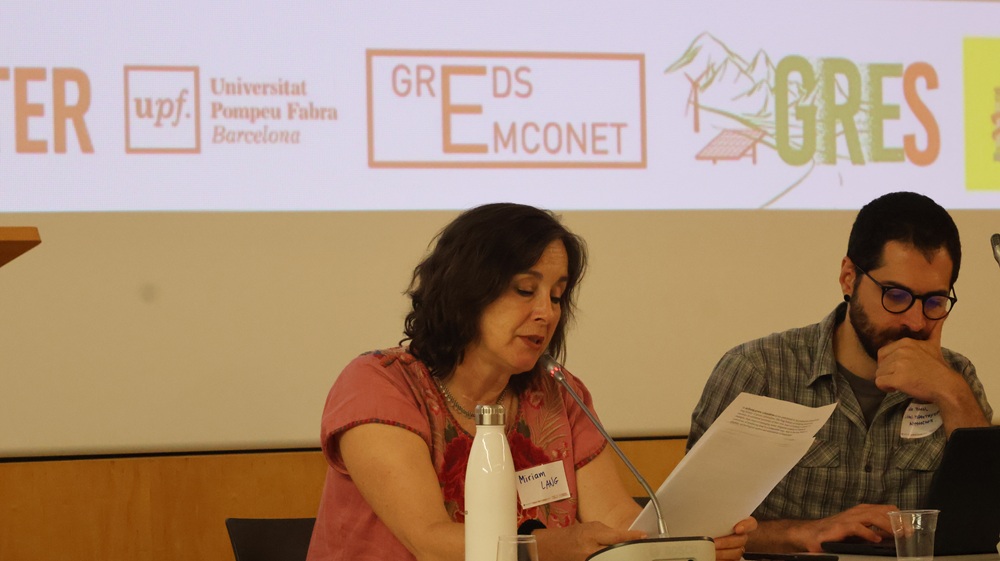
The inauguration, by Christos Zografos (UPF Department of Political and Social Sciences and JHU-UPF Public Policy Center) took place on 3 July in the multipurpose room of the Mercè Rodoreda building. Subsequently, Miriam Lang, a professor of Environment and Sustainability at the Simón Bolívar Andean University (Ecuador), delivered the inaugural conference “From a sacrifice to reparations: Re-Thinking the struggles for a dignified future from the margins”. In addition to Miriam Lang, other notable speakers at the meeting included Sofía Ávila (National Autonomous University of Mexico), Ulrich Brand (University of Vienna), Vasna Ramasar (Lund University) and Carlos Tornel (Durham University).
Beyond academic exchange, the conference programme sought to open a space for collective reflection on alternative pathways towards fair, post-colonial and ecosocial transitions. It was organized by the JHU-UPF Public Policy Center, the GREDS-EMCONET research group, and the UPF Centre for Studies on Planetary Wellbeing, and enjoyed funding by the Spanish Research Agency (AEI) and EU Next Generation funds through the GRES project.
The conference is in response to the urgent need to question the unequal and often colonial logics behind large-scale renewable energy and green growth initiatives
The two-day event gathered over 40 international academics and practitioners committed to the critical analysis of the ecological, social and political dimensions of contemporary green transition agendas. The conference is in response to the urgent need to question the unequal and often colonial logics behind large-scale renewable energy and green growth initiatives.
“The conference aims to explore the intersection between green colonialism and green sacrifice in the framework of the green transition: how climate solutions driven by the Global North can reproduce patterns of dispossession, and how the affected communities resist or re-imagine these futures”, asserted conference coordinator Christos Zografos, deputy director of the GREDS-EMCONET research group of the UPF Department of Political and Social Sciences and linked to the JHU-UPF Public Policy Center.
The programme combined plenary talks, parallel sessions, round tables and workshops, from a critical perspective, designed to foster long-term dialogue and collaboration between disciplines and countries. One highlight was the presentation of the Green Sacrifice in Spain project (GRES), which investigates local manifestations of these global dynamics.
From sacrifice to reparations: rethinking the struggle for a dignified future from the margins
Since the launch of the European Green Deal and discussions in the United States for a New Green Deal in 2019, the green transition agenda has gained decisive momentum. However, critical analyses have drawn attention to the colonial dimensions of green transitions. For example, they have pointed out how the large-scale extraction of “transition minerals” and the proliferation of industrial-scale renewable energy production facilities in the Global South to the benefit of decarbonizing the economies of the Global North are a manifestation of green colonialism. The idea of “green sacrifice” has also been explored, analysing the adverse effects of the green energy transition.
Social groups whose ways of life have historically proven sustainable, such as peasants, indigenous peoples, and people of African descent, are often dismissed or even considered threats. On a global scale, the political far right has successfully resignified ideas of rebellion and systemic change in such a way that they reject basic human values such as empathy and collaboration. However, there is a third perspective on ecosocial transformation within this dispute over our common future, based on solidarity and new visions of internationalism: at the heart of this perspective is the notion of multidimensional reparations: an approach that not only embraces diverse interpretations of materiality beyond monetary compensation for the damage caused, but also calls for structural change and establishes intersectional conceptions of justice.