
The Department of Political and Social Sciences at UPF, recognized as a María de Maeztu Unit of Excellence
The Department of Political and Social Sciences at UPF, recognized as a María de Maeztu Unit of Excellence
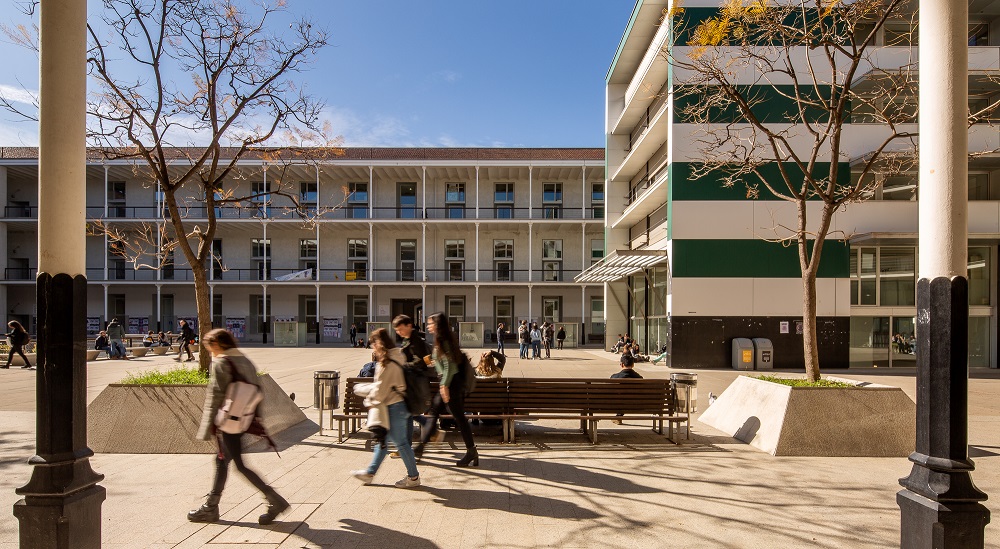
The Department of Political and Social Sciences (DCPIS) at UPF, with a scientific project led by the full professor of Political Science Mariano Torcal, has been recognized as a María de Maeztu Unit of Excellence (MdM), following the provisional resolution of the 2025 Severo Ochoa Centres of Excellence and María de Maeztu Units of Excellence call issued on 7 May by the Ministry of Science, Innovation and Universities through the State Research Agency. UPF now has three departments with this distinction: Political and Social Sciences, Medicine and Life Sciences (which earned this recognition for the third time in 2025) and Engineering (which received it for the second time in 2022).
According to Cristina Pujades, vice-rector for Research at UPF, “obtaining this accreditation, which means that UPF now has three departments accredited with the María de Maeztu distinction, in addition to the Severo Ochoa accreditation awarded to the BSE/Department of Economics and Business, validates UPF’s strategy of using a distinctive model within the university sector for attracting and retaining talent, such as the Tenure Track system, with a view to remaining a research-intensive university,” to which she added that: “The logic is simple: it’s a self-sustaining cycle. Attracting talent leads to success in competitive research funding calls, which in turn brings in research funding and enhances our ability to attract new talent.”
The Vice-Rector was adamant that the MdM excellence distinction is a “recognition of the work carried out by the departments and by the University.” She also acknowledged “the importance of having external advisory committees that help us identify our strengths and weaknesses, with the aim of providing our teaching and research staff the best possible conditions.”
Cristina Pujades: "Attracting talent leads to success in competitive research funding calls, which in turn brings in research funding and enhances our ability to attract new talent”
With this milestone, the Department of Political and Social Sciences (DCPIS) will receive a total of €3,189,000 in funding, distributed as follows: €2,250,000 for the Department’s Strategic Plan (over a four-year period starting on 1 July 2026) and €938,000 for predoctoral grants for research staff training, distributed across seven grants: each predoctoral grant amounts to €134,200, which includes €7,000 to fund research stays at R&D&I centres and to cover PhD tuition fees.
The María de Maeztu Unit of Excellence accreditation and the Severo Ochoa Centre of Excellence distinction are the highest institutional recognitions for scientific research in Spain. The purpose of both distinctions is to finance and accredit public research centres and units across all scientific fields. They are a sign of scientific impact and leadership at an international level, as well as active collaboration with the social and business environment.
Why is this accreditation important for the Department of Political and Social Sciences?
“The María de Maeztu accreditation is the most important recognition that a social sciences research unit can receive in Spain. For the Department of Political and Social Sciences at UPF, a leader in Spain in politics and sociology according to the QS World University Rankings, and ranked among the top 75 worldwide, as well as 42nd in Political Science according to the Shanghai Ranking of Academic Subjects, this accreditation represents the culmination of three decades of sustained research excellence,” affirms Clara Cortina, director of the Department of Political and Social Sciences at UPF.
Clara Cortina: “This accreditation represents the culmination of three decades of sustained research excellence”
But the accreditation goes beyond recognition: “It places us within an elite network of leading European research units and, most importantly, affords us the means to make a qualitative leap at a time when the social sciences are more necessary than ever. We are living in a time of global democratic erosion, the rise of authoritarian populism, widening inequalities and growing attacks on diversity, phenomena which demand rigorous, transdisciplinary research capable of meaningfully influencing public debate,” argues Clara Cortina.
What will this grant enable us to do?
Mariano Torcal, a full professor of Political Science at UPF and scientific head of the DCPIS’ María de Maeztu project, has led a team comprised of Verónica Benet, Beatriz Rodríguez, John Palmer, Joan Benach, Melanie Revilla and Maria Rodó-Zárate, who, as guarantor researchers, have supported the proposal and made this achievement possible. In the words of the professor, the 2026-2029 grant “will enable us to implement the Strategic Programme on Equity, Diversity and Democracy (SPEDD), a project which will transform the Department from a series of excellent research groups into a truly transdisciplinary hub. More specifically, we will fund the recruitment of several PhD students and postdoctoral researchers, launch a visiting scholars programme that will bring leading senior international researchers to Barcelona and strengthen our research infrastructure, including the Marvin computational cluster and the BESLab experimental laboratory.”
Mariano Torcal: “This grant will enable us to implement the Strategic Programme on Equity, Diversity and Democracy (SPEDD), a project which will transform the Department from a series of excellent research groups into a truly transdisciplinary hub”
Additional measures will include the holding of an annual internal call for transdisciplinary projects to encourage inter-group cooperation, support for applications to competitive European programmes such as the ERC and Horizon Europe and the promotion of knowledge transfer and public outreach.
What are the Department’s objectives?
According to Mariano Torcal, with this project, the DCPIS has three main strategic objectives: “The first is to strengthen the Department’s institutional cohesion and transdisciplinary synergies; the second is to advance evidence-based explanations of the major challenges facing our democracies; and finally, the third, and perhaps most distinctive, is to turn the Department into a leading public voice in the debate surrounding democracy, equity and diversity.” “We hope that, four years from now, when someone in Europe or beyond wants to understand developments in democracy, inequality or diversity from a rigorous and committed perspective, the Department of Political and Social Sciences at UPF will be a key reference point,” he concludes.
Reflection on UPF’s contribution to the wellbeing of society
As Vice-Rector Cristina Pujades recalls, “this recognition demonstrates the importance of the social sciences and their contributions to the transformation of society, as has also been shown in economics. What is particularly significant is that, at the national level, there are very few university departments in any field that hold the MdM distinction, except for the three departments at UPF, as most recognized organizations are research centres. That is a source of immense pride for us, because it illustrates our contribution, as a public university, to the wellbeing of society.”