
Research led by UPF reveals the most effective prosodic variations to communicate with Alzheimer’s patients
Research led by UPF reveals the most effective prosodic variations to communicate with Alzheimer’s patients
Research led by UPF reveals the most effective prosodic variations to communicate with Alzheimer’s patients
Coinciding with International Day of Caregivers (5 November), UPF has disclosed the results of this leading research analysing variations in the way of speaking (pitch, speed, intensity…) that affect patients’ emotional and cognitive response. The study has been recently published in the journal Health Communication.

Cutting-edge research led by UPF has revealed the most effective way of speaking to people with Alzheimer’s to achieve the best possible emotional reaction and levels of attention and comprehension.
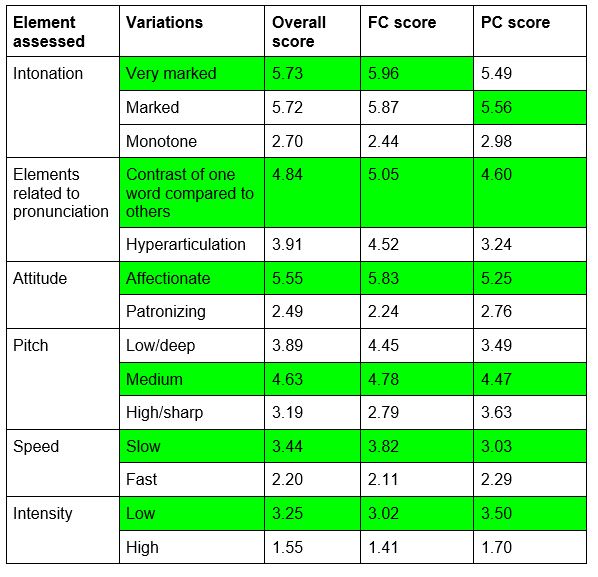
In general terms, the research concludes that the most effective way is to speak with affection but also firmly; varying intonation; stressing important words; careful articulation; speaking slowly and with medium intensity; and speaking with a medium-to-low pitch. Conversely, patients should not be spoken to quickly, patronizingly, intensely, in a high pitch and using monotonous intonation, failing to stress important words or sufficiently articulate terms.
The research is based on two different studies, involving a total of 312 participants, including caregivers and Alzheimer’s patients. The conclusions of the study conducted with caregivers have been published in the latest issue of the scientific journal Health Communication in the article entitled “The Relevance of Communication Between Alzheimer’s Patients and Their Caregivers. Effective Prosody Strategies to Improve Communication”. The research is led by Emma Rodero, a full professor of Media Psychology and Neurocommunication and director of the Media Psychology Lab at the UPF Department of Communication. Also co-authoring the article are Lluís Mas (UPF), Olatz Larrea (UB), Isabel Rodríguez-de-Dios (University of Salamanca) and Carme de la Mota (UAB). Their research enjoyed the collaboration of the State Reference Centre for the Care of Persons with Alzheimer Disease and other Dementias (CREA).
The article presents the results of research conducted on a sample of 252 caregivers. It should be noted that this sample includes family caregivers (132) and professional caregivers (120), in both cases mainly women. Participants answered a survey on the importance they give to communication with Alzheimer’s patients and which are the best strategies to do so. They also did an auditory perceptual assessment, in which they listened to the same instructions (“the blue tablets are on the table in the bedroom”) uttered in different ways to assess which was the most suitable. In this test, they had to rate from 1 to 7 different variations in the elements analysed (for example, in the case of pitch, assessing whether it was low, medium or high).
According to the principal investigator, Emma Rodero (UPF), the results “contribute to achieving an effective communication process for the patient to understand and perform tasks in an optimal mood and with motivation, and palliate situations of conflict or anxiety that occur in the day to day”.
UPF designs a leading communication course for caregivers in Spain
One of the main outcomes of the survey is that 93.7% of non-professional caregivers, usually family members of the patient, require greater training in this respect. This has led the UPF Media Psychology Lab to design specific training on this matter, that can be applied for by family or caregivers’ associations that require it.
The survey also reveals that 90% of caregivers are of the opinion that communication plays a key role in caring for people with this kind of dementia and that the way of speaking arouses emotions in patients. Slightly lower (82-83%) is the percentage of family caregivers that pay attention to the way of speaking or perceive that how they do so may affect patients’ degree of attention.
Results of the auditory perceptual assessment
Below we set out the results of the auditory perceptual assessment conducted on family caregivers (FC) and professional caregivers (PC). The parts highlighted in green show the variations with the highest score for each of the variables analysed, which yield the general conclusions of the research. The results for the two groups are similar, although some differences can be appreciated. For example, for CP, the most suitable intonation is marked and not very marked, as is the case of CF, and they give less importance to hyperarticulation.
Another study monitored the physiological reaction of Alzheimer’s patients to messages uttered in different ways
In a second study, under the umbrella of the same research, an experiment was conducted on 60 patients, 30 in the early stages of Alzheimer, and 30 in a control group. In this case, they underwent an auditory perceptual assessment, monitoring their physiological reaction to instructions uttered in different ways. Each patient was fitted with five electrodes on different parts of the body in order to record variations in their heart activity, breathing and peripheral nervous system while they listened to the instructions given in different ways. While listening, a facial emotion recognition system was also used.
The studies belong to the project entitled “Prosodic variations to improve the cognitive response and communicative interaction of Alzheimer’s patients with their caregivers”, funded by the Spanish State R&D&I Programme Oriented to the Challenges of Society (Ministry of Science, Innovation and Universities).
Reference article:
Rodero, E., Cortijo, L., Larrea, O., Rodríguez-de-Dios, E., & de-la-Mota, C. (2023). The Relevance of Communication Between Alzheimer's Patients and Their Caregivers. Effective Prosody Strategies to Improve Communication. Health Communication, 39(12), 2906–2919.https://doi.org/10.