
News: The exhibition ‘Discovering Joaquim Jordà’ can now be visited at the ‘Galeria Àrea Tallers’ of UPF
News: The exhibition ‘Discovering Joaquim Jordà’ can now be visited at the ‘Galeria Àrea Tallers’ of UPF
News: The exhibition ‘Discovering Joaquim Jordà’ can now be visited at the ‘Galeria Àrea Tallers’ of UPF
The work dedicated to the educator and filmmaker Joaquim Jordà, who was a professor in the Department of Communication at UPF, was inaugurated on Monday, October 17, at the Poblenou Campus. The project participants were present at the event, where the project’s development and aspects of Jordà’s work were discussed.
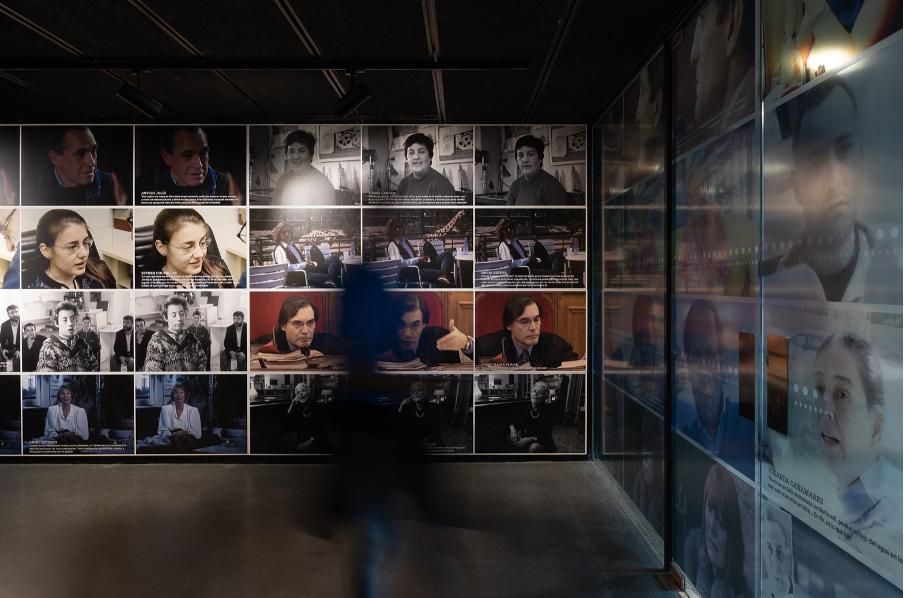
The inauguration of the exhibition and film series “Discovering Joaquim Jordà”, dedicated to educator and filmmaker Joaquim Jordà (1935–2006), who taught in the Bachelor’s Degree in Audiovisual Communication at UPF, took place on Monday, October 17, at 5:00 PM. The opening featured Oriol Amat, Rector of UPF; Jordi Balló and Glòria Salvadó, director and professor of the Department of Communication, respectively, and co-curators of the exhibition; Toni Montes, director of the Master in Ephemeral Architecture and Temporary Spaces at Elisava; and Sergi Jordà, the filmmaker’s son and professor in the Department of Information and Communication Technologies at UPF.
“Discovering Joaquim Jordà” introduces Jordà to those unfamiliar with his work and highlights both his filmmaking and his teaching at Pompeu Fabra University, emphasizing his disruptive instinct, surprise, countercurrent thinking, and sense of humor.
It is an initiative of the Centre d’Estudis Joaquim Jordà, directed by professors Fran Benavente and Glòria Salvadó, attached to the Department of Communication at UPF, and carried out in collaboration with the Master in Ephemeral Architecture and Temporary Spaces (MEATS) at Elisava. The exhibition consists of a show at the Galeria Área Talleres at the Poblenou Campus and a film series at the En Construcció cinema, adjacent to the exhibition space, which will take place during October and November.
Glòria Salvadó, co-curator, explained that the exhibition’s purpose is “to capture Joaquim’s spirit, which is to create a space for meeting, dialogue, conversation, and thought, and to serve as a starting point for many research projects, both academic and public.” Salvadó also thanked the Arxiu Comarcal de la Selva, which preserves all of Jordà’s personal and professional documentation at his express request, and the Centre d’Estudis Joaquim Jordà, which was born from another of Jordà’s wishes: “to bring together theorists, filmmakers, and young film students for a few days each year to discuss, talk, edit films, and reflect on cinema.” “From the University, we felt it was important to take on this mission, which is why we established this study center,” she explained.
At the same event, Jordi Balló gave a presentation on the project and its development. According to Balló, “Discovering Joaquim Jordà” is based “on the premise that visitors to this exhibition do not know who Jordà is, or know very little about him.” Balló also highlighted the collaboration with Elisava and Toni Montes, “the architectural soul behind the entire renovation of the Área Talleres, who committed to working with a space he himself imagined.”
According to Balló, “Discovering Joaquim Jordà” is based “on the premise that visitors to this exhibition do not know who Jordà is, or know very little about him.”
For his part, Montes emphasized that the project “has been a process of discovery for everyone involved, a risky yet collaborative process in the best sense.” “All the participants were master’s and Audiovisual Communication students, most of them international from around twenty countries across five continents, and none of them knew Joaquim or his work at all,” he stated. He explained that throughout the process, students fell in love “with him and his works” and “worked with incredible levels of enthusiasm.” “I believe everything that happened is reflected in the result, in the visions so little conditioned by prior knowledge or cultural background in this context. I feel Joaquim would be happy that this exhibition has become an experiment and a process,” he said enthusiastically.
Toni Montes: “I feel Joaquim would be happy that this exhibition has become an experiment and a process.”
Amat also mentioned Pompeu Fabra’s role in the initiative: “Pompeu Fabra is a university that wants to be different,” he said. He added that “the exhibition we have today and the series that will follow is a union of research, teaching, and knowledge transfer.” “Universities must create scientific, social, and cultural impact, and this is Pompeu Fabra’s intention: to deepen the path of culture and social impact,” he concluded.
