
Giacomo Ponzetto, recipient of the 2025 City of Barcelona Award for an academic article highlighting the value of social capital
Giacomo Ponzetto, recipient of the 2025 City of Barcelona Award for an academic article highlighting the value of social capital
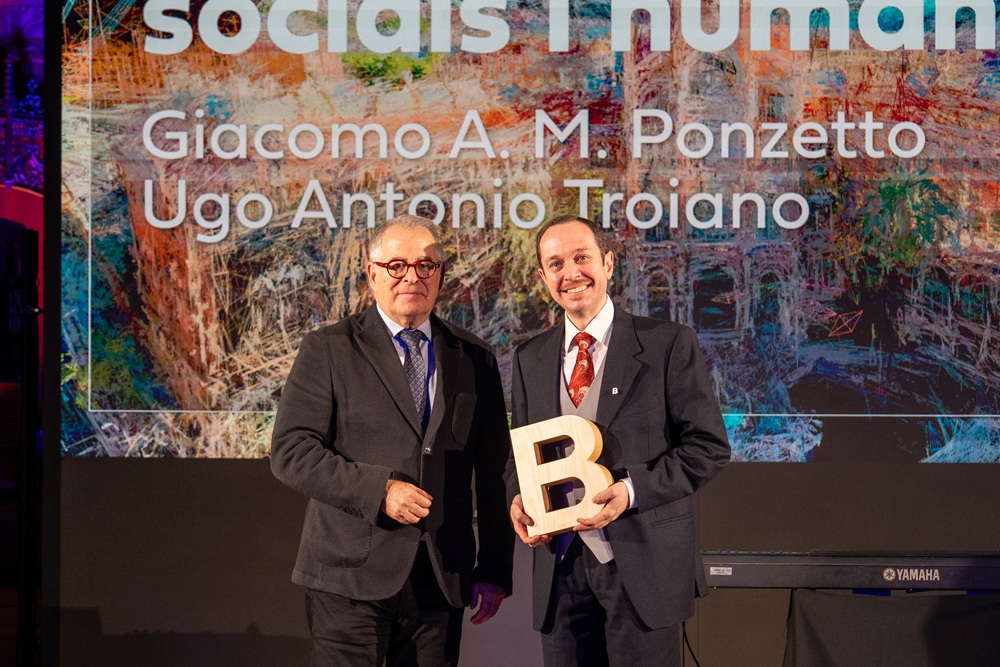
Giacomo Ponzetto, senior researcher at the Research Centre for International Economics (CREI) and lecturer affiliated with the Department of Economics and Business Studies at Pompeu Fabra University (UPF) and the Barcelona School of Economics (BSE), received the 2025 City of Barcelona Award in the Social Sciences and Humanities category for an academic article focused on social capital, during a ceremony held on 11 February in Barcelona City Hall’s Saló de Cent. The awards, which this year celebrated their 79th edition, are divided into 19 categories – 13 cultural categories and six scientific – with the aim of recognizing excellence and international impact in cultural, scientific and educational creation and research.
In this paper, the authors show that social capital improves both the quality and quantity of public investment in education, one of the key drivers for long-term growth
Together with Ugo Antonio Troiano (University of California, Riverside, USA), Giacomo Ponzetto is co-author of the article “Social Capital, Government Expenditures and Growth”, published in 2025 in the Journal of the European Economic Association. In this paper, they show that social capital – defined as the ability of a society to effectively disseminate information – improves both the quality and quantity of public investment in education, one of the key drivers for long-term growth. The jury, comprised of distinguished individuals appointed by the Barcelona Council of Culture and the city’s Scientific Advisory Council, placed particular value on its civil and legal implications.
According to Giacomo Ponzetto, “it is a special honour to receive the City of Barcelona Award from the municipal council of the city in which I have spent my entire postdoctoral career and with which I feel deeply connected, both professionally and personally,” to which he added that: “I feel it is particularly important, on the part of the institutions, that a single award recognizes both the sciences (including economics) and culture in different categories, two fields which are perhaps too often viewed as separate.”
Meanwhile, in the Environmental and Earth Sciences category, the jury awarded a special mention to the article “Co-benefits of nature-based solutions: A health impact assessment of the Barcelona Green Corridor Plan”, led by the Barcelona Institute for Global Health (ISGlobal) and Pompeu Fabra University, through the Department of Medicine and Life Sciences, which models the health benefits for Barcelona’s residents of full implementation of the Green Corridor Plan.
Long-term investments, social capital and public trust
With regards to the award-winning article, Giacomo Ponzetto notes that long-term investments, such as those in public education, pose a political challenge for governments, as citizens have a hard time assessing them. Short-term investments, on the other hand, such as in pensions, have an immediate and more visible effect, particularly for pensioners. “Such long-term investment in public education is not intended (or at least should not be intended) to please teachers, but to improve the education of young people and, consequently, the country’s future economic (and scientific and cultural) growth,” explains Ponzetto.
Giacomo Ponzetto: "Social capital is important because it combines the diffusion of information with the element of trust"
However, the problem, according to the senior CREI researcher, is that no democratic government can afford to wait a generation for the public to realize that their decisions were correct. As a result, “it is important to keep voters informed about the likely successes and failures of these public investments or the lack thereof.” For this reason, “social capital is important in this regard, because it combines the diffusion of information with the element of trust. In societies with higher social capital, people share more information and more reliable information,” Ponzetto contends, adding that when social capital increases, so does the government oversight of citizens.