
Ph.D. in Communication
Alfonso José Pujalte López defends his doctoral thesis on the role of accent as a trigger of racial bias
Alfonso José Pujalte López defends his doctoral thesis on the role of accent as a trigger of racial bias
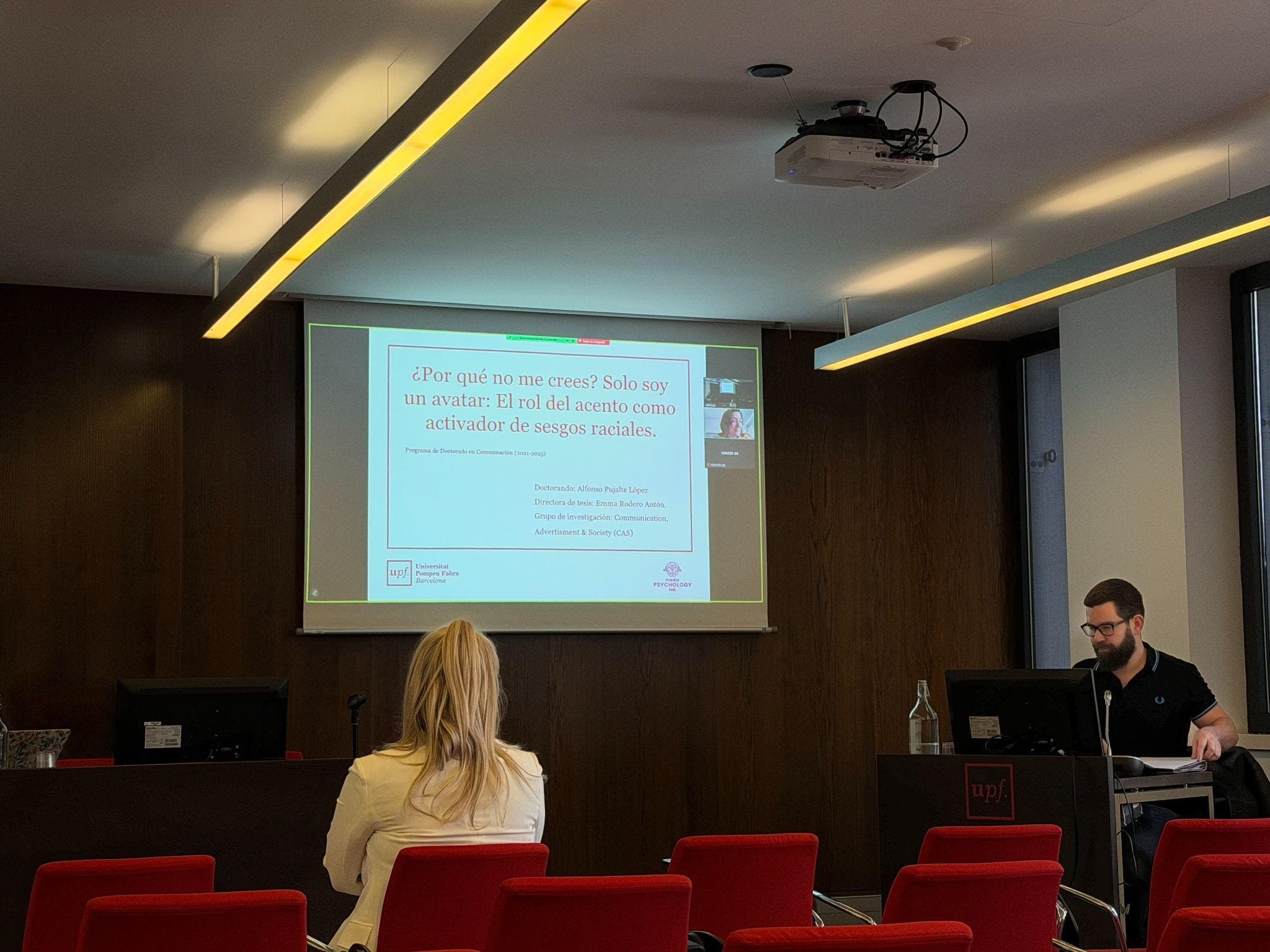
Alfonso José Pujalte López, a researcher with the Communication, Advertising and Society (CAS) group at Universitat Pompeu Fabra, defended his doctoral thesis on March 11, 2026, at the Poblenou Campus. The thesis, a traditional monograph defended in Spanish and supervised by Dr. Emma Rodero, is titled ¿Por qué no me crees? Solo soy un avatar. El rol del acento como activador de sesgos raciales.
The research is grounded in a context of growing social concern: the rise of hate crimes in Spain, where, according to Oberaxe (2024) data, 8.3% of victims are of Moroccan origin, predominantly men between 26 and 40 years of age who most commonly suffer physical assaults and injuries. Against this backdrop, the study asks what role accent plays in the credibility granted to accounts of racist experiences and proposes shifting the analytical focus from situated cognition to the interaction between interlocutors.
The research is structured in two methodological phases. The first, conducted online, involved 123 Caucasian participants with no knowledge of Arabic, who were shown four videos featuring virtual agents combining two independent variables: skin color (white or dark) and accent (Spanish or Arabic). Using a 2x2 repeated-measures design, the three dimensions of empathy were measured as dependent variables, namely cognitive, affective, and associative empathy, while participants' level of racism served as a moderating variable. The second, pilot phase brought the research into a virtual reality environment developed with Unity and the HTC VivePro 2 headset with 3D audio, in which 10 participants interacted with virtual agents. This phase incorporated the Implicit Association Test to capture implicit biases, and the Witmer and Singer (2008) Presence Questionnaire to assess the sense of immersion as a moderating variable of empathy.
The results of the first phase revealed that both skin color and accent have a statistically significant effect on empathy, though in a direction contrary to what had been hypothesized: the combination of dark skin with a Spanish accent generated higher empathy than white skin with an Arabic accent, suggesting that skin color functions as the dominant racial cue, while accent can moderate its effect on the cognitive understanding of the situation. Level of racism emerged as a strong predictor of empathy across all its dimensions, with significant differences at the cognitive level between traditional racist (fanatical) and egalitarian (minimally or non-racist) participants, and between modern racist (subtle) and egalitarian participants, and at the affective level between fanatical and egalitarian participants. The virtual reality pilot phase yielded preliminary evidence that accent affects the sense of presence, which in turn modulates empathy. The overall conclusions highlight that pre-existing prejudices override the characteristics of the avatars, that empathy may function more as a personality trait than a situational state, and that the research opens the door to practical applications in character design, the inclusion of stigmatized groups, and messaging and video-calling platforms.
The defense took place in person at the Poblenou Campus. The examining committee was composed of Dr. Leonarda García Jiménez, from the Universidad de Murcia, as chair (participating remotely); Dr. Lluís Mas Manchon, from Universitat Pompeu Fabra, as secretary; and Dr. María Blanco Hernández, from the Universidad Internacional de La Rioja, as external member. The committee particularly highlighted the creation of experimental stimuli designed specifically for the research as one of the most outstanding contributions of the thesis.