
Master’s Degree in Translation among Global Languages: Chinese-Spanish
Why choose this program?
The academic content taught on the official Master in Translation among Languages is focussed on translation and interpreting between Chinese and Spanish in areas such as private enterprises, international business, tourism or intercultural mediation. It also includes courses on translation between English and Spanish. In addition, this master also offers students a theoretical background on specialised translation and terminology, as well as comprehensive training in translation technologies and corpus exploitation tools.
Who is it for?
The official Master in Translation among Global Languages is addressed to graduate students in Humanities, Social Sciences or Philology with an advanced level of Chinese and Spanish who are interested in working as professional translators in the private sector.
Universitat Pompeu Fabra - Translation and Language Sciences Academic Coordination Unit

Structure and Syllabus
The master's degree is obtained by passing a minimum of 60 ECTS distributed as follows:
- 20 ECTS corresponding to four compulsory subjects
- up to 30 ECTS to be chosen among the elective courses
- 10 ECTS corresponding to the compulsory Final Master Project
In some cases, the student will be asked to register up to 10 additional credits in levelling courses. It is possible to add more credits to the 60 curricular credits (up to 120) in order to complete one's training. The master's program can be done on a full-time basis or on a part-time basis.
Faculty

Career prospects
- General translation (Chinese-Spanish-English) for different purposes.
- Specialized translation (Chinese-Spanish-English) in economic, commercial or administrative areas.
- Translation in official institutions such as embassies, consulates or commercial offices.
- Liaison interpreting and intercultural mediation in public services and the private sector.
- Research into general and specialized translation (Chinese-Spanish-English).
See also
Where will you study?
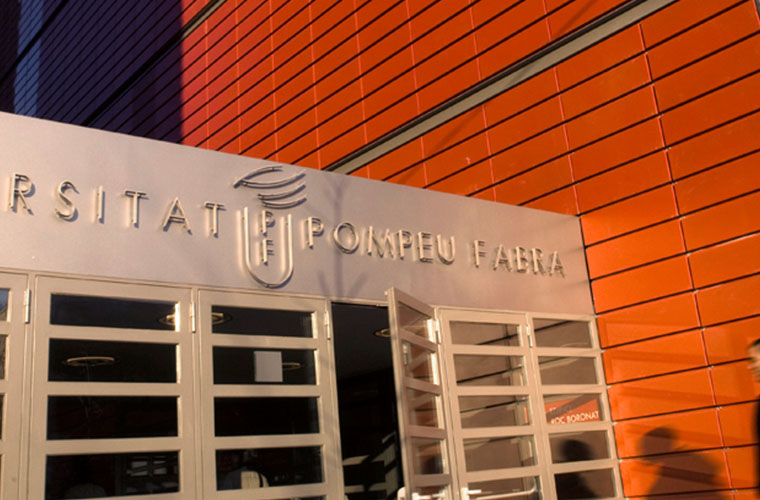
Edifici Roc Boronat (campus del Poblenou)
Roc Boronat, 138
08018 Barcelona
How to get here: