
Launch of the Book “Precarious, Unstable and Stressed. Precarious Work and Mental Health: PRESME Report”
Launch of the Book “Precarious, Unstable and Stressed. Precarious Work and Mental Health: PRESME Report”
Launch of the Book “Precarious, Unstable and Stressed. Precarious Work and Mental Health: PRESME Report”
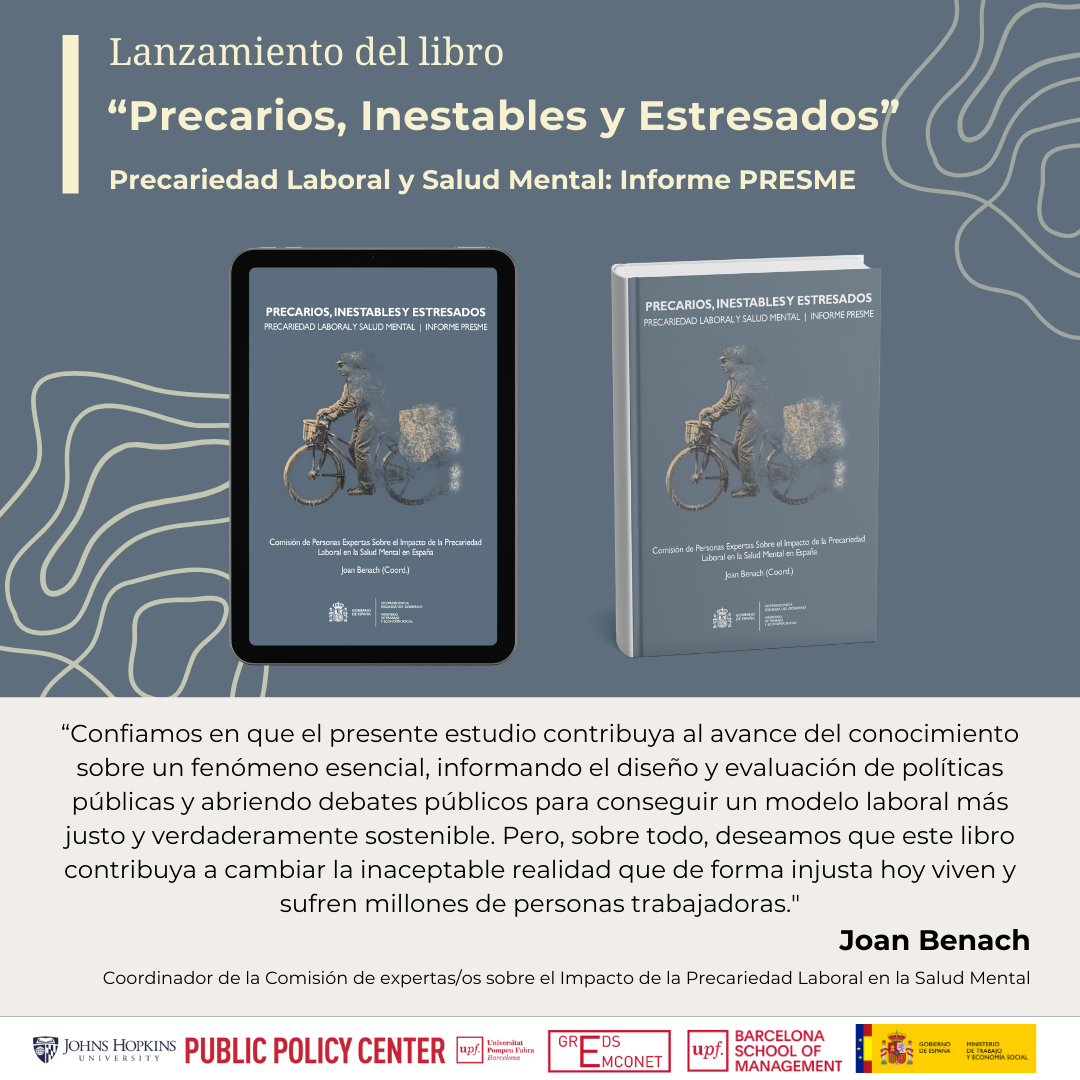
The Expert Commission that carried out the PRESME report was established by Yolanda Díaz, the Second Vicepresident and Minister of Labor and Social Economy of the Spanish Government, in April 2022. This report represents the first global study driven by a national government to address the pressing issue of precarious work and its effects on mental health. The commission's interdisciplinary approach, involving experts from diverse fields such as labor law, epidemiology, psychology, sociology, economics, and public health, led to a comprehensive report that examines the causes, evolution, and impact of precarious work in Spain, while also offering recommendations for policies and interventions to mitigate its harmful effects on workers' mental health.
According to the Expert Commission, the objectives of the report are: i) to understand the situation, causes, and evolution of labor precariousness in Spain; ii) to assess the impact of labor precariousness on mental health; and iii) to provide actionable recommendations for reducing precarious work and improving mental health outcomes for workers. The PRESME report not only aims to raise awareness about the hidden nature of work precariousness but also calls for significant action to address its widespread detrimental effects.
Joan Benach, the coordinator of the Expert Commission, Co-Director of the JHU-UPF Public Policy Center, and Director of GREDS-EMCONET research group, remarks in the report: "Work precariousness is today omnipresent in salaried employment (even in jobs with a certain degree of stability), as well as in many non-salaried and informal jobs. Paradoxically, although precariousness is everywhere, it is largely hidden. We neither understand it sufficiently well, nor measure it adequately, nor assess it in an appropriate manner. Alongside harmful jobs and work conditions, which we can, to some extent, comprehend, there are many other types of precarious work that we barely know or study. This includes informal jobs, submerged labor, or work provided in exchange for lodging and/or sustenance, with situations close to servitude and slavery that are common in impoverished countries and increasingly found in wealthier nations."
This full report, which aims to promote greater understanding and action on precarious work and mental health, is now available for those seeking to explore these critical issues in greater depth. By providing a comprehensive diagnosis and policy recommendations, the PRESME Report seeks to guide future research and policies, and ultimately help reduce the negative impact of precarious work on the health and well-being of workers.
Available here 👉 “Precarious, Unstable and Stressed. Precarious Work and Mental Health: PRESME Report”