
“Water could be used in peacebuilding” Report of the 18th edition of the Policy Dialogues series
“Water could be used in peacebuilding” Report of the 18th edition of the Policy Dialogues series
In the 18th Policy Dialogue session, a comprehensive exploration of the relation between water crises and political instability in the Middle East took place. Speakers Natasha Carmi and Jan Selby, experts in water management, conflict and security in the region, reflected on this relation and its implications, the impacts of war and violence on patterns of water resource degradation and water insecurities, and the opportunities for water-related peacebuilding.
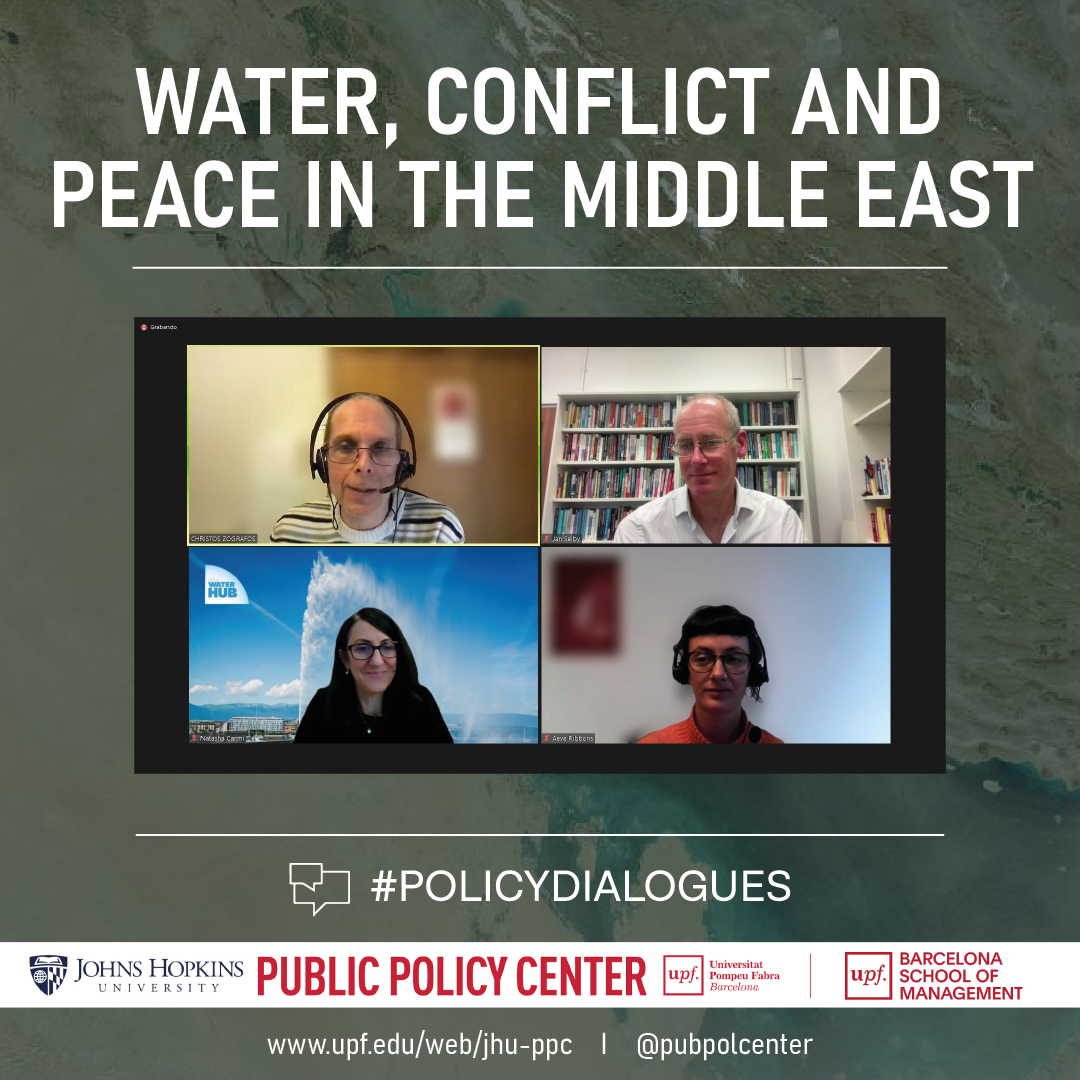
In the Middle East, severe water problems and acute political instability intertwine in complex and often devastating ways. The current crisis in Gaza starkly illustrates this dynamic. With populations across the region facing critical water shortages and poor water management, the implications for political and social stability are profound. To explore these complex relationships, the JHU-UPF Public Policy Center held the 18th session of the Policy Dialogues series: “Water, Conflict and Peace in the Middle East”. The session provided an in-depth overview of the Middle East’s water issues, examining how these problems might be fueling – or fueled by – social and political conflicts. The participants also analyzed how ongoing violence and warfare contribute to the degradation of water resources and increase water insecurity, and discussed the potential for water-related peacebuilding, exploring how initiatives aimed at using water as a tool for peace might be effectively pursued in this unstable region.
The speakers were Natasha Carmi, Water Peace Programme Manager at the Geneva Water Hub, who is currently leading the programmes for building peace through water in the WANA (West Asia and North Africa) region, and Jan Selby, Professor of International Politics and Climate Change at the University of Leeds, UK, and co-author of the book “Divided Environments: An International Political Ecology of Climate Change, Water and Security”. The session was moderated by Christos Zografos, associate professor at JHU-UPF Public Policy Center. Zografos opened the session by asking the speakers about the main insecurities that are connected to water, both at global level and also within the region, and the possible causes of those insecurities.
Natasha Carmi took the floor with a reflection on the importance of viewing water security through the lens of peace diplomacy. Emphasizing the mission of the Geneva Water Hub organization, she highlighted the need for a paradigm shift in addressing water and peace challenges. Natasha underscored that merely technical cooperation on water issues is insufficient; instead, it is vital to leverage water as a tool to foster improved relationships and political stability.
Natasha identified two primary causes of global water insecurity: the lack of political engagement in water peacebuilding and the disconnection between migration and water governance policies. She argued that addressing water security requires political processes due to its geostrategic implications, which can be leveraged to facilitate peace. Furthermore, Natasha emphasized the need to align migration policies with water governance, especially as migrations increasingly result from extreme weather events and conflicts: “If we ensure that migrating populations have water security and the human right to water, and it becomes an integral part of water governance, then we could actually lead towards peaceful communities at the regional level,” Natasha stated.
Focusing on the Middle East region, Natasha highlighted that regional water insecurity is exacerbated by the lack of infrastructure protection and water-sharing agreements. She noted that political instability and the impacts of climate change have made water infrastructure a target of conflict, further aggravating water insecurity. Additionally, she argued, the absence of regional basin-wide agreements and the challenges in securing bilateral agreements have hindered efforts to achieve water security.
Jan Selby then offered his perspective, drawing a parallel between water insecurity and food insecurity, and referencing the insights of Indian economist Amartya Sen. He emphasized that like food insecurity, water insecurity is not primarily about absolute scarcity but rather about unequal access and distribution. Jan argued that viewing water insecurity through a political lens is crucial. He cautioned against solely attributing water insecurity to natural factors such as rainfall, population growth, or climate change, asserting that these issues gain significance within specific political contexts.
Jan also highlighted that technical solutions alone are insufficient to address water insecurity. He noted that decisions about water allocation, infrastructure development, and resource governance are inherently political, affecting who benefits and who suffers as a result. He illustrated various facets of water insecurity, including farmers' struggles with groundwater access, urban challenges with intermittent water supplies, and corruption in water resource allocation.
The debate continued with a question posed by Christos Zografos about water and violence. He asked “is water the cause of violence? Is it a contributor to violence, conflict and war? And, is water likely to become a cause of conflicts in the future?”
Jan Selby outlined three main points in his response. First, he emphasized that the evidence for water being a cause of violent conflicts is extremely weak, regardless of the level of analysis—whether interstate conflicts over transboundary water resources or large-scale civil conflicts. Selby pointed out that while local disputes over water exist, they are often entangled with other issues, making it difficult to attribute the conflicts directly to water alone. He cited Syria as an example, where despite significant water problems, the onset of the civil war was driven by broader socio-economic and political issues rather than water scarcity alone.
Second, Selby argued that there are structural reasons why water is unlikely to become a major cause of violent conflict in the future. He noted that water, although biologically essential, is not as economically and politically significant as often claimed. As agriculture—which consumes the majority of water—becomes less central to national economies and political power shifts from rural to urban areas, the political importance of water diminishes. He likened this to malnutrition, which, despite its severity, is not a direct cause of interstate conflicts.
Third, Selby highlighted the reverse causality, where wars and conflicts have a profound impact on water resources, security and access. He provided examples from Lebanon, Iraq, Syria, Sudan, Libya, Yemen, and Palestine, where wars have caused extensive destruction of water and sanitation infrastructure, disrupted energy supplies, and led to health, environmental, and economic crises. The long-term consequences include the collapse of water management institutions and loss of expertise, significantly contributing to water insecurity.
Natasha continued Jan Selby's line of reasoning by emphasizing the potential of water to serve as a bridge rather than a source of conflict. She highlighted the importance of using water as a means to prevent and resolve conflicts, contrasting this with the well-documented impacts of war on water security and infrastructure.
She cited Gaza as a case study, illustrating how damage to water services and infrastructure during protracted urban conflicts leads to predictable and severe humanitarian crises. Natasha mentioned a recent study by her organization, which showed that damage to water and sewage systems in Gaza have resulted in multiple dehydration-related deaths of newborns, a dramatic rise in cases of acute diarrhea, scabies and hepatitis A, and potentially thousands of cholera-related deaths. These impacts were foreseeable and should have been mitigated by adhering to international humanitarian law, which obliges military planners to consider the indirect effects of warfare on essential services.
Natasha argued that the true driver of conflict is not water itself but water injustice and the disrespect for human rights and dignity. She ended by providing positive examples of how water management can foster peace and cooperation. One example from Iraq involved a collaboration between national stakeholders and the UNDP to establish a knowledge base for climate-resilient transboundary water agreements among Iraq and its neighbors. This project included an interdisciplinary analysis of water resources in the Euphrates, Tigris, and Arab basins, aiming to strengthen resilience through better understanding and cooperation.
The session concluded with a round of Q&A, during which participants posed insightful questions on topics such as the relationship between water and conflict, the use of water as a tool for peace, and water security for migrant and refugee communities, among other pressing issues.