“Transit the pain, organize the rage, defend the joy.” Report of the 19th edition of the Policy Dialogues series.
“Transit the pain, organize the rage, defend the joy.” Report of the 19th edition of the Policy Dialogues series.
“Transit the pain, organize the rage, defend the joy.” Report of the 19th edition of the Policy Dialogues series.
In the 19th Policy Dialogue session, an in-depth examination of the feminist movement’s evolution and challenges in the 21st century took place. Speakers Jule Goikoetxea, María Rodó-Zárate and Guiomar Rovira Sancho, leading experts in feminist theory and activism, discussed the significant achievements of the fourth wave of feminism, the unique characteristics of feminist movements in Latin America, and the persistent global struggles faced by women's rights activists. The session highlighted the transformative impacts of digital networks on feminist discourse and organization, as well as the ongoing need to navigate systemic inequalities and opposition.
Over two decades into the 21st century, the struggle for women's rights remains a global issue, marked by significant achievements driven by the feminist movement, yet consistently challenged by conservative and patriarchal resistance. The COVID-19 pandemic exacerbated preexisting, deep-seated gender inequalities, with governments’ emergency measures leading to surges in domestic violence and setbacks in women's economic independence across the world. Additionally, a rising wave of reactionary forces threatens to undermine the gains of the feminist movement in recent decades, exemplified by the U.S. Supreme Court's 2022 decision to overturn Roe v. Wade and the rollback of reproductive rights by far-right governments like that of Javier Milei in Argentina. These developments, fueled by antifeminist and misogynistic ideologies, serve as a stark reminder that women's rights are not guaranteed, but must be continuously defended.
Despite these challenges, it is crucial to recognize the ongoing nature of this struggle without succumbing to pessimism. As Angela Davis reminded those who had the privilege of hearing her speak at Universitat Pompeu Fabra in May 2024, this is a constant fight, and feminism is a global movement. Numerous examples highlight the significant progress made towards gender equality in the 21st Century, driven by feminist activism worldwide. The #MeToo movement, which began online, evolved into a global force against sexual harassment and the silencing of victims. In Spain, the success of the women’s national football team in 2024 not only made headlines but also sparked discussions on women's rights in sports across Europe, Latin America and Africa, drawing attention to broader issues of gender equality in athletics. Additionally, the Green Wave movement in Latin America, symbolized by the green scarf—a tribute to the Mothers and Grandmothers of Plaza de Mayo—continues to fight for reproductive rights, demonstrating the power of grassroots feminist movements.
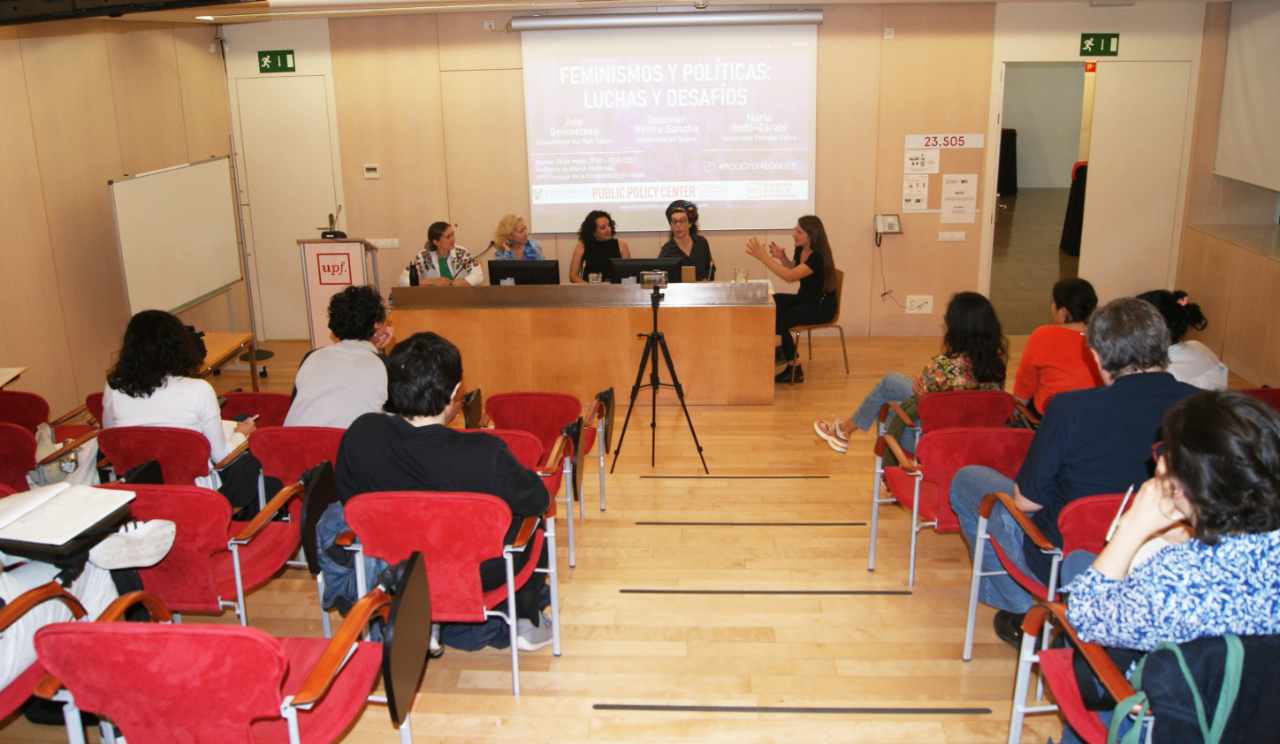
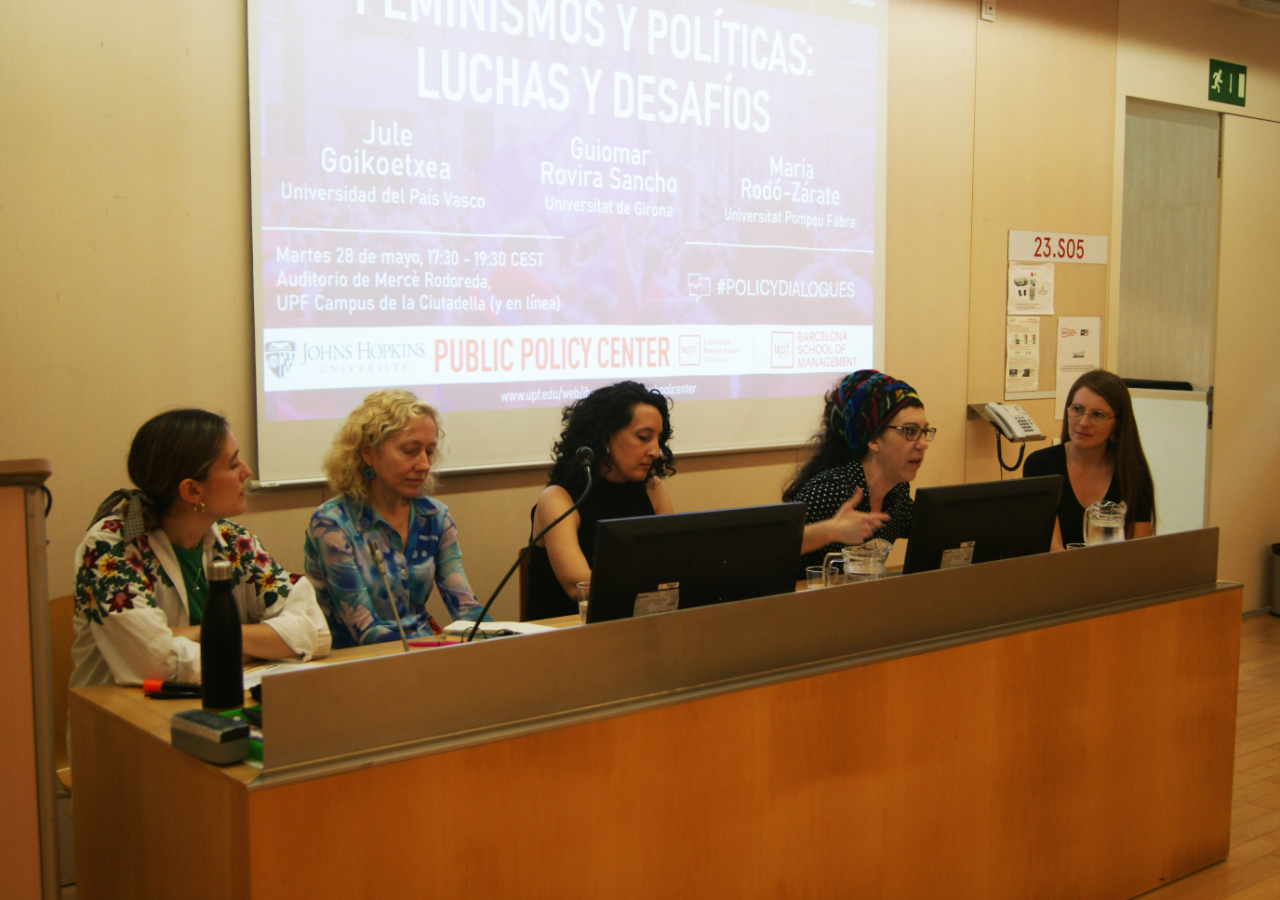
In order to delve into these issues and untangle the complexities of feminist struggles in today’s sociopolitical climate, the JHU-UPF Public Policy Center presented the 19th edition of Policy Dialogues: “Feminisms and Policies: Struggles and Challenges.” This session focused on the feminist movement in Spain and Latin America, recent institutional developments such as the implementation of feminist public policies, and the challenges faced by feminist activists, featuring an interdisciplinary panel of three experts:
Jule Goikoetxea, Professor of Political Theory at the University of the Basque Country and a member of the International Gender Studies Centre at the University of Oxford; Guiomar Rovira, PhD in Social Sciences, with a focus on Communication and Politics, Associate Professor at the Universitat de Girona and specialist in social movements and communication, feminisms, and digital networks; and Maria Rodó-Zárate, Professor in the Department of Political Science and Sociology at UPF, with a Master's in Women, Gender, and Citizenship Studies (Universitat de Barcelona) and a PhD in Geography (Universitat Autònoma de Barcelona). The session was moderated by Ángela Londoño López, a journalist, anthropologist, and master's graduate in Public and Social Policies, and Priscila González Yáñez, an Equality Consultant at Igualia, and co-founder of Equality el Podcast, a platform that raises awareness of and highlights gender inequalities in the workplace.
Ángela began the session by reflecting on the current global landscape of feminism and women’s rights. She then opened the discussion with her first question: "What do you believe have been the most significant advances of the feminist movement in the last five years, both globally and locally? And what do you consider to be the main challenges for the movement?"
Jule Goikoetxea responded by reflecting on a broader timeframe, suggesting that the current “fourth wave” of feminism began to crystallize about ten years ago, rather than just five. She emphasized that this wave has become a global phenomenon, addressing the patriarchal structures that are as widespread as capitalism and colonialism. She noted that the fourth wave has significantly advanced the movement, both in discourse and organization. In terms of discourse, it has integrated theoretical frameworks from other movements and made them more central in feminist discussions. Organizationally, she highlighted innovations in the Basque Country, such as the first feminist general strike, which merged traditional labor techniques with a new, inclusive feminist discourse. This strike brought together various social and racialized groups, reflecting a shift away from traditional dichotomies between material and symbolic issues in feminism. Jule concluded that the fourth wave is breaking down these divides, recognizing the intersectional nature of identities.
Priscila continued the session with the following question to Guimoar Rovira, who lived and worked in Mexico for 28 years: "What are the distinctive features of the 4th wave feminist movement in Latin America, and how does it differ from the rest of the world?
Guiomar Rovira began by acknowledging the paradox of discussing feminist advancements while global crises, such as the genocide in Palestine, are unfolding. She highlighted that the fourth wave of feminism emerged during a period when over half of humanity gained internet access, notably marked by the 2015 #NiUnaMenos (#NotOneLess) movement in Latin America against femicides. Guiomar pointed out that this wave is characterized by the rise of a feminist network that is intensively utilizing digital tools. She emphasized the significant impact of digital technology in democratizing feminist discourse and mobilization, allowing non-politicized women and young generations to engage in feminism in a peer-to-peer manner. This has led to a broader “feministization” of collective action, whereby traditional hierarchies and patriarchal structures are constantly challenged. Guiomar also discussed the prominence of the #NiUnaMenos hashtag underscoring its role in bringing feminist struggles to the forefront. Additionally, she noted the emergence of "women who fight" in Mexico, which is a group of women who are creating alternatives beyond mainstream feminism. These women, including indigenous and community-based feminists, offer new ways to understand the body and territory, emphasizing structural violence and the capitalist exploitation of natural resources as feminist issues. Guiomar concluded that the fourth wave's transnational nature, with symbols like the green scarf and movements like #MeToo, represents a powerful, decentralized collective movement against patriarchal dominance and contributes to the ongoing feminist struggle for global change.
Then, María Rodó-Zárate was asked about the resistance to the feminist movement in some segments of society and whether she has noticed a change in the mentality of Spanish feminists in recent years. In her response, she pointed out that there has been a significant increase in anti-gender and anti-feminist discourses, which she attributes to the rise in feminist consciousness. Rodó- Zárate emphasized that this resistance should be understood as a form of political violence, aimed at silencing voices advocating for feminist, anti-racist, and LGTBI rights. She noted, "I think it’s important to understand this as a form of political violence intended to silence, to push certain voices out of the political debate because they are disruptive. Silencing them prevents these discourses from spreading, and creates fear, which is exactly what they aim to do and what we are seeing happen." She also highlighted that this backlash is part of a broader cultural war, where challenges to existing power structures, particularly those benefiting men in privileged positions, provoke strong opposition. This resistance manifests not only in state-level dynamics but also in everyday contexts, such as within families or workplaces, as those who previously held power react to the threat of losing it.
Next, the speakers were asked to reflect on how they continue in activism after so many years of struggle. Guiomar responded by quoting a phrase from a collective called Las Siemprevivas: “transit the pain, organize the rage, defend the joy.” She highlighted the unprecedented global political solidarity and friendship among women that has been built, which, forged through shared pain and struggles, enables activists to challenge systemic violence and build resilient communities. She also spoke about the harsh reality of global capitalism, stressing the need to oppose the destructive pace of capitalism with the slow, life-affirming rhythms of activism and personal growth.
Jule responded to these comments, acknowledging the presence of violence but arguing that new technologies have made it more visible, increasing awareness. Jule emphasized the dual nature of humanity, capable of both love and violence, and advocated for channeling this understanding into activism. She also advised maintaining a historical perspective and recognizing the progress made towards gender equity and justice in the long term. She encouraged embracing political joy and hope as a form of resistance and discipline, rejecting the despair that conservative forces may try to instill.
The session concluded with a round of Q&A, during which participants posed insightful questions about feminist struggles, the role of media, and the future of the movement. This engaging discussion allowed for a deeper exploration of the topics addressed and highlighted the ongoing relevance and challenges of feminist activism in today’s world.