Philine Matzen defends her thesis on the representation of origin and citizenship in crime news stories
Philine Matzen defends her thesis on the representation of origin and citizenship in crime news stories
Philine Matzen defends her thesis on the representation of origin and citizenship in crime news stories
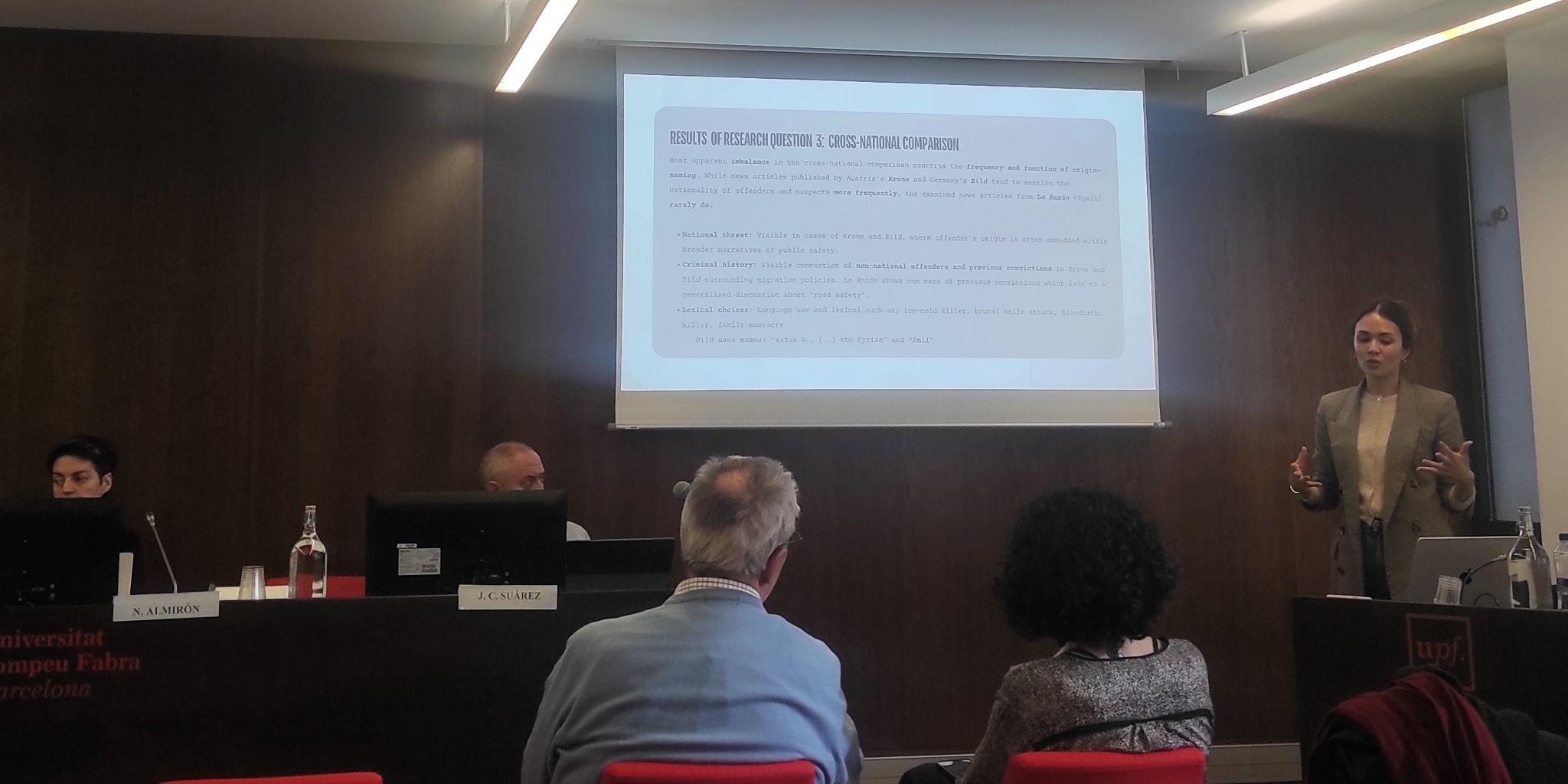
Philine Marzen, a researcher with the POLCOM-GRP research group, defended her thesis entitled “The representation of origin and citizenship in crime news stories: a transnational comparative analysis” on January 16, 2026, at the Poblenou campus of Pompeu Fabra University (UPF). The research, supervised by Dra. Ruth Rodríguez (UPF) and Dr. Miquel Rodrigo Alsina, was presented in monographic format.
The portrayal of migrants in the media has received significant scholarly attention throughout the years of research, with increased focus following key migration events in the 2000s and the European refugee crisis in 2015. Past studies found that the representation of migrants tends to be negative. The problematic portrayal of migrants in reporting resulted in the establishment of new guidelines and recommendations for journalists in order to provide a more diverse and less biased representation of society. However, while evidence of gradual progress towards more positive representations exists, discrepancies persist, particularly in the portrayal of individuals based on race, origin, and citizenship. The thesis examines patterns in homicide reporting in online news articles from Austria, Germany and Spain, focusing on how offenders are represented with regard to their origin and citizenship. Despite the countries’ partly similar media landscape, they also differ significantly not only on journalistic regulations, but also on the demographic makeup. Using van Dijk’s critical discourse analysis framework and a comparative cross-national approach, the analysis examines how often origin is mentioned and in what context, as well as the use of demographic or personal details in coverage. The findings aim to highlighting power dynamics embedded in crime-related news coverage and provide insights into the media’s role in shaping societal perceptions of origin and criminality.
Matzen had a personal and professional motivation regarding this research. She grew up in a multicultural household and hold citizenship while having a migration background, which made her “aware early on of unequal representation in public discourse, including in the media”. “Living in different European countries reinforced this perspective. Despite shared European standards and journalistic guidelines, I observed imbalances in crime reporting, particularly in the way nationality is highlighted. Professionally, this led to an interest that shaped my academic path from journalism studies to media and power in the Master, to migration research. The aim of this PhD-thesis was not normative, but to empirically analyse these patterns in crime news and offender representation”.
A qualitative approach based on integrated Critical Discourse Analysis was applied. This approach combines van Dijk’s framework, including the ideological square, the “in-group” and “out-group” concept, with Fairclough’s three-dimensional model, analysing in-depth lexical choices, discursive practices, and the broader social context.
The main results show that crime reporting in Austria, based on Krone Zeitung, follows a pattern of differentiation between national and non-national suspects and offenders. Non-national offenders are frequently identified through explicit origin-naming, often already in the headline, using nationality or residential labels. National offenders, by contrast, are rarely marked by explicit origin. The analysis further shows unequal use of personal information. National offenders are more often contextualised through relational information, while non-national offenders are portrayed to origin, age, and legal status, with socio-economic background largely omitted. These patterns are reinforced through emotionally charged language and a dominant reliance on institutional sources in cases involving non-national offenders. The main conclusion drawn from these findings is that origin-naming does not serve a purely informational purpose of understanding the context of the crime. Instead, it serves as a discursive tools of othering, reinforcing an in-group versus out-group distinction after Van Dijk. This indicates an imbalance between journalistic principles of balanced and non-discriminatory reporting and actual reporting practices.
The findings for Bild Zeitung show that the analysed news items display a strong association between origin-naming and broader societal framing. The portrayal of offenders and suspects is closely linked to national origin or residential status, particularly in cases involving non-national suspects. Non-national offenders are frequently positioned within wider societal debates, such as migration, asylum policy, or cultural conflict. Headlines often explicitly connect individual crimes to national-level issues, for instance by framing cases as evidence of failures in the asylum system, such as “The murder of girls in Illerkirchberg is fuelling the asylum debate” (Bild news article). In contrast, crimes committed by national offenders are rarely presented as societal problems and are more often framed as isolated, domestic, or individual incidents. Another key finding concerns language use. Reports involving non-national offenders rely heavily on emotionally charged and sensationalist terms, such as “killer,” “bloodbath,” “horrific crime,” or “carnage.” When origin is mentioned, Bild consistently uses national identifiers or culturally marked names, which further foregrounds difference and reinforces visibility.
The findings for La Razón show a more selective and cautious approach to mentioning origin and citizenship. In most cases, offenders remain unmarked, and origin is only mentioned when the individual deviates from what is implicitly treated as the norm. When origin-naming does occur, it usually involves references such as “Moroccan” or “Syrian” to describe the offender or suspect. Another pattern appears in cases where origin-naming is combined with religious identifiers or references to mental health. For instance, mentions of non-national offenders are sometimes linked to Islam through phrases such as “Allah is great,” which reinforces an association between ethnicity, religion, and crime. This selective practice reflects ideological patterns that mark non-national offenders as culturally different.In terms of sourcing, La Razón relies primarily on institutional voices, including the National Police, the Guardia Civil, and judicial authorities, often through paraphrased statements. Emotional or familial voices appear less frequently and are mainly used in cases involving Spanish victims. The most dominant framing in La Razón concerns victims and gender-based violence. Reports on femicide consistently emphasise domestic violence and connections to other femicide cases, rather than framing these crimes as migration-related. Overall, origin-naming in La Razón is less frequent than in Austria and Germany, but when it occurs, it tends to be selective and symbolically charged, contributing to subtle forms of othering. The main conclusion is that origin-naming can serve as a discursive strategy that can link non-national offenders and suspects to broader narratives of threat and social conflict, while national offenders remain individualised and decontextualised. This pattern indicates a selective practices of origin-naming that goes beyond contextual information and can contribute to unequal representations in crime reporting.
The panel was chaired by Dra. Núria Almirón Roig (UPF) and also included Dra. CAnna Tous Rovirosa (UAB) as Secretary and Dr. Juan Carlos Suárez Villegas (US) as Member. They praised the “relevance of the topic” as well as other aspects such as the “empirical rigour” of the research.