Archaeological research by Konrad A. Antczak obtains a 2024 ERC Starting Grant to study the everyday life of three Caribbean islands between the 17th and the 19th centuries
Archaeological research by Konrad A. Antczak obtains a 2024 ERC Starting Grant to study the everyday life of three Caribbean islands between the 17th and the 19th centuries
Archaeological research by Konrad A. Antczak obtains a 2024 ERC Starting Grant to study the everyday life of three Caribbean islands between the 17th and the 19th centuries
The Juan de la Cierva researcher of the UPF Department of Humanities will be able to conduct the project ISLANDIVES (“Alternative Modernities and Everyday Life in the Pre-emancipation Southern Caribbean (c. 1634–1863)”, with a duration of five years and an endowment some two million euros.
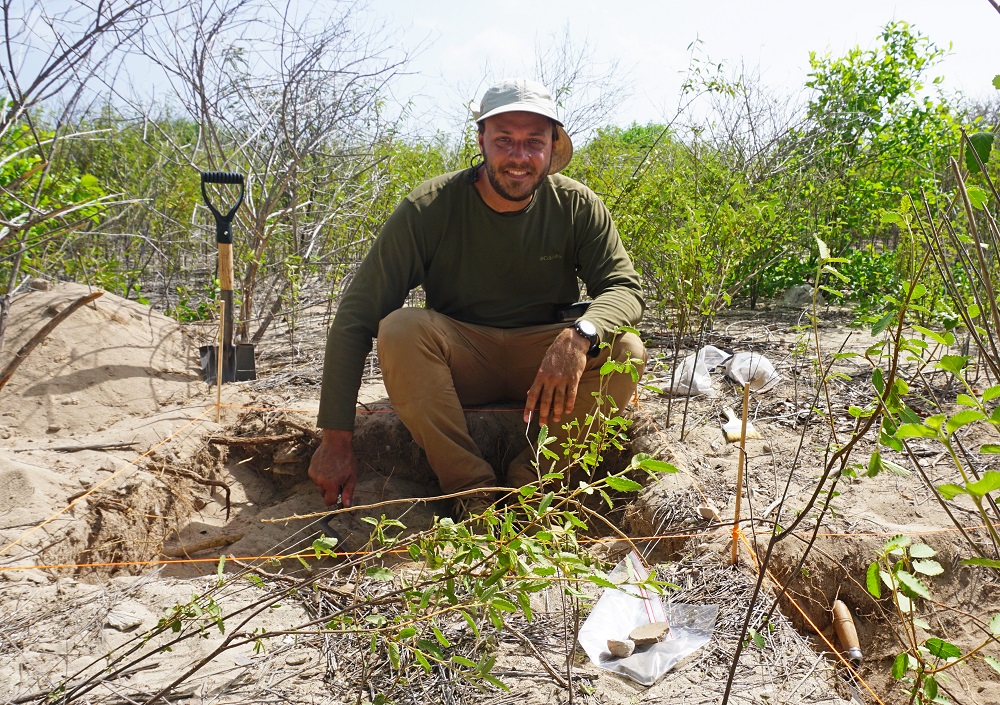
Konrad A. Antczak, a Juan de la Cierva researcher at the UPF Department of Humanities and a member of the Research Group on Colonialism, Gender and Materialities (CGM), has received a Starting Grant from the European Research Council (ERC), in its 2024 edition. This is a highly competitive call, since of the 3,474 proposals submitted, just 14.2% of the projects (494) have been funded, led by young scientists and academics from all over Europe, including the UPF researcher.
Thanks to this grant, endowed with 1,978,332 euros and set to run for five years, at UPF Konrad A. Antczak will be able to conduct the project ISLANDIVES (“Alternative Modernities and Everyday Life in the Pre-emancipation Southern Caribbean (c. 1634–1863)”, the first interdisciplinary historical archaeological project that will deploy a wide range of cutting-edge archaeological science techniques to study daily life in multiple sites on several islands in the southern Caribbean region, specifically over a period of 229 years.
Konrad A. Antczak: “ISLANDLIVES aims to reveal how knowledge of past alternative modernities can help us better understand contemporary societies on the islands of Aruba, Curaçao and Bonaire and, ultimately, critically challenge Eurocentric narratives in the present, which are deeply rooted in the past”
Using archaeology as a basis for analysing the everyday life of islands outside of the colonial European model
The Dutch islands of Aruba, Curaçao and Bonaire (ABC islands) were unconventional colonies that did not fit the typical European model of modernity created in the Caribbean, driven by the plantations. Rather, they occupied a “grey” area, and thrived on illicit trade with the mainland, mainly with the Spanish provinces of present-day Venezuela.
Thus, the project aims to reveal the inner workings of the alternative modernities of the seventeenth to nineteenth centuries in the Caribbean: it will do so based on terrestrial and maritime archaeological research, archival research and archaeometric, proteomic, archaeobotanical and zooarchaeological analyses, within a sophisticated conceptual framework.
Most of the scientific evidence will be obtained through archaeological excavations at six sites, whose careful interpretation will generate the first complete cross-section of daily life on the ABC Islands.
According to Konrad A. Antczak, “ISLANDLIVES aims to reveal how knowledge of past alternative modernities can help us better understand the contemporary societies of the islands of Aruba, Curaçao and Bonaire and, ultimately, critically challenge Eurocentric narratives in the present, which are deeply rooted in the past”. And he adds: “The project is aimed at furthering research on how different island peoples, including free and enslaved blacks, indigenous people, the Sephardim and the Dutch, navigated through modernity in their own controversial and contingent way”.
A historical archaeologist specializing in Caribbean archaeology
Konrad A. Antczak is a Venezuelan historical archaeologist who received his doctorate from The College of William and Mary (Virginia, USA, 2017). He joined UPF thanks to a Marie Curie grant, with which he conducted the project ArCarib: Archaeology of Informal Commerce in the Colonial Caribbean, supervised by Sandra Montón Subías, an ICREA research professor at the Department of Humanities and coordinator of the Research Group on Colonialism, Gender and Materialities (CGM).
From the outset of his research career, he specialized in the historical archaeology of the south-eastern and Venezuelan Caribbean, focusing on commercial goods, daily lives and maritime mobility from the 16th to the 19th centuries, including the cultivation and itineraries of sea salt and contraband or informal trade. Since 2011, he has been a researcher at the Archaeological Studies Unit of the Simón Bolívar University in Caracas (Venezuela).
Empowering researchers early in their career
The ERC Starting Grant 2024 call, the results of which have been published today, 5 September, is funded with a total of nearly 780 million euros. It supports cutting-edge research in a wide range of fields, from life sciences and physics to social sciences and the humanities.
These grants will help researchers who are at the outset of their scientific career to launch their own projects, train their teams and pursue their most promising ideas. Selected candidates proposed to conduct their projects at universities and research centres in 24 EU member states and associated countries, led by Germany (98 grants), The Netherlands (51) and the United Kingdom (50). They represent 51 nationalities, mainly German (94 researchers) and Italian (61).