The chair publishes the book “Influencers y comunicación política” and opens the debate on the role, limits, and impact of digital opinion leaders.
The chair publishes the book “Influencers y comunicación política” and opens the debate on the role, limits, and impact of digital opinion leaders.
The chair publishes the book “Influencers y comunicación política” and opens the debate on the role, limits, and impact of digital opinion leaders.
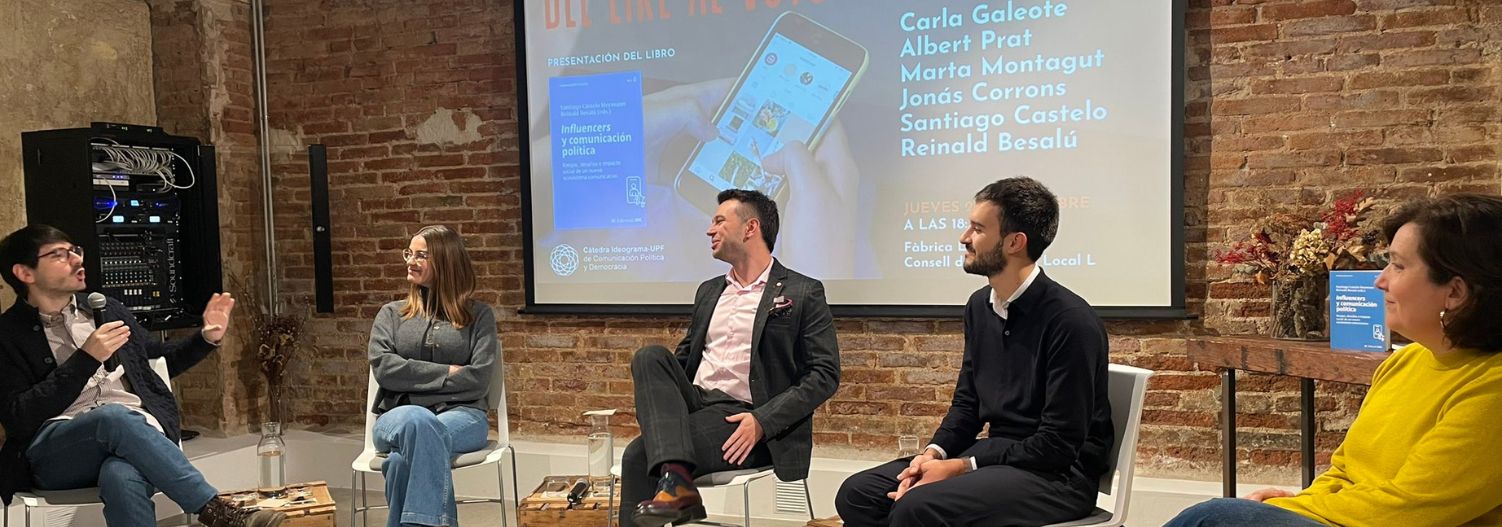
The Ideograma–UPF Chair has published the book Influencers and Political Communication. Traits, Challenges, and Social Impact of a New Communicative Ecosystem, presented at the Lehmann Factory in Barcelona, Ideograma’s headquarters, at the end of November. The book was edited by Reinald Besalú, deputy director of the Chair, and by Santiago Castelo, head of Ideograma. The presentation became a plural and dynamic space for debate to reflect on the role of influencers in contemporary politics, and on the limits and tensions they generate within the media ecosystem.
The event brought together voices from different fields of communication: Santiago Castelo, consultant at Ideograma and one of the book’s coordinators; Carla Galeote, an influencer specializing in political content from a feminist perspective; Albert Prat, a journalist at Catalunya Ràdio with experience as a correspondent at the Congress of Deputies; Marta Montagut, a researcher at URV and author of one of the book’s chapters; and Jonás Corrons, social media advisor to the President of the Generalitat. Before opening the debate, the Chair’s deputy director and book coordinator, Reinald Besalú, gave a brief presentation of the publication, highlighting the need to analyze influencers as new intermediaries in public debate.
One of the central axes of the conversation was the increasingly blurred boundary between journalism, activism, and content creation. The question of whether figures such as Vito Quiles can or cannot be considered journalists and hold press credentials at the Congress served as a starting point to discuss what the rise of these profiles implies for the journalistic profession, the criteria of informational legitimacy, and the quality of public debate.
The success of far-right influencers
The discussion also addressed why influencers linked to the far right tend to achieve greater visibility and virality on digital platforms. Speakers pointed to factors such as the use of emotional language, message simplification, social media algorithms that favor them, and the difficulties progressive-leaning content faces in competing within these formats. In this regard, Carla Galeote shared her personal experience as a content creator with a feminist and progressive outlook, acknowledging the feeling of swimming against the current in an often hostile environment, while asserting the need to maintain digital spaces with critical and rigorous discourse.
Another key debate revolved around the real impact of influencers on political behavior. Despite the strong media and digital resonance of these profiles, participants questioned to what extent they can directly influence voting, or whether their effect is more concentrated on shaping interpretive frames, agendas, and polarization. It was suggested that, although their impact may currently be limited, it is on a growing trend. This reflection opened the door to discussing whether it is necessary to regulate the activity of political influencers, especially with regard to transparency, accountability, and disinformation.
The presentation made clear that the phenomenon of influencers goes beyond what the book covers: it is not only an object of academic study, but an immediate challenge for journalism, institutions, and democracy. With this event, the Ideograma–UPF Chair reaffirmed its commitment to creating spaces for dialogue between research and professional practice in order to better understand a communicative ecosystem undergoing profound transformation.
Below you can find a summary of the book’s chapters:
Chapter I. Evolution, challenges, and potential of the influencer as an intermediary in political communication
Aleix Martí-Danés and Carles Pont Sorribes analyze how influencers have taken over from the classic “opinion leaders” in politics. Their chapter reviews the evolution of models such as the two-step flow of communication and how they are transformed in today’s digital environment. Using the 2024 U.S. presidential campaign as an example, they show that content creators are strategic allies for candidates seeking to connect with young people.
Chapter II. Politicians as celebrities and their relationship with fans
Xavier Peytibi focuses on the “celebritization” of politicians, a phenomenon driven by social media whereby followers become genuine fans of public leaders. The chapter explains how politicians create a sense of closeness through interaction, emulating influencer dynamics, and even suggests that some end up functioning as true digital celebrities. In this context, Peytibi distinguishes three profiles within this new trend of “celebritization” in the public sphere: celebrities who support causes, stars who enter politics, and celebrities who act like stars on social networks.
Chapter III. From star politician to influencer politician
Santiago Castelo Heymann differentiates between the phenomenon of “celebrity-ization” and the process of “celebritization.” In his analysis, he explains how influencers not only exert influence from outside politics, but also integrate into it as activists or even as candidates. Castelo shows how some politicians adopt communicative logics typical of social media to resemble digital creators, with influencers who have become politicians and politicians who play at being influencers.
Chapter IV. Influencer marketing in the institutional sphere: a necessary strategy to reach new audiences
Teresa Ciges explores how influencers are also key partners for public institutions seeking to communicate specific initiatives. In a context where traditional media have lost ground, digital creators bring credibility and closeness to institutional campaigns. The chapter includes a decalogue of best practices for collaborating with them, highlighting the value of micro-influencers, whose specialization and engagement enable public administrations to effectively reach specific population niches.
Chapter V. The effect of influencers on citizen participation: stimulus or obstacle?
Paloma Piqueiras and Mariana Herrera-Capriz open the debate on the real impact of influencers on political participation. On the one hand, they argue that these figures energize digital conversation and stimulate civic engagement. On the other, they warn of the risks in a post-truth context, where disinformation circulates easily. With their amplifying power, influencers can be both drivers of public debate and obstacles to democratic quality.
Chapter VI. Political influencers and disinformation
Marta Montagut and Carlota Moragas Fernández focus on the darker side of influencers: their role in the spread of falsehoods and propaganda. So-called “political social media influencers” (PSMI) become channels of disinformation, often without adequate preparation. Added to this are “pseudo-informers,” who imitate journalistic aesthetics to legitimize their messages. In response, the authors propose measures such as strengthening media literacy and reinforcing audiences’ critical thinking.
Chapter VII. From the “woke virus” to anti-wokeism: the power of language in contemporary polarization
Guadalupe del Valle shows how the rhetoric of influencers and digital leaders has turned the term “woke” into a weapon of polarization. The chapter explains how figures such as Elon Musk have labeled it a “virus,” a discourse replicated by the new right to attack progressive movements. This strategy turns social networks into arenas of cultural battle where influencers amplify divisions. For the author, anti-wokeism exemplifies how language, digitally amplified, can manufacture social confrontation.
Chapter VIII. Influencers of “no”: who fights against climate action?
Ariadna Romans i Torrent examines influencers who spread messages against climate action, from politicians like Donald Trump to YouTubers. These voices question the scientific consensus on climate change, and the author distinguishes three attitudes in response: scientific, ideological, and anthropogenic denialism. She also reveals the simplistic narratives used to sow doubt. With their direct and viral communication, these creators are now a central obstacle in the global fight against climate change.
Chapter IX. Influencers: faces of cultural wars. The case of Taylor Swift
Brenda Silva Romero analyzes how Taylor Swift became a political icon in the 2024 U.S. elections. More than a singer, Swift appears in the book as a genuine political influencer, a symbol for Democrats and a target of attacks by Republicans. The chapter highlights the power of her fan community, the “Swifties,” capable of mobilizing collectively and generating real impact. The artist embodies the union of pop culture, activism, and political influence in the digital age.
Chapter X. Elon Musk: a political leader
Agustina Falak devotes her chapter to Elon Musk, a figure who transcends the business sphere to become an influencer with an ideological agenda. Musk has popularized rejection of the “woke virus” and promotes a kind of “far-right diplomacy,” aligning himself with leaders such as Donald Trump and Javier Milei. The author argues that, beyond his companies, his role fits the definition of a political leader. With millions of followers, Musk positions himself as a global actor who directly influences public opinion.
Chapter XI. YouTubers and misogynistic discourse. The case of Roma Gallardo
David del Pino Díaz focuses on influencers from the so-called “manosphere,” with Roma Gallardo as a case study. He explains how Gallardo’s videos ridicule feminism and downplay gender-based violence, constructing a reactionary narrative that resonates with part of the male audience. Gallardo exploits YouTube’s viral logics to legitimize misogynistic discourse and gain influence, becoming a reference point in a digital space where masculine identity is being reshaped in response to feminist advances.