Disinformation among older adults: the impact of verification on information credibility
Disinformation among older adults: the impact of verification on information credibility
Disinformation among older adults: the impact of verification on information credibility
Analysis of how Spaniards aged over 60 evaluate information credibility, as well as the effect of fact-checking platforms on this segment of the population.
Information credibility is one of the main lines of research of the Ideograma–UPF Chair. Previous studies have consistently shown that older individuals experience greater difficulties in identifying disinformation and, at the same time, are more likely to share disinformation or false news (Besalú et al., 2021; Besalú & Pont-Sorribes, 2020; Pont-Sorribes et al., 2020).
Given that there is a substantial body of research on how younger people use digital media (Bakker & de Vreese, 2011; Casero-Ripollés, 2012; Giraldo-Luque & Fernández-Rovira, 2020; López de Ayala et al., 2020; Pasek et al., 2006), in this study we consider it relevant to focus on the older population, which we refer to here as the senior population. Specifically, this study addresses citizens aged 60 years and older.
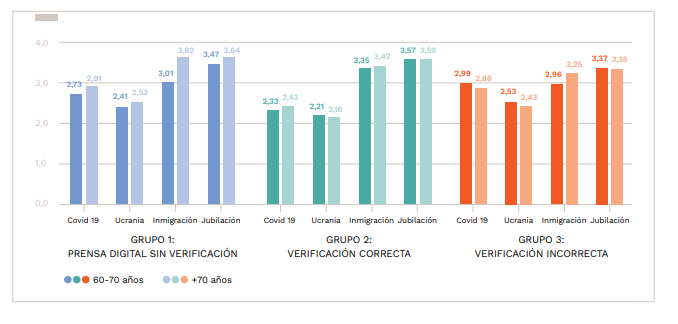
Based on previous research, it has been established that seniors have lower levels of digital navigation skills, feel more disoriented when consuming online news, and are more vulnerable to unverified digital content. One emerging element that has proven useful in combating online disinformation over the past decade is the rise of verification platforms, also known by the Anglicism fact-checkers. Information verification processes carried out by journalists and other specialized professionals have produced an effective tool for debunking hoaxes and disinformative content circulating in the digital sphere, which pose a threat to democratic well-being (Moreno-Gil, Ramon, & Rodríguez-Martínez, 2021; Moreno-Gil, Ramon, & Mauri-Ríos, 2022).
This study brings together all these elements with the aim of analyzing, first, how seniors assess the credibility of digital print news, including both true and false information, whether verified or unverified. Second, it seeks to examine seniors’ awareness of and exposure to fact-checking tools and their impact. Finally, the study aims to contribute valuable insights to address the dissemination of disinformative content affecting this segment of the population.
METHODOLOGY
To carry out this research, we designed a reception study with three symmetrical experimental groups (n = 400). The study was conducted by YouGov Spain during October 2022. Each of the experimental groups was exposed to four news items covering different topics.
The first two news items (Immigration and Retirement) contained true information and were drawn from other media outlets. In contrast, the news items concerning the COVID-19 vaccine and the war in Ukraine were false and were specifically created by the research team. This design allowed us to assess seniors’ accuracy in evaluating the content, as well as the impact of verification labels.
|