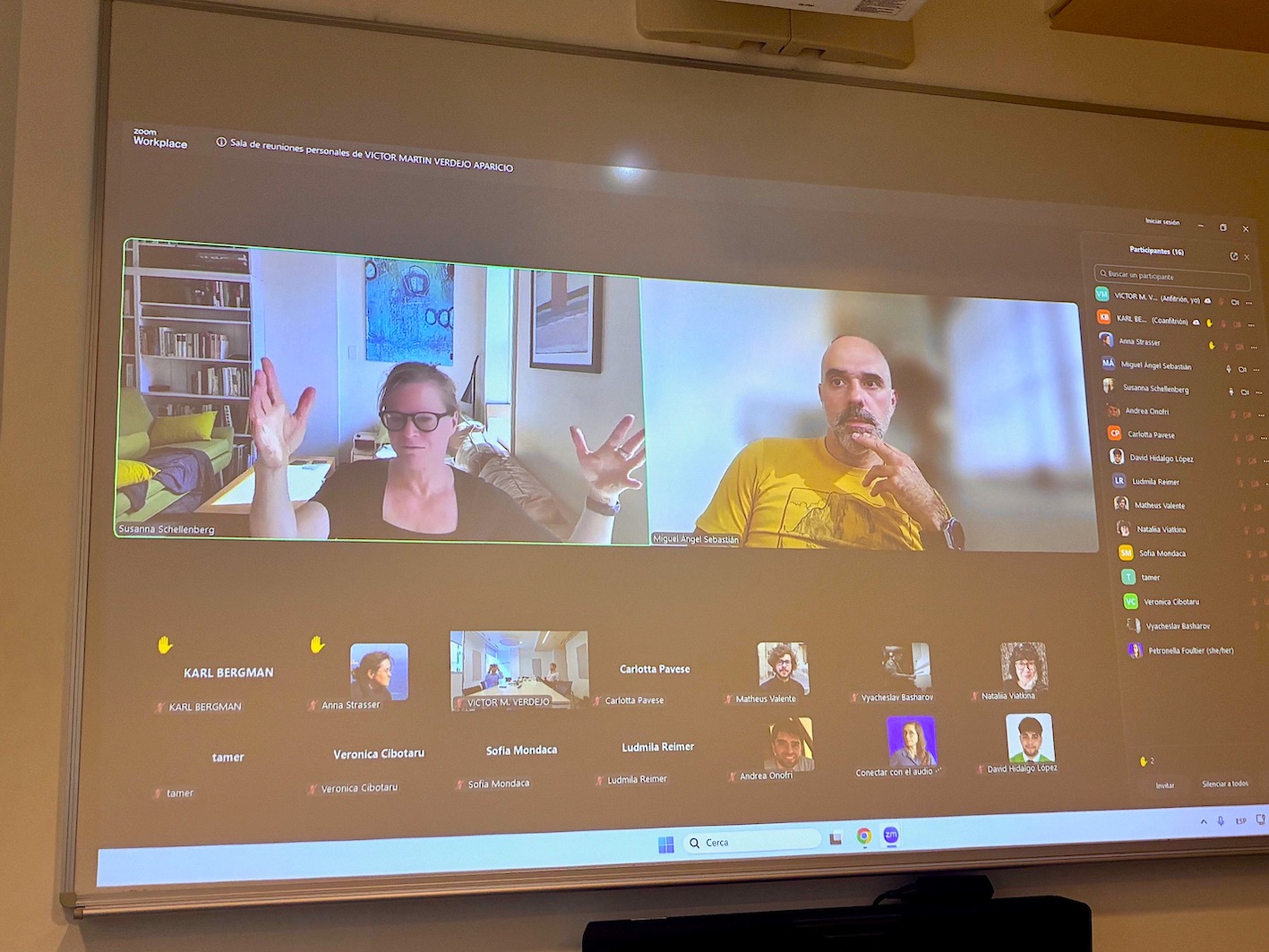
Andrea’s talk concerned a proposal by Mark Richard, to the effect that the meaning of an expression is its interpretative common ground (ICG): A set of presuppositions associated with the word, that any competent speaker of the language must share. Andrea criticized Richard’s proposal, but went on to suggest that shared presuppositions can be modeled through signaling games, where they help to explain how agents converge on shared communication strategies.
An ICG, according to Richard, is a set of presuppositions tied to the use of particular words which are common ground in a linguistic community. Examples include “cousins are children of one’s parents’ siblings,” “the Marquis de Sade was an author,” etc. Understanding of and competence with an expression, argues Richard, requires sharing an ICG with one’s linguistic community. The ICG thus constitutes the meaning of the expression, in at least one sense of this word.
Andrea criticized this view by pointing out that it leads Richard to an implausible account of word identity. According to Richard, two individuals use the same word just in case they associate the same ICG with it. But, Andrea pointed out, individuals can use the same word even if they associate it with very different presupposition, thus do not share the same ICG. Andrea discussed various moves Richard might make in response to this critique, involving relaxation of the proposed requirement of word-identity, but argued that they are unsuccessful.
Another problem with Richard’s view, according to Andrea, is that it is implausible as an account of what it means to understand and be competent with the use of a word. Richard claims that for any word, there is an ICG such that sharing it is necessary for understanding the word. This claim, too, should be rejected—and for the same reasons. Individuals may understand and competently use a word like “arthritis” even if there are no presuppositions they all have in common.
Andrea granted, however, that two ordinary speakers who communicate successfully will share a number of presuppositions, even though they need not share these presuppositions with their broader linguistic community. This could, in turn, help explain the reproduction of communcative strategies. In the last part of his talk, Andrea developed this idea within the framework of evolutionary game theory and, specifically, the theory of signaling games developed by David Lewis and Brian Skyrms. In this theoretical framework, communication is modelled as a coordination problem, wherein a sender and a receiver are trying to coordinate on a communicative strategy.
Carlotta’s talk concerned the notion of general intelligence, of importance to the recent AI debate. She offered a historically conextualized criticism of the influential “g-factor model” of general intelligence and proposed an alternative conception, the profile view.
The “g-factor model,” in outline, proposes that a single, common cause, the g-factor, underlies performance on a range of cognitive tests. The model has its historical origin in attempts to explain observed correlation among individuals’ results on a range of cognitive performance tests. Since it’s original formulation by Charles Spearman, g-factor models have proliferated in psychology and come to shape the scientific and popular understanding of “intelligence.”
Though influential, g-factor models are undersupported by the observed pattern of correlations, and attempts to identify the g-factor in the brain/mind have been inconclusive. An alternative explanation, the sampling model, conceives the mind as a collection of capacities, each of which contributes to performance on only some tests. Godfrey Thomson demonstrated that even if these capacities are independent, they may generate correlations between test scores of the kind observed, provided the overlap in the range of capacities recruited by distinct tests is sufficiently large. Carlotta showed how the modelcan be refined by positing interconnections between the capacities. What results is a picture of the mind as lacking any central g-factor.
G-factor and sampling models both explain the pattern of positive correlations. How to break the tie? Carlotta went on to advance the argument from exclusion and instability against the g-factor models. The argument took the form of a dilemma. On one horn, proponents of g-factor models exclude certain tests from counting as measures of intelligence, e.g. tests of social and practical skills—but this cannot help but seem arbitrary and question-begging. On the second horn, such tests are admitted; but we then no longer get a recognizable g-factor, at least not one that can be plausibly identified with “general intelligence.” The sampling model does not have these problems: It can admit more additional tests, since any resulting covariation pattern simply reflects varying degrees of overlap in the range of capacities recruited by distinct tests.
Carlotta went on to argue that, although the sampling model does not constitute a theory of general intelligence, endorsing it does not thereby means to endorsean error-theory of general intelligence. On her view, general intelligence should be viewed as a profile property, a higher-order capacity that can be realized in different ways by the interaction of underlying and overlapping capacities—in much the same way as white light can be produced by different electromagnetic spectra. Carlotta ended her talk by indicating some initial empirical evidence in favor of this profile view of intelligence.
Susanna’s talk developed an account of self-reference, with the aim of determining whether artifical agents such as LLMs possess this central human capacity. After presenting a detailed characterization and several conditions to address the issue, Susanna concluded with the observation that though LLMs arguably possess limited self-reference, there remains a vast gap between them and humans with regard to the range and flexibility of these capacities.
Here is the abstract for her talk:
Our capacity for self-reference allows us to introspect on our thoughts and preferences, engage in metacognition, and evaluate our progress on projects while reconfiguring our approach as needed. Despite being central to human intelligence, it has received marginal attention in developing artificial intelligence.
There are burgeoning signs of an artificial equivalent of our capacity for self-reference. To illustrate, so-called self-attention mechanisms in Large Language Models, meta-reinforcement learning modules, and second-guessing can each be argued to be examples of artificial self-reference.
However, in each case, the capacity is rigid in scope compared to our human capacity, and it developed as a side effect of pursuing other goals. To date, no explicit attention has been directed at artificially replicating this central element of human intelligence. The paper argues that a general capacity for self-reference is key to bringing AI to the next level.
Discussion
In the Q&A, the discussion centered on the following issues among others: how requiring a strict, identical set of presuppositions is either too strict (excluding speakers who communicate via partial overlap) or too weak (overgenerating identity across unrelated uses); whether communicative success should be modelled in terms of overlapping threads of presuppositions rather than a unified public language; whether a "profile view" of general intelligence better balances statistical data without excluding essential human abilities; and its implications for the general account of Artificial General Intelligence; whether artificial mechanisms (like LLM self-attention) genuinely manifest self-reference or whether human-like self-reference is inextricably bound to self-awareness and conscious experience; as well as the significance of implementation structures and evoling LLM action profiles in determining a capacity for self-reference.
Work produced with the support of a 2025 Leonardo Grant for Scientific Research and Cultural Creation, BBVA Foundation. The Foundation takes no responsibility for the opinions, statements and contents of this project, which are entirely the responsibility of its authors.
We use cookies to deliver personalized content, analyze trends, administer the site, track user movements on the site, and collect demographic information about our user base as a whole. Accept all cookies for the best possible experience on our website or manage your preferences.
Legal notice