How can skilled practitioners coordinate their efforts in joint activities? And, in particular, what cognitive resources do they draw on to accomplish these ends?
Elisabeth Pacherie began her talk by delineating the target notion of skill. Expert skills, she argued, are best understood in terms of domains of interlocked action types, such as those involved in playing a game of tennis. The measure of our skill in some area is, thus, partly a measure of our grasp of the domain’s structure and interrelations. In contrast to habits, skills are heterogeneous, flexible, and subject to cognitive control.
Flexibility, in turn, varies along three dimensions. Strategic sensitivity is sensitivity to the agent’s goals. Situational sensitivity is sensitivity to the action context. Finally, implementation/sensorimotor sensitivity is sensitivity to changes in immediate sensory information.
Yet three factors make skilled joint action more difficult to investigate than skilled individual action: It comes in many varieties, it presents various asymmetries, and it involves more complex cognitive processes.
Skilled joint action may also involve different coordination demands at the different levels of the action-representation hierarchy (strategic, situational, sensorimotor).
Elisabeth ultimately proposes that developing joint-action expertise involves transitioning from reliance on agent-specific predictive models, where oneself and the other partners are each represented separately, to agent-neutral models that abstract from the identity of individual participants. She calls this kind of model PANJAMs: Predictive Agent-Neutral Joint Action Models. She advances three key claims about the significance of PANJAMS decreasing cognitive demand, representational alignment between partners, and dynamic role-allocation by the principle of collective prediction-error minimization.
Hong-Yu Wong gave a big-picture, programmatic talk canvassing possible strategies by which to answer the question whether there are group minds, i.e., whether there are minds belonging not to any individual member of a group, but the group itself. By thinking through this question, Hong Yu argued, we can also think through the questions of what a mind is, whether there are plant minds, whether there are artificial minds, and so on. These questions, he suggests, must be addressed together.
One way of asking the question is: Can there be a generalized theory of mentality that applies to both individuals and groups? There are four general ways of answering this question based on theoretical unity, genus-species relation, reduction to individual minds, or abstraction from groups (the "Hegelian" option). A fifth option is eliminativism: The concept of mind is hopeless and should be abandoned.
These options direct us to the foundational question: What is the mind? One way to approach this is by considering candidate marks of the mental. Hong Yu presented four such candidate marks from the tradition based on self/subjecthood, the notion of intentionality, consciousness, and agency. However, Hong Yu expressed skepticism as to whether the “mark” or “criterion” methodology is an apt method to answer the question of group minds: a list of criteria doesn’t address the question of mindedness, because people will disagree on whether the criteria apply in specific cases.
A more promising strategy is to focus on possible examples of group mindedness, such as insect hiveminds and “wisdom of the crowd” effects, where groups seem to have mind-like causal powers above and beyond those of their members. Joint action also seems subject to special joint commitments, entitlements, and epistemic norms, which give reasons to think that groups are agents and thus have minds.
This puts us in a position to address the titular question: What hangs on whether there are group minds and, more precisely, how to adjudicate the question of whether there are group minds. He discussed four possible basic approaches: functional, biological, phenomenological, and hermeneutic approaches. None of these approaches seem ultimately satisfactory facing problems that include functional sufficiency, biological chauvinism, group phenomenology, and overattribution of mentality.
Having introduced the four approaches and their shortcomings, Hong Yu ended his talk by presenting a trilemma for future inquiry; we either:
Rule in too much
Rule out too much
End up with eliminativism
Any future attempt to find out if there are group minds must avoid this trilemma. Picking one of the criteria discussed above and biting the bullets is dialectically unsatisfying. We need an independent anchor for debate.
Stephan Torre
Stephan Torre’s talk mounted a defense of de se exceptionalism—the view that de se attitudes are necessary or essential to action explanation—in the face of certain objections by Herman Cappelen and Josh Dever.
Stephan began his talk by defining de se attitudes as what we get if we deny either one of the three tenets of the “traditional theory of attitudes”: 1) Binarity: attitudes are binary relations between subjects and contents; 2)Absolutism: Attitude contents vary in truth value at most between different worlds; 3)Shareability: It is possible for different subjects to be related to the same content.
He then went on to define the position of de se exceptionalism, provisionally, as the view that
(AE1) Necessarily, all successful action explanation requires appeal to de se attitudes
Cappelen and Dever have argued that if “necessarily” is read as denoting logical or metaphysical necessity, this is false. Stephan granted this, but went on to argue that de se attitudes nevertheless can play a crucial role in action explanation. This is shown by reflection on so-called Known Distinct Predicament cases, or KDP cases, in which agents have distinct predicaments (e.g., David’s trousers are on fire, Susan’s are not.) leading to distinct actions but share the same overall predicament (e.g., to put out David's trouser fire). KDP cases motivate endorsement of a weakened form of AE1:
(AE2) Our best theory of action explanation requires an appeal to de se attitudes.
Stephan then proceeded to give an argument for this conclusion, on the basis of a further principle about action explanation:
EXPLANATION: If the explanation for why performed an action of type is the fact that has attitudes , then if shares the attitudes then, in the absence of disturbing factors, will also perform an action of type.
From this, we can conclude that de se attitudes are part of the best folk-psychological explanation of KDP cases. AE2 is thus vindicated.
Stephan then went on to discuss Cappelen’s and Dever’s response to arguments of this kind. Cappelen and Dever argue that in KDP cases, things are not equal, because the two agents have different actions available to them. But action types mentioned by EXPLANATION, Stephan argued, should not be understood as individuated in this agent-specific way; and differences in available actions presuppose a difference in de se attitudes, since the agents need to know that they have access to the actions in question; and, finally, such differences in available actions are not plausibly part of the ceteris paribus clause, since they are normal, systematic features of KDP cases.
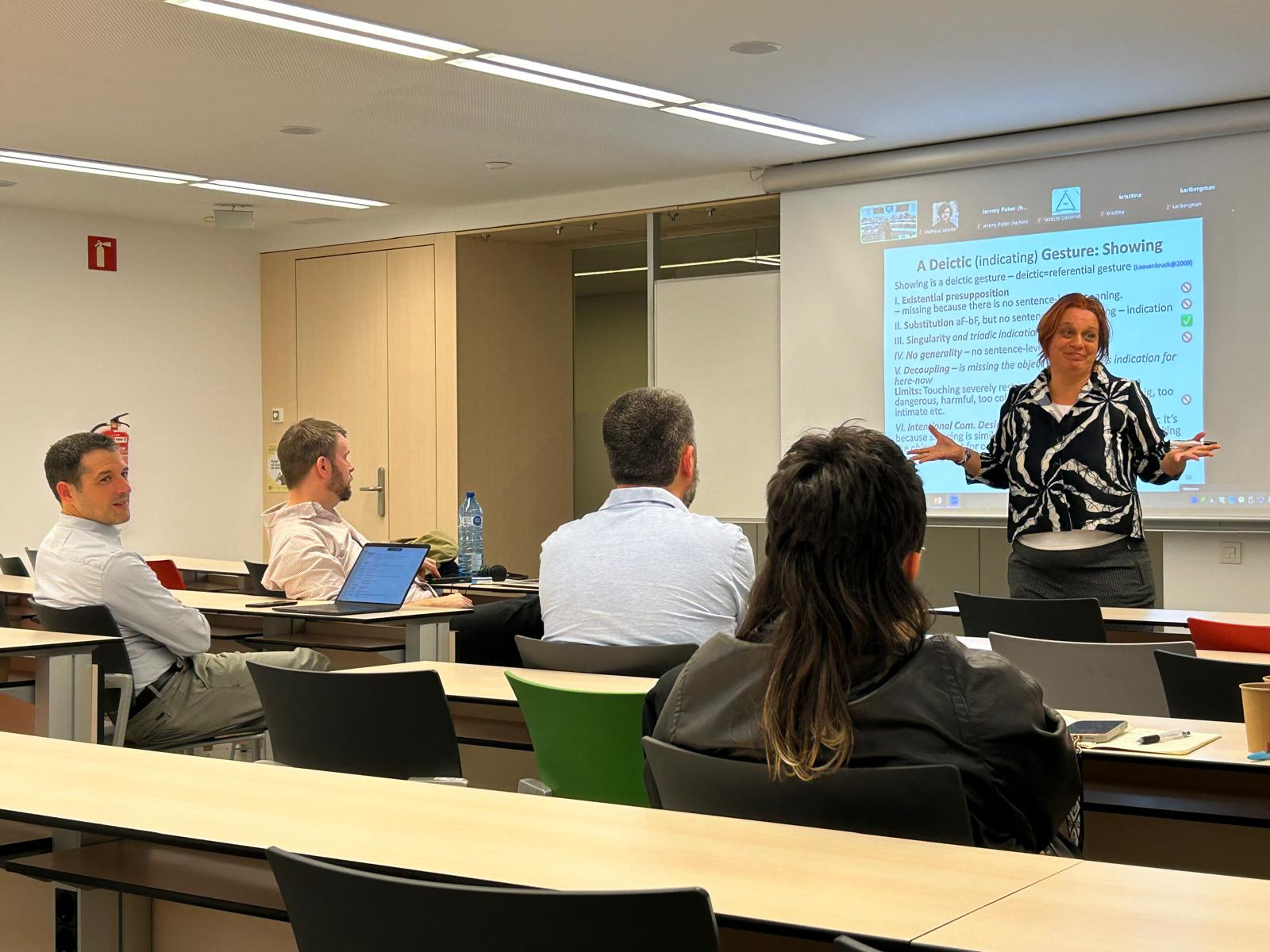
Krisztina Orbán’s talk defended the thesis that referential pointing (R-pointing) is the beginning of referential communication. The literature often considers pointing to be proto-referential, whereas full referential communication is only found in language; but Krisztina argued that R-pointing meets all criteria for full-fledged referential communication and, moreover, that it is the precursor to the more sophisticated referential communication we find in human language.
Krisztina first delineated the requirements for some behavior to count as referential pointing. It requires:
The pointer looks at the object being pointed at.
The index-finger is extended towards the object.
The behavior establishes joint visual/cognitive attention between pointer and spectator.
The result is intentional communication about the indicated object, which, as a minimum, involves:
The pointer checks the receiver response.
Error management takes place.
Infants develop such behavior at 9–15 months. But in what sense is referential pointing, thus characterized, language-like? Krisztina argued that R-pointing and language share a structure of triangulation scaffolded by joint attention. Furthermore, like speech-acts, R-pointing has illocutionary force (imperative and declarative) and sentence-level (propositional) meaning, and is designed to elicit a certain reaction on the part of the spectator.
More specifically, R-pointing has a “subfunction” and a “superfunction.” The subfunction is to indicate a certain object, while the superfunction is to express a certain singular propositional content about this object (“go there”; “this is interesting”).
To support her thesis, Krisztina gave seven criteria for reference (existential generalization, substitution salva veritate, reference-fixing, singularity, intentional design, decoupling, generality) and went on to argue in detail that R-pointing meets all seven criteria. To bring the message home, Krisztina contrasted pointing with showing, which, she argued, does not satisfy the above criteria—except for singularity.
Krisztina ended her talk by giving some reasons to think that pointing is the origin of reference in the hominid line. Among hominids, we have an explosion in material culture which created adaptive pressure to talk about objects. Pointing is well-adapted for this purpose, since it supports shared attention, memory and object organization, and it is particularly apt for the purpose in the hominid line, due to hominid manual dexterity.
The talks prompted discussion on a number of research questions that also brought out their interconnections. Here is a representative list of a debate that will continue in the course of developing the TSA project.
1. What is the kind of approach pursued by each approach (functional, biological, phenomenological, hermeneutic), and what is the role of empirical data in each?
2. How do Predictive Agent-Neutral Joint Action Models (PANJAMs) reduce the cognitive load of individual agents, and how is this compatible with the asymmetries that are usually postulated and are relevant in discussions of de se attitudes?
3. Does the transition from agent-specific models to PANJAMs constitute a "mark of the mental" for the group as a collective subject? How should we understand the relation between the collective and the individual actions?
4. Relatedly, are de se attitudes a prerequisite for an agent to transition into an "agent-neutral" model (PANJAM), or does the PANJAM effectively eliminate the need for de se content?
5. In general, what is the connection between "agent-specific" and "agent-neutral" representation? In a Known Distinct Predicament (KDP), does the "best theory of action explanation" require attributing different PANJAMs to the agents, or just one shared joint-action model?
6. Could we adopt an instrumentalist or pragmatist approach towards the question of "group minds", or "joint action" or would that just be a form of hermeneutics that is fundamentally unsatisfactory?
7. Is the explanatory strategy pursued to demonstrate the requisite de se attitudes also applicable to other forms of cognition (infant, animal) and to AI agents? For instance, does the existence of AI agents require AI de se attitudes?
8. Is referential pointing in a way also a requirement for KDP cases? Do de se attitudes presuppose a more basic self-pointing capacitiy?
9. Can "team reasoning" be explained entirely through the sharing of absolute attitudes, or does it require a unique "de se" attitude belonging to the team as a whole? What is the distinction betwee a shared "I"-phenomenology and a "we"-phenomenology?
10. Do the empirical approaches pursued in accounts of R-pointing (Orbán), PANJAMs (Pacherie), or KDP models (Torre) provide the "independent anchor" needed to adjudicate the existence of group minds and thought sharing more generally?
Work produced with the support of a 2025 Leonardo Grant for Scientific Research and Cultural Creation, BBVA Foundation. The Foundation takes no responsibility for the opinions, statements and contents of this project, which are entirely the responsibility of its authors.
We use cookies to deliver personalized content, analyze trends, administer the site, track user movements on the site, and collect demographic information about our user base as a whole. Accept all cookies for the best possible experience on our website or manage your preferences.
Legal notice