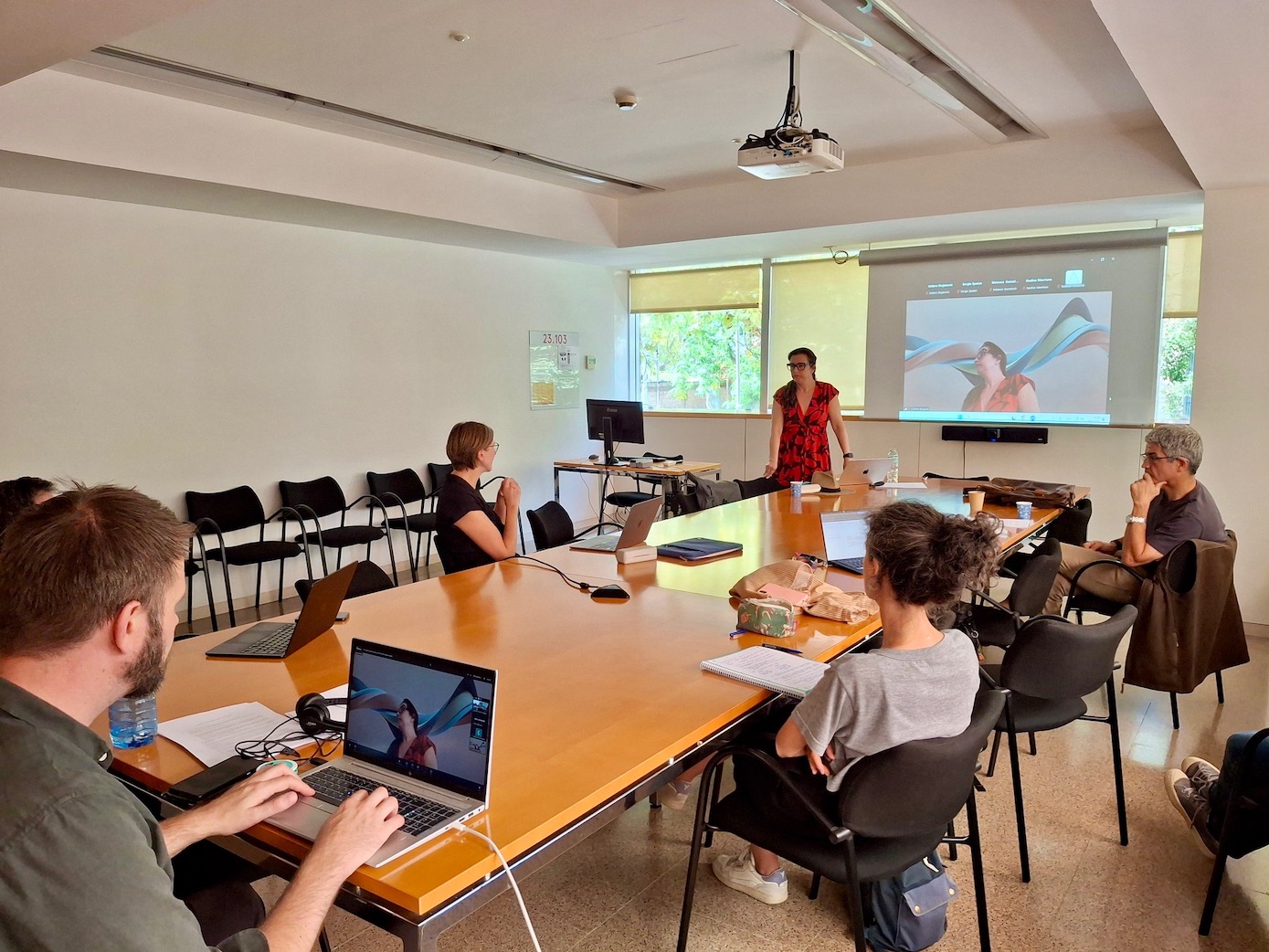
Cristina addressed the origins of communication sharing, a topic related to but also independent of the first-person authority of children. She started out by outlining an intentionalist-normative account of communicative acts. She continued by discussing the onset of the phenomenon via pointing, showing or communicative looks. All this served finally as background to table the question “what is shared in communication?”, and to discuss some tentative answers.
The social-pragmatist system contrasts with the “code model” and takes communicative acts as the basic units in the explanation of communication. Two broad families of approaches here are mentalism, with a focus on Gricean intentionalism, and the social-normative perspective, where communicative acts are thought to create commitments between interlocutors, as noted in developments by Brandom and Geurts.
Gricean approaches rely on communicative intentions to produce a state of mind in one's addressee partly by revealing this intention to them. But this is too demanding from the point of view of pre-linguistic communication. Geurts proposes instead commitment negotiation as the key communicative element, where “communication is coordinated action for action coordination". As an alternative, Cristina proposes a combination of non-Gricean intentionalism and a norm-based understanding of coordinated expectations. According to this view, a communicative act is a socially directed, intentional act guided by a communicative intention understood as a primitive notion, and realised through behaviour whose goal is to fulfil a communicative function as part of a normative communicative practice.
With this basic framework in place, continuity from the onset of communication is to be seen at the level of communicative function and normative structure, not behavioural form, in a range that goes from pointing, showing and giving, to communicative looks at around 6 months of age. Cristina discussed the communicative functions at each stage of development drawing on directive, expressive and constative varieties.
What is then shared in communication? A number of candidates are relevant: attention, subject matter or content, affect or attitude, goal or intention or a normative structure of expectations. At this point, Cristina observed, it is crucial to consider both sharing as sameness and sharing as difference. Communicative acts seem to presuppose shared attention, subject matter, and norms. That is sharing as sameness. However, it is implausible to suppose that there is strict sameness concerning contents, intentions or perspectives. Cristina’s suggestion is that we also share differences in communication in these respects. In communication, “we expect the unexpected.”
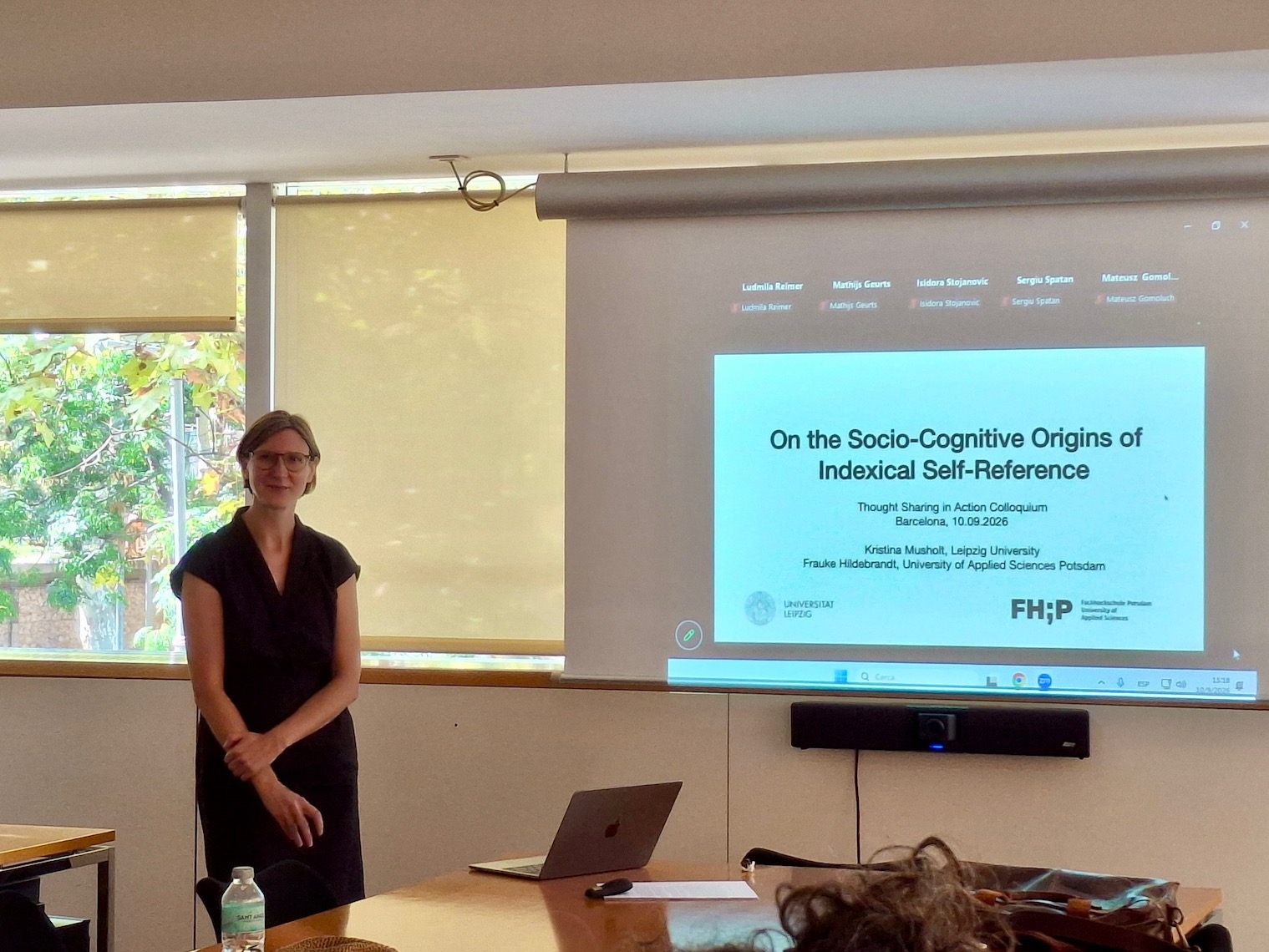
Kristina discussed the socio-cognitive origins of indexical self-reference presenting work co-authored with Frauke Hildebrandt. The background to the talk is an interest in self-consciousness and the role of social interaction for its development, as well as empirical work by Hildebrandt and colleagues on the distinction between feature-based cognition and propositional thinking, itself inspired by the work of Ernst Tugendhat.
According to Kristina, infants' understanding that indexicals can be substituted by one another carries with it an intersubjectively constituted spatial framework allowing the identification of objects as individual tokens. In particular, since two objects can be entirely identical in all discernible features, individuation cannot rely solely on similarity but on their unique spatial (and temporal) position relative to other objects.
How does this line of research extend to self-reference in children? The basic claim Kristina defended is that the full understanding of “I” goes hand in hand with the full understanding of “here” and “there”, with intermediate steps on the way. Drawing on insights from Strawson, Evans, Perry, and Bermúdez, Kristina outlined an account of children’s abilities to refer to themselves as identifiable objects among others. The proposal is that learning to understand the use of the first person involves a shared Intersubjective space which must be distinguished from a more primitive feature-based kind of understanding. On this approach, the listener’s, child perspective is adopted, reflecting the basic trajectory of language acquisition to shed light on the conditions for the possibility of such understanding.
Children initially understand terms as quasi-predicates like “dog” based on similarity of recurring features in the environment. The hypothesis is then that children first use “I” similarly. Kristina spelt out this analogy further and the connection between the use of “I” and that of other expressions such as “he”/“she” or “this”/“that”. These contrasts illustrate how fully understanding “I” involves an intersubjectively constituted spatial framework.
Competence with “here”/“there” is however decisive in both not being feature-based and in exploiting substitutability within a space that defines identity criteria for objects. From this stage on, “I” transitions to being used as a singular term referring to the speaking person. This, Kristina suggests, can also account for the fact that understanding “I” does not depend on the application of any criterion to oneself but on occupying a certain position determined by others: “one is locatable without locating oneself.”
Kristina finished the talk by reflecting on potential extensions to the analysis of “I” and “you”, as well as the kind of (a)symmetries involved, and the fact that, on the account proposed, the shareable character of the capacity to use “I” is a condition on its emergence.
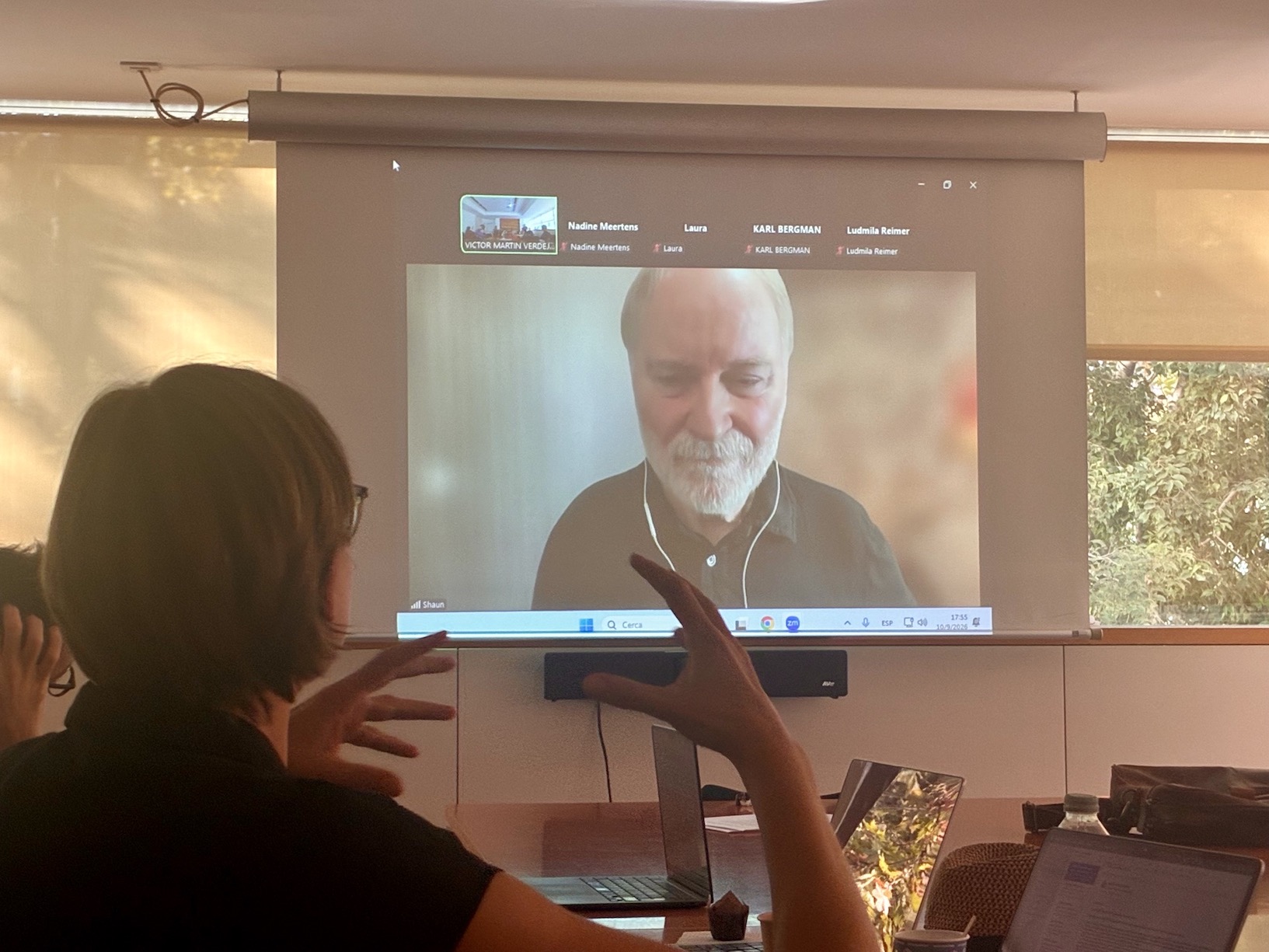
Shaun’s talk concerned how we attribute rationality and subjectivity: the “intentional stance,” in Daniel Dennett’s influential terminology. It reviewed various ideas about the principles according to which such attributions are and should be made, and related these in particular to how we attribute mental states to large language models.
Shaun began by characterizing a “double bias” that tends to accompany our attributions of mental states. This double bias has its source in folk-psychology’s reliance on anthropocentric, and in particular linguistic, markers in attributing mindedness. The implication is that our attributions of consciousness and other forms of mentality to nonhuman animals is “selective and inconsistent”, while we, conversely, tend to over-attribute such states to LLMs. The bias is reflected in the philosophical tradition, which has often construed consciousness as disembodied and aligned with reason and language. It also tends to infect scientific views of mindedness and consciousness.
Theorists like Ned Block have been careful to distinguish rationality and the associated notion of (access) A-consciousness—availability of information for report, reasoning, and control of action—from (phenomenal) P-consciousness or subjectivity. But the intentional stance, under the influence of the double bias, again tends to conflate these, and take capacities associated with A-consciousness as grounds for attributing P-consciousness. An example of this tendency is the use and abuse of “global workspace” models of consciousness. Such models are arguably best understood as models of A-consciousness, but the presence of global workspaces have been taken by some authors as evidence of phenomenal consciousness in, for example, LLMs.
Shaun ended by discussing multi-dimensional or pattern views of consciousness as a possible way to counteract the double bias. On such views, consciousness is conceived as a pattern or constellation of features situated along multiple independent dimensions, such as perceptual richness, synchronic unity, and self-other discrimination. Though Shaun was sympathetic to these efforts, he pointed out that whether such an approach will overcome the double bias depends on which dimensions are acknowledged and how they are weighted against one another. Indeed, as Shaun pointed out, Dennett’s idea of the intentional stance included a focus on patterns from the outset. The challenge going forward, then, is to identify patterns that incorporate a more diverse set of elements, not restricted to markers of discursive rationality as traditionally understood.
José’s paper constituted an attempt to understand and link two classical ideas about self-awareness: Edmund Husserl’s idea of the body as a zero-point for our experience of the world and Ludwig Wittgenstein’s distinction between subjective and objective uses of “I”—and to defend an interpretation of these ideas in terms of self-specifying information.
To understand the two ideas, José first looked to Hume, who famously argued that in introspection, we never perceive a “self” at all. However, as José argued with the help of Sydney Shoemaker, there is a thin sense of “perceiving” on which this claim must be false. This is the sense of adjectival perception, on which to perceive that F(a) ipso facto is to perceive a. To find a true reading, we must distinguish a thicker sense of perception: identifying perception, the form of perception characteristic of perceiving objects. The Husserlian zero-point thesis can then be identified with the claim that we perceive ourselves in a way intermediate between purely adjectival perception and identifying perception.
To further develop this idea, José looked to Wittgenstein’s distinction between subjective and objective uses of “I,” where the former but not the latter are immune to error from misidentification. This distinction, argued José, is grounded in the content of perception itself. Our perception of ourselves as subjects—grounding uses of “I” of the former sort—derives from self-specifying information about the body present in the perceptual input, in propioception, and in our ability to navigate the environment. Such information, José argued, makes possible an experience of the body as a distinctive sort of object, involving no identification and thus immune to errors of misidentification.
However, José raised a worry about the aforementioned account. It may seem that the arguments of Hume, Husserl, and Wittgenstein about the special status of the self in experience concerned, primarily, introspective awareness of sensation, perception, affect, and thought—whereas self-specifying information seems to be present primarily in ground-level perception.
To meet this concern, José sketched an account of introspective awareness of mental states on the model of the “self-intimating” character of bodily sensations. To experience that I have a pain is not a perceptual state over and above the pain itself, and there is thus no room for a special introspective form of the zero-point thesis with regard to such sensations. José then extended this picture to perception: Here, too, there is no consciousness of the perceptual state distinct from the perception itself.
Finally, José extended the picture also to emotions and cognitions. Here, José suggested that we should view such states as, in effect, abstractions from a single multidimensional experiential field, evolving continously in time: the cognitive-affective-perceptual field. Some phenomena supporting this idea include the bodily components of emotions, the complex interplay between emotion and perception, and the importance of verbal expression and imagery to thought.
Discussion
The questions afterwards concerned several key clarifications of the views presented, including the nature and explanatory character of the primitive communicative intentions of infants in communicaiton; the exact senses in which we can consider sameness and differences in infant-adult interactions; the conditions of reference and the intervention of different modalities, quantification, and gender, in feature-based thinking for “I”; the understanding of “I” as involving mental-state attributions that are immune to error through misidentification; and the connection between singular thought and the social dimensions of thought.
As regards consciousness and subjectivity, questions were raised about the biases and illusions in attributing subjectivity and rationality to diverse agents like infants, animals, and AI; the need to better understand the way LLMs work; the comparative limitations of multidimensional models, as well as their normative and pragmatic implications; the significance of limiting cases where one's consciousness or self-awareness is altered or experieced as disembodied; the role of self-specifying information in communication; as well as other forms of non-perceptual awareness, such as agentive awareness.
Work produced with the support of a 2025 Leonardo Grant for Scientific Research and Cultural Creation, BBVA Foundation. The Foundation takes no responsibility for the opinions, statements and contents of this project, which are entirely the responsibility of its authors.
We use cookies to deliver personalized content, analyze trends, administer the site, track user movements on the site, and collect demographic information about our user base as a whole. Accept all cookies for the best possible experience on our website or manage your preferences.
Legal notice