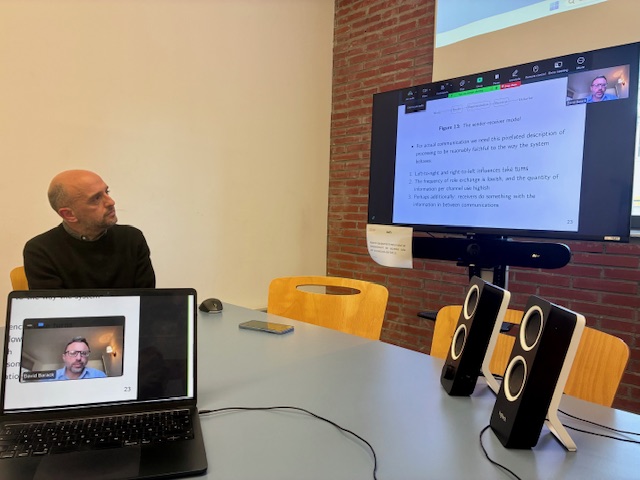
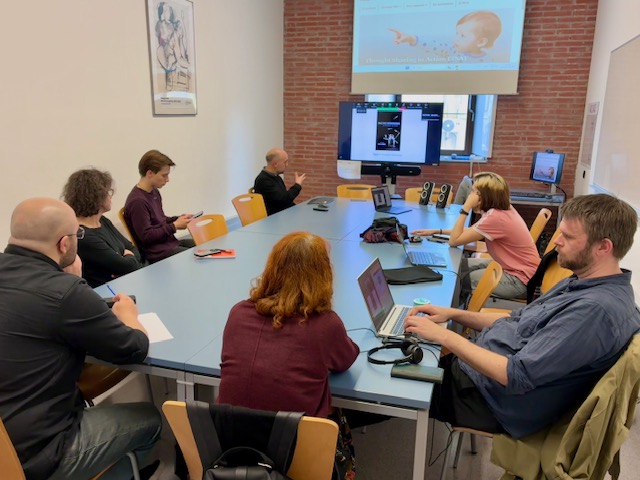
David defended the claim that there is such a thing as Zetetic agency, agency in inquiry, and offered a set of jointly sufficient conditions for such agency.
Inquiry, argued David, is a “temporally extended, goal directed activity aimed at answering a question or understanding some phenomenon.” In activities of this sort, we have agency over what to inquire about, how to inquire about it, and how to take next steps. We exercise this agency by controlling the transitions between representations. Defending the existence of such agency is important, insofar as it provides the basis for an account of the norms of agency. It is, moreover, intuitively plausible: Inquiry seems to be something we do.
David offered a set of jointly sufficient conditions for zetetic agency which included clauses that capture a reasons-responsiveness conception of action: for a move in inquiry to be an exercise of agency, it has to be explained by the agent’s reasons, and had the agent had other reasons, she could have made a different move. Reasons-responsiveness is not sufficient for agency, however, since there are cases of automaticity where the agent draws conclusions “despite themselves”—such as when a modus ponens mechanism is automatically triggered by some premises—which may nevertheless be reasons responsive.
David went on to defend the sufficient condition against certain arguments due to Hilary Kornblith. Kornblith argues that our agency is involved in inference only in the way that the agency of an airport screener is involved in the use of a metal detector, thereby denying that we have the sort of control over our inferential process that is required for agency. In response, David argued that inquiry is sensitive to the decisions of agents in a way the metal detector is not, pointing to the possibility that a given set of premises may lead to different conclusions or to the same conclusion through different routes. In such cases, the relevant difference is explained by the agent’s decisions.
David ended the talk by outlining some implications of his view. His account stands to explain differences in zetetic strategies among agents in wider social contexts. David put an ecological spin on this, comparing different zetetic strategies to the different foraging strategies of animals. In poor epistemic environments, agents may opt for risk-averse “scrounging” strategies, while in rich environments they may instead opt for risk-prone “production” strategies.
Manolo’s talk was an attempt to capture and distinguish two forms of interaction: communication and influence.
While communication is characterized by a leisurely back-and-forth of information, as in a conversation, the paradigm of influence is the sort responsiveness to the other’s actions that you see in competitive
sports, dancing, and similar interactions. In such cases, there is mutual “attunement” but, it seems, no communication. Communication is associated with information, representation and computation, while influence is linked to dynamical systems theory, joint action, and “maximal grip.”
Manolo began the talk by sketching some background ontological assumption. In the study of cognition, we have a number of conceptual tools—memories, language, intentions, maps, representation, motor programs—and the goal of inquiry is to find a set of entities/categories that make cognitive processes as intelligible as possible. These are “leaky abstractions”: They constitute a “pixelated” description of the mind that saves as many phenomena as possible but will inevitably distort or simplify some aspects of it. Most of the abstractions we use do have some application to the mind—“most things exist”—and the question is only what is useful when. The task Manolo set for himself was to answer this question for the case of communication vs influence.
According to a popular model, the “sender-receiver model”, communication consists in two parties, a sender and a receiver, coordinating through the flow of information. This model is great for a lot of things, but not so great if the aim is to tease apart communication and influence. We can show that there is no coordination, and a fortiori no influence, without information flow, so the sender-receiver model collapses influence into a form of communication. More fine-grained abstractions are needed if the two are to be pried apart.
Manolo proposed that we instead understand influence on the model of dynamic coupling. In cases of dynamic coupling, we have short burst of intense information exchange between the two coupled entities, followed by periods of no information exchange at all when the entities are in dynamic equilibrium. In such cases, information flow is not the right abstraction: It happens in very low quantities and very high frequency in both directions. All the information is, as it were, in both systems at once, and everything is “communicated” all the time.
This contrasts with paradigm cases of communication, where left-to-right and right-to-left influences take turns. The frequency of role exchange is low, and the quantity of information transmitted each turn is high. It also seems like receivers do something with the information in between turns, before they assume the role of sender. Communication thus has a “dialogical” character, as opposed to influence where information is transmitted all at once in both directions.
With these abstractions in hand, we may be able to approach anew the debate between representationalism
and 4E. Is influence enough to understand the mind? Is communication enough? Or are they both needed, and if so, when?
In the ensuing discussion, David, Manolo and the audience considered several questions, including whether the process of inquiry is best understood on the model of communication or on the model of influence. In inquiry, are we coupled with the subject matter, or is there a back-and-forth, a “dialog with nature,” perhaps on the model of Jaakko Hintikka’s “information-seeking dialogues”?
Other questions disscussed during the session involved the distinction between inquisitive and other kinds of reasons, the nature and scope of zetetic agency, the possibility of collective or joint zetetic agency, the conditions for collaborative individual inquiry, the experience and neurocognitive character of agency, the distinctive nature and different forms of turn taking at the personal and intentional levels, and the connection to the more classical debates on indexicality, among others.
Work produced with the support of a 2025 Leonardo Grant for Scientific Research and Cultural Creation, BBVA Foundation. The Foundation takes no responsibility for the opinions, statements and contents of this project, which are entirely the responsibility of its authors.
We use cookies to deliver personalized content, analyze trends, administer the site, track user movements on the site, and collect demographic information about our user base as a whole. Accept all cookies for the best possible experience on our website or manage your preferences.
Legal notice