IUC Institut de Cultura
"Aesthetic Ruptures: Revolution and Dissensus in Jacques Rancière and Gianni Vattimo" — III International Workshop with IDSVA. October 23, 2025
"Aesthetic Ruptures: Revolution and Dissensus in Jacques Rancière and Gianni Vattimo" — III International Workshop with IDSVA. October 23, 2025
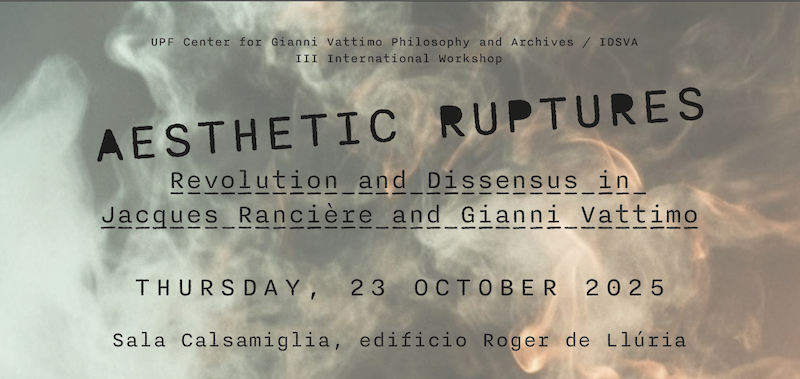
In his unpublished manuscript “Art in the World of Media” (approx. 1960), Gianni Vattimo asserts that aesthetic experience is an experience of truth because it does not put us in front of a harmonious reality, but instead, it forces us to confront a “cracked, conflictual, inherently unstable reality.” Vattimo’s words echo the anxiety hovering over contemporary times. In a context where derangement seems to be the hallmark of the 21st Century, it becomes crucial to learn ways of navigating the present that foster new constellations of collective life. As Jacques Rancière argues, political and artistic practices are, essentially, dissensual practices aimed at reconfiguring the consensual fabric of the real. Unmasking the fiction underlying societal partitions and discursive orders is a necessary step to generate alternative imaginaries. Hence, aesthetics is a modus operandi that is intended to disrupt the status quo. Both Vattimo and Rancière challenge traditional aesthetics, valuing rupture over order, dissensus over consensus, emphasizing the importance of maintaining these tensions alive instead of covering them monolithically.
The goal of this workshop is to explore, interrogate, critique, and amplify these two views on aesthetics within a broader horizon of hermeneutics and references to contemporary crises and states of emergency. The aim is to promote a multifaceted horizon of interpretation whereby it is possible to reconceptualize aesthetics at the core. As Vattimo notes, “a conception of art inspired by ontological-hermeneutic nihilism will also and primarily look at the disseminated aesthetic that is imprinting with itself the world of commodities, information, all collective life.” Aesthetics can no longer solve its problems without philosophy and politics, and “the experience of value as rarity can be given in a mass society only as the experience of a plurality of communities, lifestyles, models.” Politics and art are intertwined because their respective practices are capable of reshaping sensus communis, thus fostering horizons of care necessary to cope with our damaged realities. Tracing cartographies that disclose spaces of resistance and possibility is essential to contrast the frames of precarity that orchestrate and regulate the distribution of the sensible. In order to produce a transformation project for the future, reinterpreting aesthetics is a critical endeavor that goes beyond the artistic sphere, unsettling existing social, political, and artistic regimes to the point of revolution.