
Videos
 What Will Wi-Fi 8 Be?
Driven by the strict requirements of emerging applications, next-generation Wi-Fi is set to prioritize Ultra High Reliability (UHR) above all. In video, we explore the journey towards IEEE 802.11bn UHR, the amendment that will form the basis of Wi-Fi 8.
Integrating Terrestrial and Non-terrestrial Networks: 3D Opportunities and Challenges
In a quest for anything, anytime, anywhere connectivity, next-generation wireless networks are envisioned to break the boundaries of the current ground-focused paradigm and fully embrace aerial and spaceborne communications. In this lecture, we will discuss the key opportunities and challenges arising from such a 3D (r)evolution by presenting some of its disruptive use-cases, reviewing recent results, and pointing to open research problems.
What's the Story with UAV Cellular Communications?
What will it take for UAVs—and the associated ecosystem—to take off? Arguably, ubiquitous high-capacity links paired with hyper-reliable command and control all along. And indeed, meeting these aspirations may entail a full-blown mobile network support. While the understanding of UAV cellular communications has been advancing, many fundamental challenges remain to be addressed, with new applications demanding original solutions. In this talk, we blend academic and industrial views, navigating from 4G to 6G UAV use cases, requirements, and enabling technologies.
Wi-Fi 7: All You Need to Know
As hordes of data-hungry devices challenge its current capabilities, Wi-Fi strikes again with 802.11be, alias Wi-Fi 7. This brand-new amendment promises a (r)evolution of unlicensed wireless connectivity as we know it, unlocking access to gigabit, reliable and low-latency communications, and reinventing manufacturing and social interaction through digital augmentation. More than that, time-sensitive networking protocols are being put forth with the overarching goal of making wireless the new wired. With its standardization process being consolidated, we provide an updated digest of 802.11be essential features, place the spotlight on some of the must-haves for critical and delay-sensitive applications, and illustrate their benefits through standard-compliant simulations.

New preprint “Wi-Fi: Twenty-Five Years and Counting“, 2025.
Abstract—Today, Wi-Fi is over 25 years old. Yet, despite sharing the same branding name, today’s Wi-Fi boasts entirely new capabilities that were not even on the roadmap 25 years ago. This article aims to provide a holistic and comprehensive technical and historical tutorial on Wi-Fi, beginning with IEEE 802.11b (Wi-Fi 1) and looking forward to IEEE 802.11bn (Wi-Fi 8). This is the first tutorial article to span these eight generations. Rather than a generation-by-generation exposition, we describe the key mechanisms that have advanced Wi-Fi. We begin by discussing spectrum allocation and coexistence, and detailing the IEEE 802.11 standardization cycle. Second, we provide an overview of the physical layer and describe key elements that have enabled data rates to increase by over 1,000×. Third, we describe how Wi-Fi Medium Access Control has been enhanced from the original Distributed Coordination Function to now include capabilities spanning from frame aggregation to wideband spectrum access. Fourth, we describe how Wi-Fi 5 first broke the one-user-at-a-time paradigm and introduced multi-user access. Fifth, given the increasing use of mobile, battery-powered devices, we describe Wi-Fi’s energy-saving mechanisms over the generations. Sixth, we discuss how Wi-Fi was enhanced to seamlessly aggregate spectrum across 2.4 GHz, 5 GHz, and 6 GHz bands to improve throughput, reliability, and latency. Finally, we describe how Wi-Fi enables nearby Access Points to coordinate in order to improve performance and efficiency. In the Appendix, we further discuss Wi-Fi developments beyond 802.11bn, including integrated mmWave operations, sensing, security and privacy extensions, and the adoption of AI/ML.
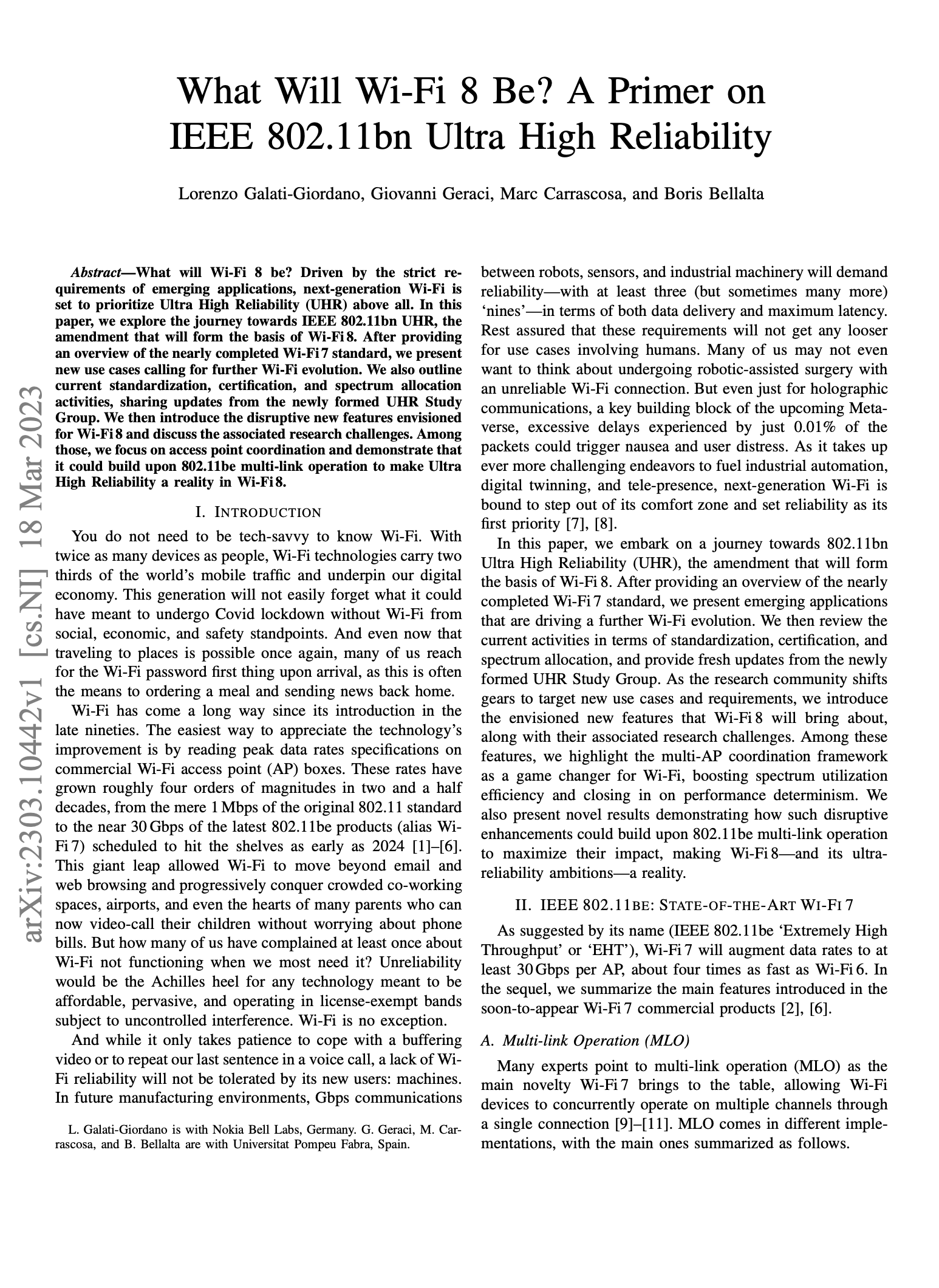
New article “What Will Wi-Fi 8 Be? A Primer on IEEE 802.11bn Ultra High Reliability,” in IEEE Communications Magazine.
Abstract—What will Wi-Fi 8 be? Driven by the strict requirements of emerging applications, next-generation Wi-Fi is set to prioritize Ultra High Reliability (UHR) above all. In this paper, we explore the journey towards IEEE 802.11bn UHR, the amendment that will form the basis of Wi-Fi 8. After providing an overview of the nearly completed Wi-Fi 7 standard, we present new use cases calling for further Wi-Fi evolution. We also outline current standardization, certification, and spectrum allocation activities, sharing updates from the newly formed UHR Study Group. We then introduce the disruptive new features envisioned for Wi-Fi 8 and discuss the associated research challenges. Among those, we focus on access point coordination and demonstrate that it could build upon 802.11be multi-link operation to make Ultra High Reliability a reality in Wi-Fi 8.
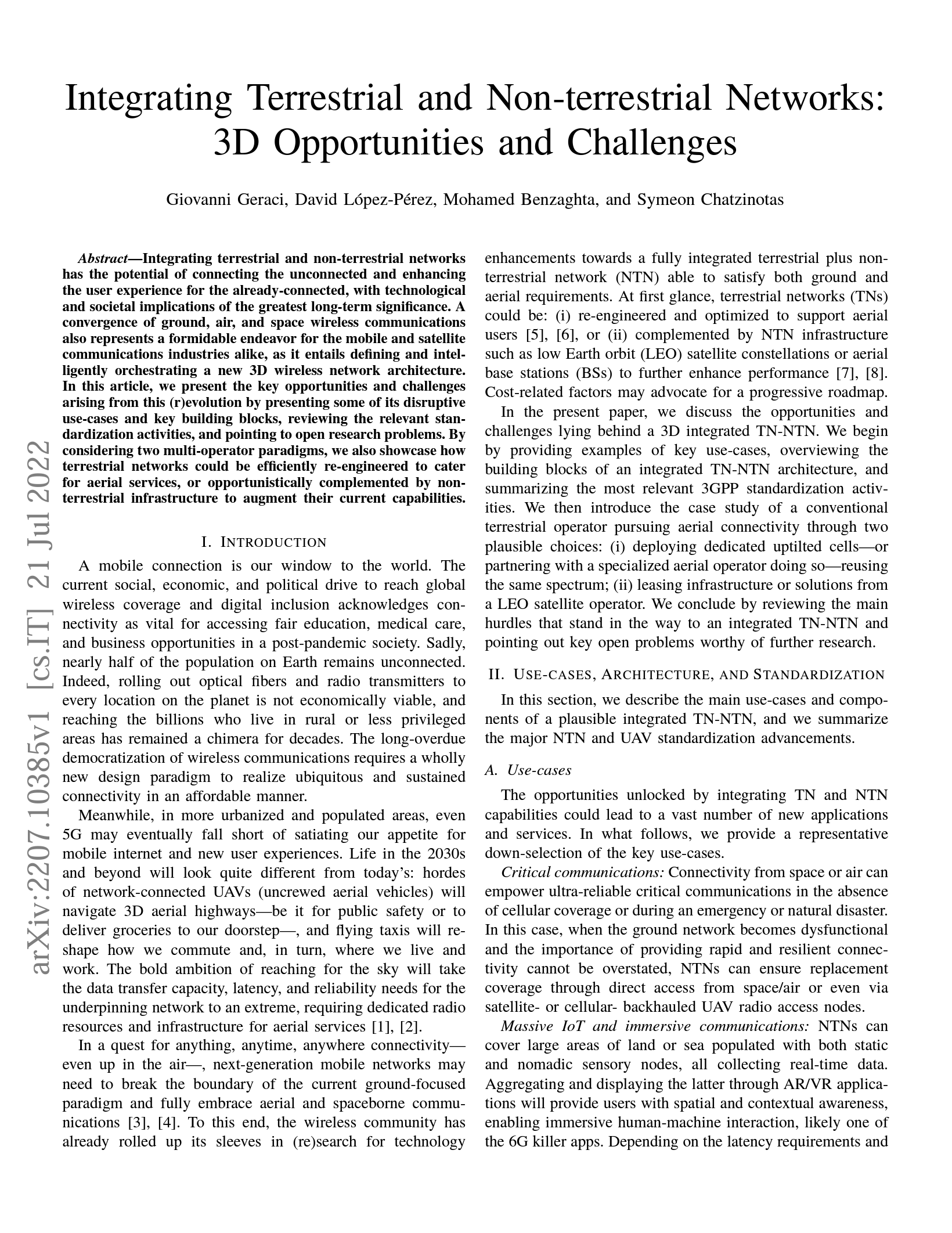
New article “Integrating Terrestrial and Non-terrestrial Networks: 3D Opportunities and Challenges”, in IEEE Communications Magazine.
Abstract—Integrating terrestrial and non-terrestrial networks has the potential of connecting the unconnected and enhancing the user experience for the already-connected, with technological and societal implications of the greatest long-term significance. A convergence of ground, air, and space wireless communications also represents a formidable endeavor for the mobile and satellite communications industries alike, as it entails defining and intelligently orchestrating a new 3D wireless network architecture. In this article, we present the key opportunities and challenges arising from this (r)evolution by presenting some of its disruptive use-cases and key building blocks, reviewing the relevant standardization activities, and pointing to open research problems. By considering two multi-operator paradigms, we also showcase how terrestrial networks could be efficiently re-engineered to cater for aerial services, or opportunistically complemented by nonterrestrial infrastructure to augment their current capabilities.
New article “What Will the Future of UAV Cellular Communications Be? A Flight from 5G to 6G”, in IEEE Communications Surveys and Tutorials, coauthored with:
- Dr. Adrian Garcia-Rodriguez, Ericsson R&D, France
- Dr. Mahdi Azari, University of Luxembourg
- Prof. Angel Lozano, Universitat Pompeu Fabra, Spain
- Dr. Marco Mezzavilla, New York University, USA
- Prof. Symeon Chatzinotas, University of Luxembourg
- Yun Chen, North Carolina State University, USA
- Prof. Sundeep Rangan, New York University, USA
- Prof. Marco Di Renzo, Université Paris-Saclay, France
New book on “UAV Communications for 5G and Beyond” by Wiley – IEEE Press (Dec. 2020), coedited with:
- Prof. Yong Zeng, Southeast University, China
- Prof. Ismail Guvenc, North Carolina State University, USA
- Prof. Rui Zhang, National University of Singapore
- Prof. David W. Matolak, University of South Carolina, USA