
18-02-2026 From Prehistoric PhDs to Computational Modelling in Cardiology. BCN MedTech seminars
18-02-2026 From Prehistoric PhDs to Computational Modelling in Cardiology. BCN MedTech seminars
16.02.2026
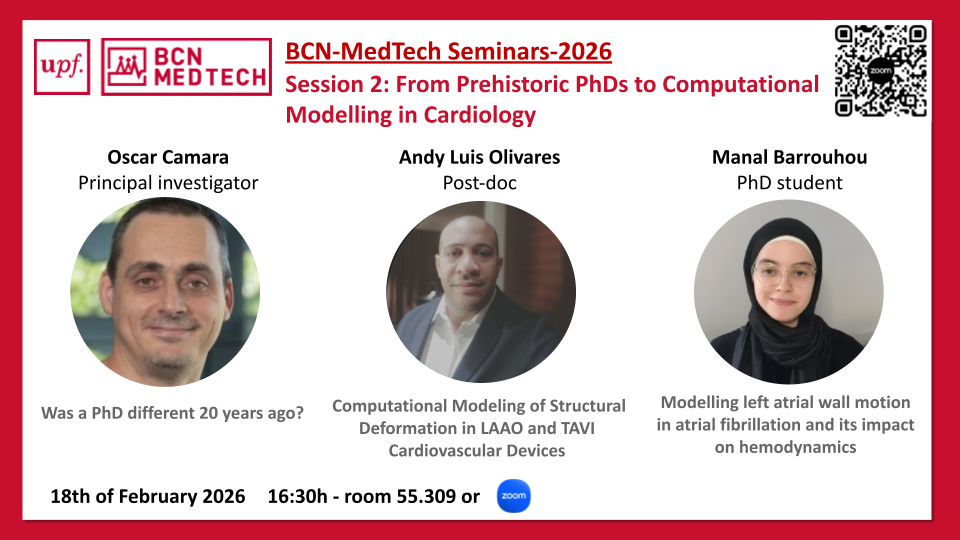
18th February, 16.30 PM. Room: 55.309. BCN MedTech seminars
Title: From Prehistoric PhDs to Computational Modelling in Cardiology
- Oscar Camara: Was a PhD different 20 years ago?
- Abstract: I did an industrial doctorate from 2000 to 2003 at ENST Paris, in collaboration with an SME called Segami SARL, on non-rigid registration of thoracic and abdominal CT and PET images. It was quite a different period compared to today, which seems almost prehistoric when you realise what boring PhD researchers can do now in the defence of a colleague making memes with Nano Banana. Still, I reckon there are a lot of common issues that are still valid, from the awful financial situation, the eternal imposter syndrome, the need for support from lab colleagues, the friendships that will always last, the challenge of getting clinical data and interacting with physicians, and so on. In this talk, I'll share my personal thoughts comparing the PhD journey from 20 years ago.
- Abstract: I did an industrial doctorate from 2000 to 2003 at ENST Paris, in collaboration with an SME called Segami SARL, on non-rigid registration of thoracic and abdominal CT and PET images. It was quite a different period compared to today, which seems almost prehistoric when you realise what boring PhD researchers can do now in the defence of a colleague making memes with Nano Banana. Still, I reckon there are a lot of common issues that are still valid, from the awful financial situation, the eternal imposter syndrome, the need for support from lab colleagues, the friendships that will always last, the challenge of getting clinical data and interacting with physicians, and so on. In this talk, I'll share my personal thoughts comparing the PhD journey from 20 years ago.
- Andy L. Olivares: Computational Modeling of Structural Deformation in LAAO and TAVI Cardiovascular Devices
- Abstract: Transcatheter cardiovascular interventions, including Left Atrial Appendage Occlusion (LAAO) and Transcatheter Aortic Valve Implantation (TAVI), involve complex mechanical interactions between self-expandable devices and highly variable patient-specific anatomies. Device deformation during deployment critically affects anchoring, sealing, and long-term performance, yet it remains difficult to assess using imaging alone. This study presents a preliminary finite element model to evaluate deformation and device–tissue interaction in LAAO and TAVI procedures, with the objective of supporting the pre-procedural planning.
- Abstract: Transcatheter cardiovascular interventions, including Left Atrial Appendage Occlusion (LAAO) and Transcatheter Aortic Valve Implantation (TAVI), involve complex mechanical interactions between self-expandable devices and highly variable patient-specific anatomies. Device deformation during deployment critically affects anchoring, sealing, and long-term performance, yet it remains difficult to assess using imaging alone. This study presents a preliminary finite element model to evaluate deformation and device–tissue interaction in LAAO and TAVI procedures, with the objective of supporting the pre-procedural planning.
- Manal Barrouhou: Modelling left atrial wall motion in atrial fibrillation and its impact on hemodynamics.
- Abstract: Atrial fibrillation induces abnormal left atrial mechanics and blood flow, contributing to thrombus formation in the left atrial appendage and an increased risk of stroke. Computational modelling of left atrial hemodynamics offers a powerful framework to investigate these mechanisms; however, its accuracy critically depends on a realistic representation of atrial wall motion. This seminar presents ongoing research focused on modelling left atrial wall motion in atrial fibrillation using different imaging modalities and assessing its impact on left atrial hemodynamics. The robustness of the proposed modelling pipeline is evaluated through validation against experimental data obtained from in-vitro phantom models, including both rigid and dynamic configurations. This work aims to improve the reliability of atrial hemodynamic simulations and support future applications in stroke risk assessment and interventional planning.