
Participatory Audiovisual Methodology and educational commons: the doctoral thesis of María José Palacios-Esparza at JOVIS
Participatory Audiovisual Methodology and educational commons: the doctoral thesis of María José Palacios-Esparza at JOVIS
Participatory Audiovisual Methodology and educational commons: the doctoral thesis of María José Palacios-Esparza at JOVIS
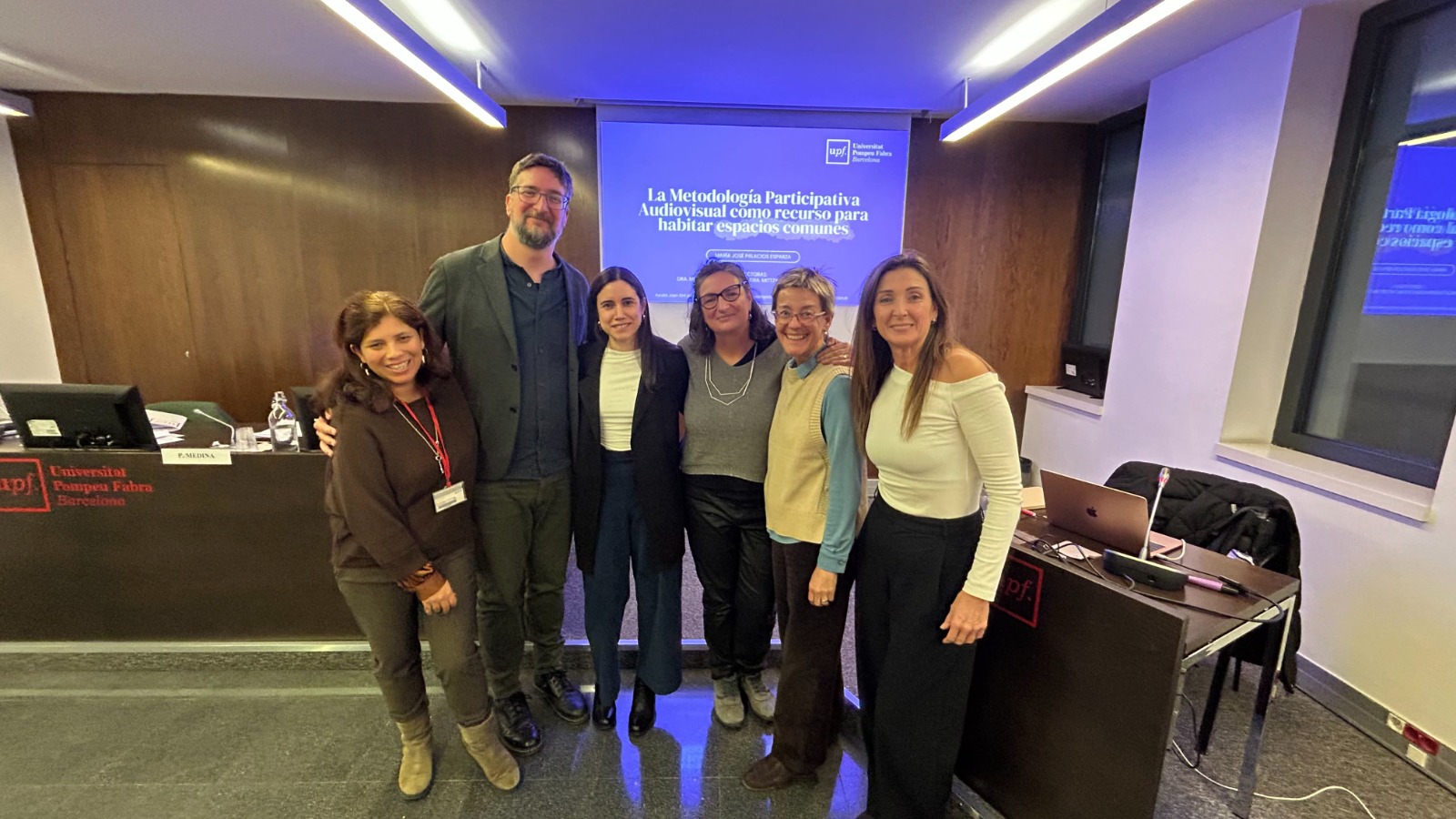
María José Palacios-Esparza, researcher at the JOVIS group, has defended in Spanish her article-based doctoral thesis “La Metodologia Participativa Audiovisual como recurso para habitar espacios comunes” at the Poblenou campus of Universitat Pompeu Fabra. The study is part of the European project Smooth Educational Spaces. Passing through Enclosures and Reversing Inequalities through Educational Commons (SMOOTH), conducted in Barcelona’s Raval neighbourhood with young people who took part in workshops across two phases (2022 and 2023), combining ethnographic work, participatory action research and feminist methodologies.
The thesis investigates the potential of Participatory Audiovisual Methodology (PAM) to activate educational commons and rethink the role of educators. Drawing on five publications, the work shows how narrative productions and photovoice, adapted to the audiovisual language, enabled young participants to connect their personal experiences with broader structures of inequality. The process unfolded through different thematic rounds —for instance, focusing on the future, bullying, or intensive use of platforms such as TikTok— that involved topic discussion, collective story-building, the production of audiovisual pieces, and their public screening within the community.
Among its findings, Palacios-Esparza identifies the consolidation of spaces for critical reflection and community belonging, as well as peer-governance and youth self-organisation, where adult mediation is intentionally reduced to give prominence to young people’s own decisions. PAM emerges as a methodology that simultaneously opens spaces for collective reflection, self-management through convivial tools, and the revision of educational practices among both young people and educators, while making visible the tensions of a system shaped by adultcentrism.
The thesis emphasizes that working with audiovisual media is not only about generating content; it can also become a way to reframe audiovisuals as tools of the commons, from which to question norms, negotiate conflicts, and challenge traditional hierarchies. In this sense, the study argues for creating contexts that encourage dialogue, the confrontation of ideas, and self-organisation based on young people’s interests, positioning them as political and epistemic subjects.
The research was supported by the FI 2022 grant from the Catalan Agency for the Management of University and Research Grants (AGAUR) and is linked to the European SMOOTH project, funded by the European Union’s Horizon 2020 programme. During the defense, the committee formed by Dr Pilar Medina-Bravo (chair, Universitat Pompeu Fabra), Dr José Miguel Tomasena (secretary, University of Barcelona) and Dr Beatriz Gallego Noche (member, University of Cádiz) highlighted the dialogue between Latin American communication traditions and commons studies, the articulation of critical theory and collaborative practice, and the rigor and sensitivity with which the thesis addresses adultcentrism and power relations between adults and young people.