Would you like to share workspaces with other European universities?: discover EUTOPIA’s opportunities for PTGAS
Would you like to share workspaces with other European universities?: discover EUTOPIA’s opportunities for PTGAS
Would you like to share workspaces with other European universities?: discover EUTOPIA’s opportunities for PTGAS
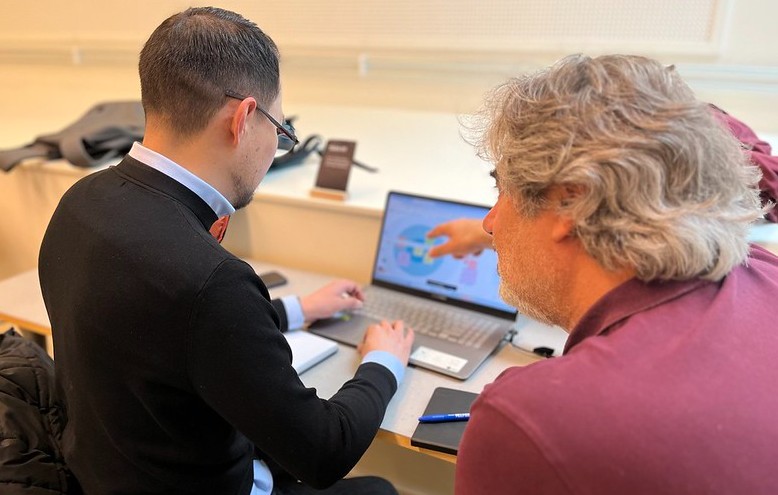
The EUTOPIA Alliance is an innovative project to create a European knowledge community, which generates spaces for meeting and interrelating among the communities of a dozen universities in different countries, including UPF. The Alliance also has a transformative spirit, as it aims to foster changes and improvements within university environments based on the synergies established between its members. All groups of the university community can participate in the Alliance: students, teaching and research staff and also the Technical, Management and Administration and Service Staff (PTGAS).
This initiative provides PTGAS with the opportunity to participate actively in various working groups (see the list of working groups at the end), collaborating in university improvement and innovation projects, whereby the network of professional contacts can also be developed and expanded. In this report, we will find out about the experiences of several members of the UPF PTGAS who have already been involved in the Alliance since its creation in 2018.


Lluïsa Rojas, head of the UPF Equality and Diversity Unit: “The fact that we work in the same university environment allows us to see that all universities have similar problems and we can take home good examples from the mistakes and successes of others”
One of them is Lluïsa Rojas, head of the UPF Equality and Diversity Unit. Lluïsa has followed online EUTOPIA meetings related to gender and diversity issues since 2021 and, on 10 November, she participated in the organization of Eutopia Day at UPF. In 2025, the conference was devoted to diversity in the university environment and the Equality and Diversity Unit was involved in the design of the workshops held there.
More recently, at the beginning of 2026, she participated in a EUTOPIA conference on ethical criteria and power relations in university environments, entitled “Navigating power and ethics: preventing and responding to transgressions in a university alliance”, which was hosted by Ca’Foscari University of Venice on 22 and 23 January.
After participating, Rojas has the following words of appraisal of the meeting: “It was an interesting joint reflection on the abuse of power and harassment in a university setting and how they can be addressed. The legal frameworks of the different member universities differ greatly and this does not allow us to reach a single formula for all, but, in any case, we concluded that there is a very high reputational risk for our institutions if we do not act against transgressions in coexistence and that a good balance must be found between punishing offenders and reparations for those affected”.
For Rojas, spaces like these for sharing experiences are also a good source of learning. “The fact that we work in the same university environment allows us to see that all universities have similar problems and we can take home good examples from the mistakes and successes of others”, she explains.
During the Venice conference, Rojas was especially interested to hear about good practices from other universities on the reparation of victims of discrimination. Indeed, UPF is working on updating its protocol on the subject, which will incorporate the concept of reparation for the first time. To tackle this and other challenges of the University, “taking from good practices can be a good work tool that helps to advance in equality, diversity and inclusion”, she concludes.

Another UPF professional involved in the EUTOPIA Alliance, also a member of the University’s PTGAS, is Xavier Martínez Granell. At UPF, he is in charge of the Management and Administration Unit (UGA) for Economics and Business; and, in EUTOPIA, he is sits on a board that provides the perspective of the workers of the member universities to the Alliance’s strategy. This is the Faculty and Staff Council, which advises the Alliance on various issues, especially on the implementation of education, research and innovation actions and the development of collaborative services.
The Council was set up three years ago and its members are currently appointed by the rectors of each member university. Each institution appoints three members, including both academic staff and representatives of administrative services. Xavier Martínez Granell was appointed as a member of this body in May 2023, which also includes UPF professors Josep Capdeferro (Faculty of Law) and Ana Janic (Faculty of Medicine and Life Sciences).
The Council met for the first time during EUTOPIA Week in Lisbon (June 2023) and, since then, its members have held at least two meetings a year. EUTOPIA Weeks are biannual meeting spaces where the representatives of the member universities take stock of the actions undertaken and discuss future lines of action. Indeed, in 2026, one of the two scheduled EUTOPIA Weeks will take place at UPF, in Barcelona, from 23 to 27 November. It will be at this meeting that the final appraisal of the strategic programme of the EUTOPIA-More Alliance (2023-2026), which has been coordinated by UPF, will be made and the new project of the Alliance for the next two years (2027-2028), for which EU funding will be sought, will be dealt with.
From his experience in EUTOPIA, Xavier says: “Mobility between universities of the Alliance complements other mobility opportunities for PTGAS, with the advantage of not having to ‘cold call’ because the contacts are already made. Participating in the EUTOPIA representative bodies and working groups is also a form of mobility and a way to escape the everyday environment. It serves to learn new things, but sometimes it also serves to confirm that the difficulties you commonly experience are not unique to you, or here, and that you are doing things as best you can”.
For Xavier, these spaces for exchange also useful to reinforce dialogue skills: “We have to learn that it is ideas that are discussed, not people. If the idea you propose is not approved, it is not a failure and you should not feel personally questioned: we move forward and discuss another proposal”, he assures.

Eva Martín, director of the UPF Research Service, currently heavily involved in the development of the Eutopia Health initiative (2024-2029) has also learned a great deal from the EUTOPIA Alliance. Its goal is to promote collaboration in health research, from an interdisciplinary perspective, mainly with researchers from EUTOPIA universities located in growing countries (University of Ljubljana, in Slovenia; NOVA University Lisbon, in Portugal; and Babeș-Bolyai University, in Romania).
Within the framework of the initiative, UPF leads a working group to promote researcher mobility and manage a call for grants to fund collaborative projects led by universities in growing countries, with the participation of the rest of the Alliance’s centres. EUTOPIA Health has also organized Hackathons to seek joint responses to shared challenges in health, and has provided training for university researchers in this field, among other activities.

Prior to EUTOPIA health, Martín had already been involved in another research initiative, funded by the European Horizon 2020 programme. It was EUTOPIA TRAIN (2021-2023), which aimed to promote shared collaboration tools in research and transfer among the six founding universities of the alliance, including UPF. “We wanted to define a framework to create a virtual office of shared projects for major Horizon Europe calls that the European Commission itself identified as a good practice”, Martín recalls. The project also sought to promote open science, to facilitate free access to data and research results, which also involved the UPF Library/CRAI.
As a result of these and other experiences in the Alliance -she has also participated in several Eutopia Weeks and other research-related activities-, Eva has learned a lot. For example, she has identified good practices at other universities, which could inspire new initiatives at UPF, for example in the field of participation, research data management or in citizen science issues. Eva adds that participating in EUTOPIA has given her new professional perspectives: “it has allowed me look at something other than the day to day at UPF to understand how science is managed in very diverse ecosystems. I have learned that despite differences in legislation, challenges and difficulties are universal. In addition, it has served as a live laboratory of good practices, which has allowed me to compare how participation in ERC grants is managed by different universities and this has been an asset to improve our internal processes and also enforce them”.
In a more personal light, Martín highlights the intercultural nature of the Alliance: “managing projects in which ten different work cultures converge teaches you to listen more and find creative consensuses”. Above all it is “a network of European colleagues who have become allies, a community of professionals who help each other and who can be resorted to when necessary”. “Personally, it has been enriching and I have fond memories of it”, adds Eva, who does not hesitate to recommend the experience to her colleagues at UPF: “Although it is often seen as extra work, I recommend participating in EUTOPIA because it is a good investment in your own professional assets: you learn, interrelate and grow”.
Which EUTOPIA working groups can PTGAS get involved in?
If you are a member of the PTGAS and you would like to get involved in EUTOPIA, you can find out which Alliance working groups you could participate in in the table below.
|
Working group |
Objectives |
|
Equality and diversity |
To promote diversity and inclusion throughout the EUTOPIA Alliance, based on establishing good practices shared among the member universities, foster an academic and professional environment that contributes to creating a culture of respect and collaboration for the benefit of students, staff and the university community as a whole. |
|
Mobility |
To facilitate international mobility and exchanges within the EUTOPIA Alliance, promoting transnational collaboration, global learning and the exchange of knowledge and good practices between universities. |
|
Impact |
To promote and enhance the impact of university activity within the entire EUTOPIA Alliance. The group reflects on the meaning of impact, establishes strategies and mechanisms to disseminate the results, and promotes collaborations with other universities, companies and social actors to maximize the relevance and usefulness of the project’s outcomes. |
|
Responsible internationalization |
To promote responsible internationalization throughout the EUTOPIA Alliance, based on integrating international, intercultural and global dimensions in all university areas and ethical and sustainable practices that encourage collaboration with partner universities, companies, social actors and public institutions.
The group has organized several thematic workshops and a Summit in Brussels to discuss good practices, share experiences and guide the Alliance towards more ethical, reflective and beneficial global cooperation for the entire university community. |
|
Human resources |
Jointly to manage talent, mobility and wellbeing within all EUTOPIA member universities, and create opportunities for collaboration, develop skills and a positive and inclusive work environment. |
|
Community on the practice of microcredentials and the recognition of learning
|
To discuss and develop opportunities for the recognition of activities throughout the EUTOPIA Alliance, based on establishing a common framework that allows certifying the skills and experiences of students and staff in a flexible and internationally recognized manner.
This group is working on the implementation of the EUTOPIA Label and the EUTOPIA Microcredentials, with the aim of creating common standards, fostering mobility and cross-cutting learning among partner universities and ensuring that academic and training efforts are visible and valued inside and outside the Alliance. |
|
Technology and knowledge transfer |
To promote the transfer of technology and knowledge within the EUTOPIA Alliance, to transform academic research into real and socially relevant impact. The group gathers technology transfer professionals, researchers and institutional stakeholders to establish common practices, address ethical and operational challenges, and foster collaboration with local and global players.
In 2025, two workshops were organized at Ca’Foscari University to discuss good practices, share experiences and reinforce a responsible and participatory approach to knowledge transfer. |
|
Digitalization |
To develop and implement shared digital services and tools across the EUTOPIA Alliance, to support partners’ projects and initiatives, as well as the needs of students, staff and society.
Within this framework, the Digitalisation Incubator call has been launched. This initiative invites students, academic and administrative staff to prototype and implement innovative digital tools for all partner universities, and promote collaboration, interoperability and the impact of digital solutions in the European environment. |
|
Communication |
The communication working group is responsible for promoting joint outreach actions of the different universities of EUTOPIA to publicize the activities of the alliance as a whole. It also serves to amplify the dissemination of the activities of each of the member universities, especially in relation to EUTOPIA or other European projects, among the other members of the alliance. Likewise, the group coordinates the Alliance’s communication, image and visibility strategies in digital channels or on the campuses of the different member universities, among other functions. |
Further information and contact of the EUTOPIA Office at UPF
Here you can find more detailed information about all the working groups. If there is an area that interests you, you can contact the UPF EUTOPIA Office at [email protected] where they will help you get involved in the project in the area that interests you most.