
Centre for Studies on Planetary Wellbeing

Centre for Studies on Planetary Wellbeing
Pompeu Fabra University

Would you like to stay updated on all of our activities?
Sign up here to receive our monthly Newsletter!
The Centre for Studies on Planetary Wellbeing at Universitat Pompeu Fabra (Centre de Estudis sobre Benestar Planetari) stems from the Institutional Initiative on Planetary Wellbeing promoted by the former Rector Jaume Casals.
The Centre functions as a catalyst for people who are interested in themes related to Planetary Wellbeing within UPF. We envision that through dialogue and continuous exchange of ideas, new opportunities will arise, in the form of collaborative research proposals, proof-of-concepts, creation of networks, artistic performances, etc.
The Centre embodies UPF's efforts to implement environmental stewardship into society and education. The Centre will convey and accelerate UPF's commitment to the SDGs and its institutional transformation, to respond effectively to the challenges of imagination, knowledge and social and political action posed by the climate and biodiversity crisis.
Contact: [email protected]
Social media:
- Instagram: @upfplanetary
Do you want to receive our monthly Newsletter? Sign up here!
Where to find us? Mercè Rodoreda building (Ciutadella campus), Ramon Trias Fargas, 25-27, 08005 Barcelona
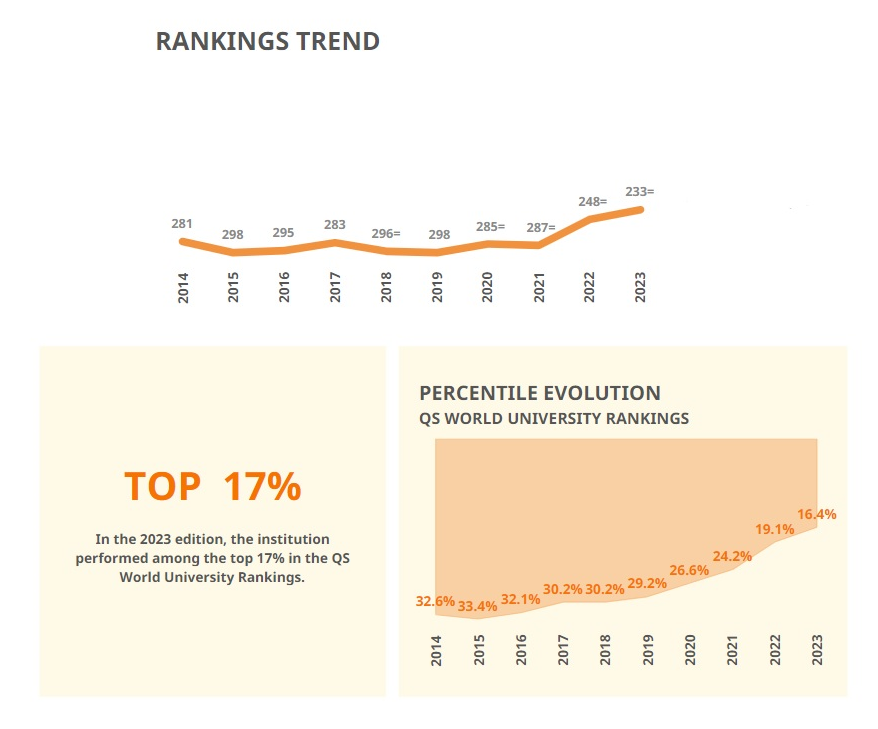
UPF comes 233rd in the world in the QS ranking, the best since the classification was created, consolidating its position after climbing 54 places in the last two years
UPF comes 233rd in the world in the QS ranking, the best since the classification was created, consolidating its position after climbing 54 places in the last two years
Among the indicators analysed, UPF stands out especially for citations, coming 60th in the world, followed by the percentage of international faculty and academic reputation.

QS Quacquarelli Symonds has recently published the 2023 edition of the QS World University Rankings, one of the most consulted university rankings in the world, which puts UPF in 233rd position overall, an improvement of 15 places over the previous year, and of 54 over the last two years, and in 97th place in Europe, 10 higher than last year. This is the best result ever achieved by the University in this ranking.
Since 2012, Pompeu Fabra University has oscillated between 280th and 300th position. It has now made a leap forward and has managed to position itself among the top 240 institutions in the world, consolidating its upward trend begun last year when it entered the top 250 for the first time. Also, the institution has come in the top 17% of the institutions listed, improving progressively since 2014 (within the top 32.6%), then 29.2% (2019) and 19.1% (2022).
Oriol Amat, UPF rector, offers a most positive appraisal of the achievement: “We are most satisfied with UPF’s evolution in this ranking, which evaluates the activities of over 5,500 institutions around the globe. We compete with institutions whose budgets often treble ours. Our position can be largely explained by the indicator linked to scientific publications and, therefore, we must highlight our teaching staff’s talent and hard work”.
“We are most satisfied with UPF’s evolution in this ranking. We compete with institutions whose budgets often treble ours. Our position can be largely explained by the indicator linked to scientific publications and, therefore, we must highlight our teaching staff’s talent and hard work”
At national level, UPF is in fifth place, as last year, in a list headed by the Autonomous University of Barcelona, the University of Barcelona, the Autonomous University of Madrid, and the Complutense of Madrid.
In global terms, the Massachusetts Institute of Technology (MIT) tops the list for the eleventh time in a row, Cambridge climbs to second place and Stanford, goes to third. The top five in the world are completed by Oxford and Harvard, in fourth and fifth, respectively.
Evolution of UPF in the QS ranking
Much of UPF’s improvement is due to its rise in the citations per lecturer indicator, where it comes 60th in the world, 12 places higher than in the previous year, with a score of 91.5 (87.2 last year). This indicator, based on data from the Scopus database of publications, measures the average number of citations received by articles of teaching and research staff and is an estimate of the impact and quality of universities’ scientific output.
Out of a total of 100, the general score for UPF is 39.9 points, nearly four points higher than the previous edition.
Regarding the other five indicators, UPF scores: percentage of international faculty (67.3), academic reputation (30.8), employer reputation (26.2), percentage of international students (22.2), and teacher:student ratio (9.9). Out of a total of 100, the general score for UPF is 39.9 points, nearly four points higher than the previous edition.
The highest weighted indicator is academic reputation (40%), followed by the number of citations and the ratio between teachers and students (both 20%), employer reputation (10%) and percentage of international faculty and international students (both 5%).