TROMPA, a project that aims to open musical cultural heritage to the public domain

Contra el genocidi i contra la violació dels drets humans, a Gaza i arreu del món

Peace comes when you talk to the person you most hate. And that’s where the courage of a leader comes.
Desmond Tutu (1931-2021), first recipient of an honorary doctorate from UPF
These words, spoken by Desmond Tutu, the first person ever to be awarded an honorary doctorate by UPF, are more applicable today than ever. The UPF condemns, and will always condemn, the use of violence to settle disputes. At UPF, we advocate approaching political or territorial conflicts based on dialogue and respect for all peoples and minorities.
As a university, we also want to show our support to the academic community in countries at war. Universities and scientific institutions are more necessary than ever in these regions. Access to education and the promotion of critical thinking, in the context of strong independent institutions, are the way to ensure the informed debate and reflection that can open the door to new avenues for finding solutions.
At UPF, we are aware of the university community’s concern for the human rights violations we are seeing in the conflicts around us. That is why on this website you will find information about campaigns and actions related to current conflicts, as well as opinion pieces and institutional statements. We also offer a dedicated e-mail address – [email protected] – to contact the university and let us know about your interests and concerns.
TROMPA, a project that aims to open musical cultural heritage to the public domain
It has kicked off this May within the European H2020 programme and is coordinated by Emilia Gómez, head of the Music Information Research Laboratory. In addition, it involves Davinia Hernández-Leo, head of the Research Group on Interactive and Distributed Technologies for Education (TIDE) and the spin-off Voctrolabs.
Classical music is one of the greatest treasures of Europe’s cultural heritage and it is continuously being performed and revitalized through musical performances. Most of the classical repertoire is in the public domain; online repositories provided by the community contain a massive number of scores and recordings available to scholars and musicians. However, it is often not possible to gain a complete vision of the whole wealth of our musical cultural heritage.
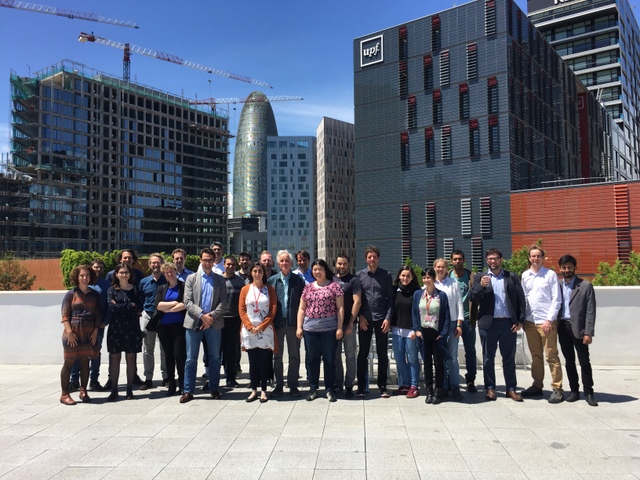
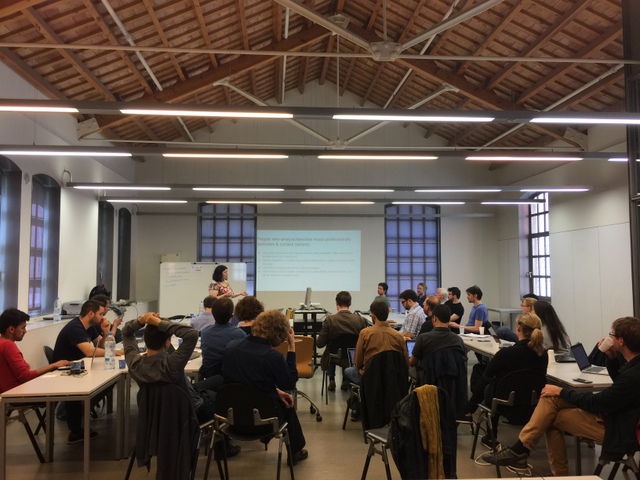
On 14 and 15 May on UPF’s Poblenou campus the first meeting of the TROMPA (Towards Public Richer Online Music Public-domain Archives) project was held, funded by the EU’s H2020 programme and coordinated by Emilia Gómez, head of the Music Information Research Laboratory (MIRLab), involving the participation of Davinia Hernández-Leo, head of the Research Group on Interactive and Distributed Technologies for Education (TIDE), both groups of UPF’s Department of Information and Communication Technologies (DTIC), as well as Voctrolabs, a UPF spin-off working on improving singing processing technologies.
Today, technology offers ways to enrich and contextualize this repertoire so that users can understand and appreciate it better. The TROMPA project aims to create public domain music files that include scores, recordings (audio, video) and descriptions of the music. TROMPA combines artificial intelligence (description and music generation technologies developed by the research group coordinated by Emilia Gómez) and human intelligence, through a series of applications that serve to involve music lovers in the generation of musical data. In particular, “we will work on applications addressing singers of choral music and the people who like to listen to music but who don’t have knowledge of music theory”, explained Emilia Gómez.
The TROMPA project aims to democratize our musical heritage and put it at the disposal of the public via a user-centred co-creation configuration. To analyse and link data from music to scale, the project will employ and improve the most advanced technology. Music-loving citizens will be able to collaborate with technology, providing their comments on algorithmic results and annotating the data in accordance with their personal knowledge. This is precisely the area of expertise in which the TIDE research group, directed by Davinia Hernández-Leo, will be participating.
TROMPA follows a philosophy of open innovation. All of the resulting knowledge will be re-released to the public for re-use. Through the consortium and the people who associate with the project, it will be possible to reach a global audience on an unprecedented scale, with possible outreach activities for millions of users.
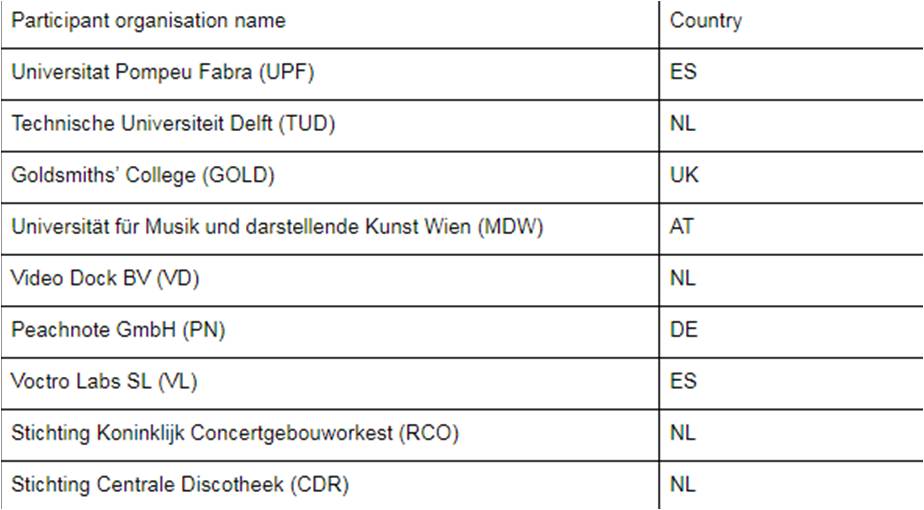
TROMPA Project consortium (table)
Related Assets

Catalan government
Catalan development cooperation aims to help prevent and respond to emergency situations. This page explains how you can collaborate on the provision of foreign aid both in general and to specific regions.
European Commission
Through cooperation and assistance programmes, the European Commission offers humanitarian aid and coordinates efforts with other international actors to promote peace and stability in war-torn regions.
Oxfam Intermón
Oxfam Intermón works in 90 countries. They have launched a fundraising campaign, which is more necessary than ever, given the magnitude of today’s wars. The NGO is also sponsoring a campaign to collect signatures to call for a ceasefire in Gaza.

Doctors Without Borders (MSF) is a medical-humanitarian action organization that provides assistance in 70 countries to people threatened by armed conflicts, violence, epidemics or neglected diseases, natural disasters and exclusion from medical care. They have also promoted a campaign to collect signatures to ask for a ceasefire in Gaza.
Red Cross
The Red Cross also provides emergency humanitarian aid in regions in crisis.

Legal Clinic
The UPF Legal Clinic regularly holds talks and roundtables on the protection of human rights in crisis regions.
Libraries Without Borders
The Libraries Without Borders programme, sponsored by the Catalan Development Cooperation Agency (ACCD), offers Catalan public library patrons knowledge and insight into situations of human rights violations and provides resources to take action.
Council for At-Risk Academics
The Council for At-Risk Academics, in partnership with universities and higher education institutions, provides urgently-needed help to academics in immediate danger, those forced into exile, and many who choose to work on in their home countries despite serious risks.