
UPF launches an open tool for analysing social inequalities from an intersectional perspective
UPF launches an open tool for analysing social inequalities from an intersectional perspective
Relief Maps+ is a website for research and social intervention that provides insight into the complex patterns of inequality and is available to anyone interested in creating or taking part in a project. This online platform is one of the main results of the European research project Intermaps, led by Maria Rodó, a lecturer in the Department of Political and Social Sciences at UPF.
The study of social inequalities is a complex phenomenon based on multiple factors, as it involves numerous aspects (e.g. gender, ethnicity and class) and dimensions (social, geographic and emotional), elements which are often linked and require an intersectional analysis.
UPF recently launched an innovative tool for analysing the relationship between these elements and how they affect our experiences, Relief Maps+, a digital online platform through which social inequalities may be studied from an intersectional, emotional and spatial perspective.
The new website is the result of over two years of work as part of the European research project Intermaps, whose purpose is to help shed light on how structural inequalities are (re)produced and the different effects they have on people’s daily lives.
“Relief Maps are a tool for collecting, analysing and viewing complex social data. Completing a Relief Map is in itself a reflective and transformational process which requires paying special attention to ethics and caring for participants”
The project received an ERC Starting Grant in 2021 from the European Research Council and features Maria Rodó, a lecturer in the Department of Political and Social Sciences and coordinator of the GRETA Research Group, as principal investigator, at the helm of a team of eight researchers.
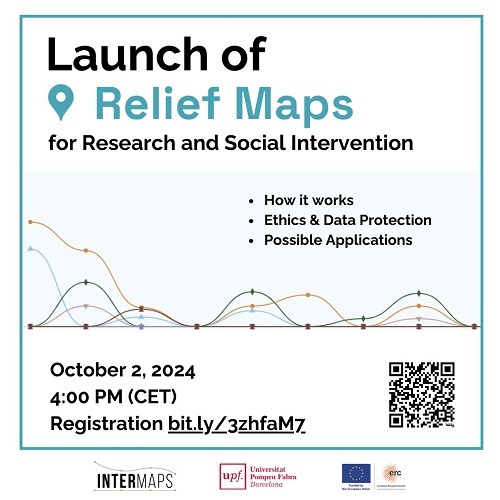
The application was launched during an online seminar held on 2 October, in which members of the research team presented the tool, its features, characteristics, uses and applications.
The event was intended for research staff, professionals, activists and anyone interested in using this tool. Relief Maps+ is not limited to use in research or as part of the Intermaps project, but now offers more comprehensive functions and may be used by anyone looking to create their own project or take part as a participant.
Relief Maps+ is applicable in a host of fields, including research projects (e.g. those related to social or health sciences), education, consulting and organisational management (to conduct a diagnosis on inequality and discrimination) and as part of social action projects.
A platform that provides insight into the complex patterns of inequality
One of the groups for which Relief Maps+ is intended is research staff: this tool enables researchers to create their own project on the platform; choose the questions and profile categories and define the places they wish to study; collect data and share their project with participants; and view the results, based on an analysis of the collected data.
It may also be accessed by anyone interested in taking part in a specific ongoing project: to share their experience and use the interactive platform to reflect on the feelings of wellbeing and discontent present in numerous aspects of daily life. These contributions help chart a visual and interactive map of how social position and place shape people’s experience of inequality.
The new Relief Maps+ website, which considers social (positions and identity), psychological (emotions) and geographical dimensions, boasts several key new features that have enhanced the data collection process and user experience: profile avatar, interactive relief maps and georeferenced data.
“Relief Maps are a tool for collecting, analysing and viewing complex social data. Completing a Relief Map is in itself a reflective and transformational process which requires paying special attention to ethics and caring for participants. It also complies with all European data protection laws,” explain the project researchers.