
Training
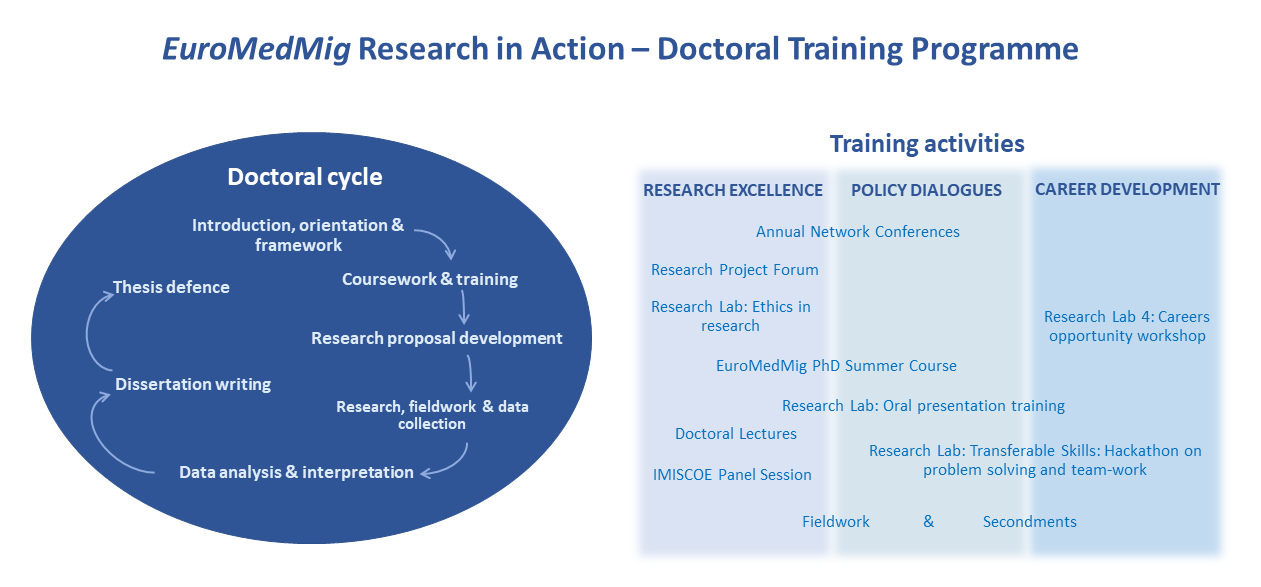
Doctoral Cycle
1. Introduction, orientation & framework | 2. Coursework & training | 3. Research proposal development | 4. Research, fieldwork & data collection | 5. Data analysis & interpretation | 6. Dissertation writing | 7. Thesis defence
Training activities
Training activities have been designed to cover all three pillars of the project: Research Excellence, Policy Dialogues and Career Development.
- Annual Network Conferences: will gather all EuroMedMig community, showcase the evolution of PhD students' research, provide thematic training, and ensure transfer of skills between academic and associate partners.
- Research Project Forum: EuroMedMig PhD Students will present to all fellow students their research scope, research progress and demonstrate quality of their research plans, conceptual and methodological framework, and first literature review. It will allow for peer-learning and feedback, and will stimulate sound research debates.
- Research Lab: Ethics in doing Research: This lab will provide PhD students with ethical guidance to ensure that they set up thought-through ethical frameworks for their researches, considering aspects such as positionality, transparency, ethical fieldwork with vulnerable populations, data privacy, etc.
- Research Lab: Transferables skills: Hackaton on problem-solving and team-work: PhD students often report feelings of loneliness and disconnection to real-world challenges throughout their doctoral journey. The hackaton will bring together all PhD students to find innovative and creative solutions for a specific selection of social challenges related to migrations in the Mediterranean in a very short period of time and in a collaborative spirit.
- Research Lab: Careers opportunity workshop: Will allow PhDs to foresee future employability and potential career opportunities and paths both inside and outside Academia.
- Research Lab: Oral presentation training: A specialist will provide training and guidance on body language, body posture, voice control and pitch a project or an idea and tailor it according to the targeted audience.
- Summer school: A five-day summer course will be organised in Barcelona. PhDs will meet and gain conceptual and methodological skills.
- Doctoral Lectures: A total of 13 Lectures by reknowned researchers and experts in migrations in the Mediterranean will be organized throughout the 4 years of the project.
Being migration a complex phenomenon at the cross-roads of many different disciplines, EuroMedMig PhD Network training programme is interdisciplinary, following partners and researchers’ disciplinary complementarities. It is articulated throughout the following 4 thematic pillars, which serve as the 4 Working Packages of the Project:
WP1: Governance, Policies & Politics
- Migration trends, routes, multi-lateral governance, policies, political cooperation, discourses, ideologies.
- Assessing the role of key actors in migration governance with a focus on geopolitical Mediterranean relations.
WP2: Taxonomies of Motion and Drivers
- Drivers of migration
- Regional trends
WP3: Social and Cultural Transformations
- Socialization, cultural practices, community dynamics, inequalities, spatial segregation, collective memory, etc.
- In origin, transit & destination countries
- Short and long-term
WP4: Economy & Labour Markets
- Labour market dynamics
- Informal economy & vulnerabilities, high-skilled migrants, labour policies, visa policies.