
The Barcelona International Summer School gets under way with the participation of some 200 students

Contra el genocidi i contra la violació dels drets humans, a Gaza i arreu del món

Peace comes when you talk to the person you most hate. And that’s where the courage of a leader comes.
Desmond Tutu (1931-2021), first recipient of an honorary doctorate from UPF
These words, spoken by Desmond Tutu, the first person ever to be awarded an honorary doctorate by UPF, are more applicable today than ever. The UPF condemns, and will always condemn, the use of violence to settle disputes. At UPF, we advocate approaching political or territorial conflicts based on dialogue and respect for all peoples and minorities.
As a university, we also want to show our support to the academic community in countries at war. Universities and scientific institutions are more necessary than ever in these regions. Access to education and the promotion of critical thinking, in the context of strong independent institutions, are the way to ensure the informed debate and reflection that can open the door to new avenues for finding solutions.
At UPF, we are aware of the university community’s concern for the human rights violations we are seeing in the conflicts around us. That is why on this website you will find information about campaigns and actions related to current conflicts, as well as opinion pieces and institutional statements. We also offer a dedicated e-mail address – [email protected] – to contact the university and let us know about your interests and concerns.
The Barcelona International Summer School gets under way with the participation of some 200 students
The Barcelona International Summer School gets under way with the participation of some 200 students
The seventh edition of the University’s international summer school, which goes on until 27 July, offers subjects of varying length, with a modular, flexible structure.
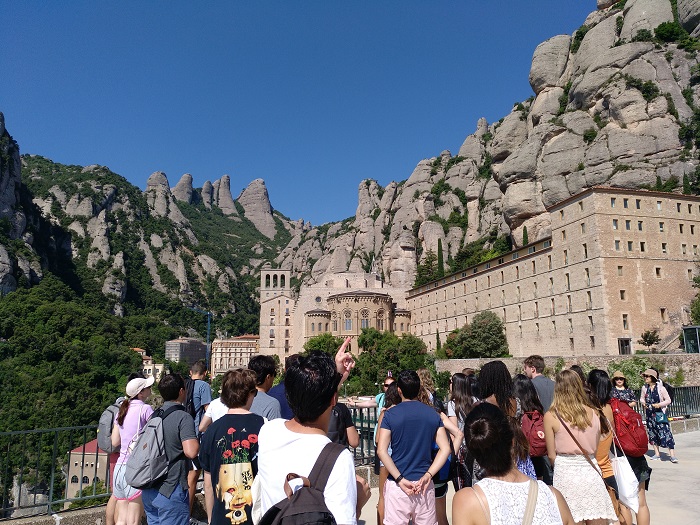
This week, the classes of the seventh edition of the UPF international summer school are starting, with a new, extended academic programme and the participation of 195 students, 92 from UPF and 103 international students.
The international students come from more than 15 countries, thus consolidating this school as a quality academic programme in all areas of knowledge of UPF and in which diversity in the classroom creates a true international environment for learning and discussion on issues of global interest.
The 103 international students come from 15 different countries
During the welcome ceremony, which took place on Friday, 22 June, the academic director of the BISS, professor Marc Sanjaume, reminded those in attendance that the 21 subjects that make up the catalogue of the Barcelona International Summer School have been designed to allow students to gain advanced credits in the summer with a highly applied, multidisciplinary approach, at classes given by UPF lecturers and guest specialists.
This year, the BISS programme presents subjects of varying length, with a modular, flexible structure, and is complemented by a programme of activities that make the city of Barcelona and the surrounding region a stage for studying outside the classroom as well. The participants have already been on some cultural trips, such as a visit to the monastery of Montserrat.
An interdisciplinary programme through a practical approach
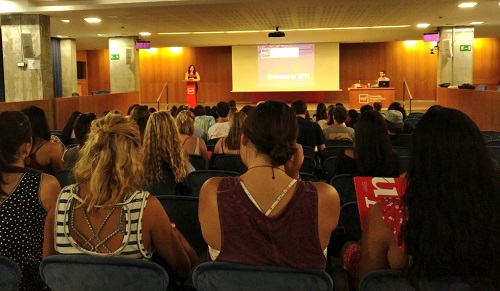
The interdisciplinary academic programme includes subjects of practical thinking. art and culture; economics and innovation; global cities, justice and rights; media and social dialogue; mind, life and the environment; social analysis and methods and data.
The subjects are available in Catalan, Spanish and English, and are designed as an invitation to think and learn beyond the traditional disciplines. The programme is divided into courses of five, three, two and one weeks, between 25 June and 27 July, which can be combined flexibly. All the subjects studied will be recognized by ECTS credits.
Lecturers of the University will share their current lines of research, going beyond the established studies, with the participating students, who will approach them from a practical and applied perspective, often involving field work. In addition, they will also be able to monitor their independent research projects.
Related Assets

Catalan government
Catalan development cooperation aims to help prevent and respond to emergency situations. This page explains how you can collaborate on the provision of foreign aid both in general and to specific regions.

European Commission
Through cooperation and assistance programmes, the European Commission offers humanitarian aid and coordinates efforts with other international actors to promote peace and stability in war-torn regions.

Oxfam Intermón
Oxfam Intermón works in 90 countries. They have launched a fundraising campaign, which is more necessary than ever, given the magnitude of today’s wars. The NGO is also sponsoring a campaign to collect signatures to call for a ceasefire in Gaza.

Doctors Without Borders (MSF) is a medical-humanitarian action organization that provides assistance in 70 countries to people threatened by armed conflicts, violence, epidemics or neglected diseases, natural disasters and exclusion from medical care. They have also promoted a campaign to collect signatures to ask for a ceasefire in Gaza.

Red Cross
The Red Cross also provides emergency humanitarian aid in regions in crisis.

Legal Clinic
The UPF Legal Clinic regularly holds talks and roundtables on the protection of human rights in crisis regions.

Libraries Without Borders
The Libraries Without Borders programme, sponsored by the Catalan Development Cooperation Agency (ACCD), offers Catalan public library patrons knowledge and insight into situations of human rights violations and provides resources to take action.
Council for At-Risk Academics
The Council for At-Risk Academics, in partnership with universities and higher education institutions, provides urgently-needed help to academics in immediate danger, those forced into exile, and many who choose to work on in their home countries despite serious risks.