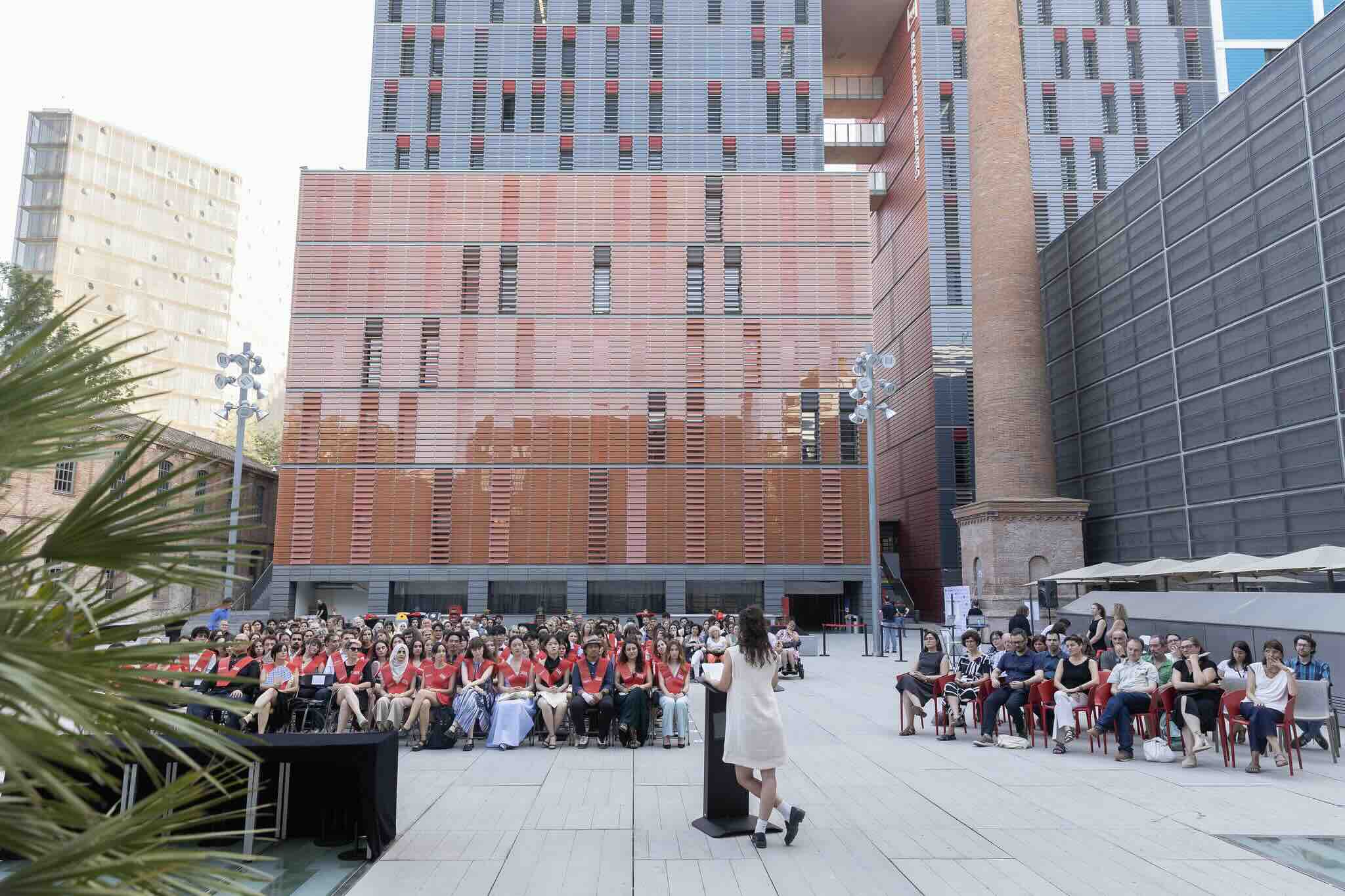
'Good night and good luck', keynote speech by Lena von Zabern
'Good night and good luck', keynote speech by Lena von Zabern
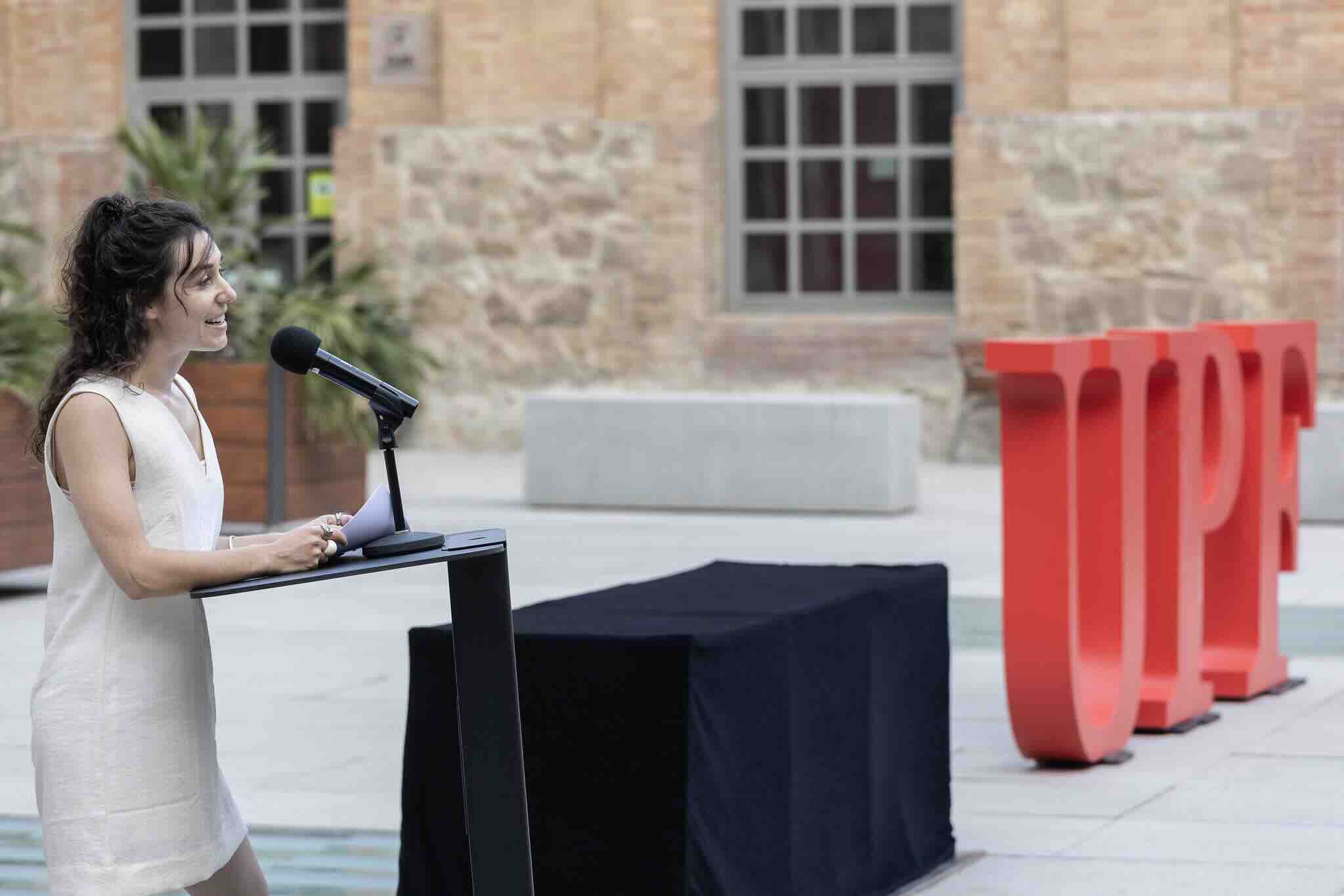
Lena von Zabern, a 2019 graduate of the MA in International Studies in Media, Power and Difference and currently a Communications Officer at the United Nations World Food Programme, delivered an inspiring keynote speech at the graduation ceremony for the 2025 master's and doctoral cohorts of the Department of Communication at UPF.
This is her speech:
Good Night, and Good Luck – on Media, Power and making a Difference in times of global crises
Lena von Zabern
Good evening graduates, good evening, everyone,
Like many of you here, I have always been fascinated by a good story. And today, many stories are being told. We read these stories in the newspaper, we see and listen to them on TV, radio, or on social media, we hear them from our politicians and world leaders. Every story shapes our thinking. I dare to say that we live in an age, where stories are so powerful, they can change the course of history.
So let me tell you a story tonight. A story about a journalist. The time is the early 1950’s, the height of the cold war. The place is America, and it is the era of Senator Joseph McCarthy. This Senator from Wisconsin is running a relentless public witch hunt against alleged “communists” and “homosexuals”. The American government, he argues, is infiltrated by communists who want to take control over America. He declares queer people as a national security risks and communist sympathizers, leading to the dismissal of many queer individuals from government positions. McCarthy repeatedly attacks anyone who questions his authority. He is threatening the media, accusing people without evidence, and creating a climate of fear and suppression of dissent. Sounds familiar?
But what would a good story be without a hero? So here we are, it is a late Tuesday evening in New York City. It is springtime in New York, March 9, 1954, 10:30 pm to be exact, and in the studios of CBS, journalist Edward R. Murrow has just finished his evening news show “See it Now” with his signature sign-off “Good night, and good luck.” CBS is one of the biggest American news broadcasters at the time and Murrow a well know journalist. He has risen to fame with his reporting from the Second World War in Europe and is seen as one of the pioneers of early news hour television. On this Tuesday Evening, Murrow is wearing his usual suit and tie, dark hair combed back as he looks up from his notes and begins his half hour report on Senator McCarthy. He uses public speeches of McCarthy himself, showing his lies, his inconsistencies, exposing his tactics of fear and shattering his image. Murrow is not the first to call out McCarthy, but "See it Now" is influential and after the episode on McCarthy has aired, CBS is flooded with thousands of letters in support of Murrow – and against McCarthy. It is this moment when public opinion slowly begins to shift. Some would even say, it is the beginning of McCarthys downfall. In December, the same year, he is forced to give up his committee chair in the Senate, breaking what is left of his power.
The story of Murrow and McCarthy does not only show the bravery of an individual, but the immense power media reporting and storytelling can have on public opinion. A power that goes so far, that it can change political realities. Good night, and good luck. 71 years after Murrow’s famous news broadcast, we are living in a world where the responsibility of the media in the face of injustice has never been more important.
As you are finishing your studies in communication, you will enter a world where right-wing populism is gaining strength, where democratic societies are threatened by their own governments. You enter a world in which the number of conflicts and wars has doubled over the past five years. A world that despite science and protests is still falling short of climate targets. A world which does not treat you equally because of your gender, your sexuality, the color of your skin, your religion, your social class, your nationality, or your species. In which the word “human” is only handed to some and denied others. A world in which facts and truths have become “alternative” and a world that risks passing on our bias from the past into the technology of our future.
Sadly, inequality, injustice and indifference are nothing new. But what is new – or rather new again – is how bluntly inequality is put into words. How casual some of those in power are labeling “the other” as “animals”, as “threats”, as “mutation”. In some cases, and especially for you as future media professionals, narratives of injustice have become easily detectable. In other cases, and for most people, language of indifference and discrimination is hidden behind words – and we only have to take a look at the human rights violations in Gaza or the war in Sudan to see that. Where what is not mentioned, not reported, speaks volumes. I strongly believe that studying at this faculty gave you the knowledge and the tools to make injustice visible.
You, more than anyone, know the power of words and narratives. For the past year you have been taught to take a closer look at where it gets uncomfortable. You have been taught to search for the truth and by truth I do not mean right or wrong, black, and white but the reality with all its complications and grey zones - and the power structures that lie underneath it. Researching the truth takes courage. And I believe your studies in communication gave you the courage to ask critical questions about the stories that we tell ourselves to explain and justify our world as it is. This courage looks different for everyone. Some of us have become journalists, others have become researchers, teachers, filmmakers, some of us are working in policy, in PR, for NGOs, or UN agencies. But what we all have in common is the courage to be critical, to point out injustice when we see it.
To be courageous you need to have empathy. And this is the second thing your studies taught you. We have come here from across the world. I remember our discussions in class vividly. How we were not only classmates but became friends. The kind of friends who would always challenge each other's thinking, requiring each other to show empathy towards different perspectives, experiences, and realities.
Since I finished my M.A. in International Studies on Media Power and Difference, I went on to see many places with my job at the United Nations and been to crises that you read about in the news (or sometimes, not read about in the news). And the more you see, the more you value the safety of a place like Barcelona. A safety that allows you to be critical, to be empathetic. Many people in the world do not have that privilege. And for those people who are staying behind, we as researchers, as journalists, as people that work on and with the media are responsible. We have a responsibility of making their voices heard, of pointing out reporting that silences these voices. Knowing what we know, we have a responsibility towards empathy. So, as you begin this new path after finishing your studies, there are a thousand ways to have empathy. I want to dare you to look closer where it gets uncomfortable and to be courageous, especially when the world seems desperate. It was the same Edward Murrow, the journalist who helped bring down Senator McCarthy who said, “there is a great and perhaps decisive battle to be fought against ignorance, intolerance and indifference”.
The fact that we are here tonight, celebrating your graduation and the 10th anniversary of International Studies on Media, Power and Difference means that we are already playing our part in fighting this battle. Going back 71 years, to that late night in March 1954, shortly before Murrow ended the news broadcast that would change history, he said something that I would like you to remember when life gets difficult or when you find yourself in times where hope is rare: “We will not walk in fear, one of another.” And with that, I wish you a good night and - good luck.