A delegation from the University of Paris-Seine visits UPF in the framework of the EUTOPIA project

Contra el genocidi i contra la violació dels drets humans, a Gaza i arreu del món

Peace comes when you talk to the person you most hate. And that’s where the courage of a leader comes.
Desmond Tutu (1931-2021), first recipient of an honorary doctorate from UPF
These words, spoken by Desmond Tutu, the first person ever to be awarded an honorary doctorate by UPF, are more applicable today than ever. The UPF condemns, and will always condemn, the use of violence to settle disputes. At UPF, we advocate approaching political or territorial conflicts based on dialogue and respect for all peoples and minorities.
As a university, we also want to show our support to the academic community in countries at war. Universities and scientific institutions are more necessary than ever in these regions. Access to education and the promotion of critical thinking, in the context of strong independent institutions, are the way to ensure the informed debate and reflection that can open the door to new avenues for finding solutions.
At UPF, we are aware of the university community’s concern for the human rights violations we are seeing in the conflicts around us. That is why on this website you will find information about campaigns and actions related to current conflicts, as well as opinion pieces and institutional statements. We also offer a dedicated e-mail address – [email protected] – to contact the university and let us know about your interests and concerns.
A delegation from the University of Paris-Seine visits UPF in the framework of the EUTOPIA project
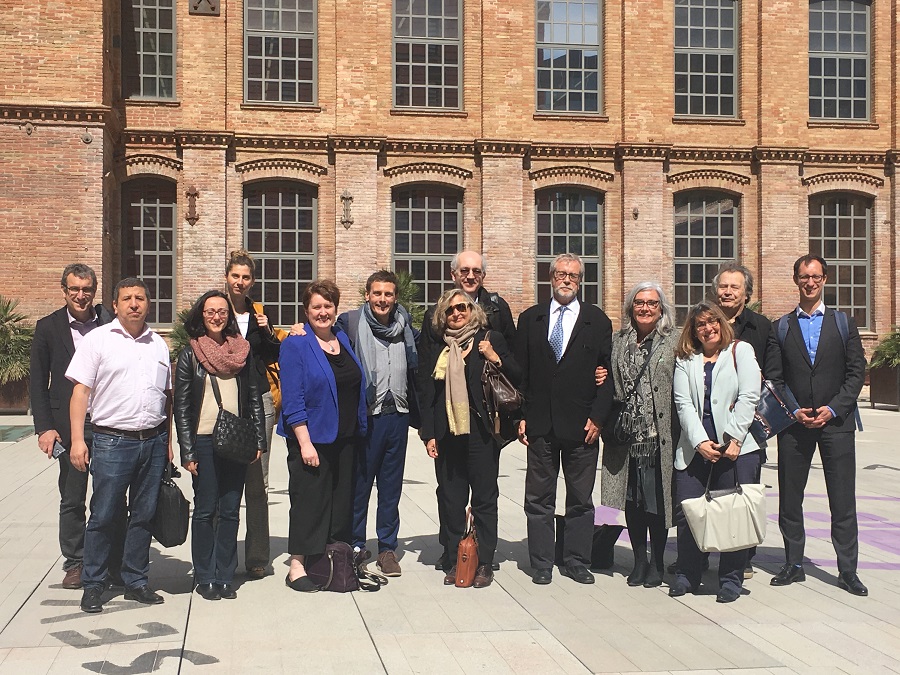
Led by its rector, François Germinet, they visited the University last week with the aim of creating synergies in the field of higher education and building strong international partnerships.
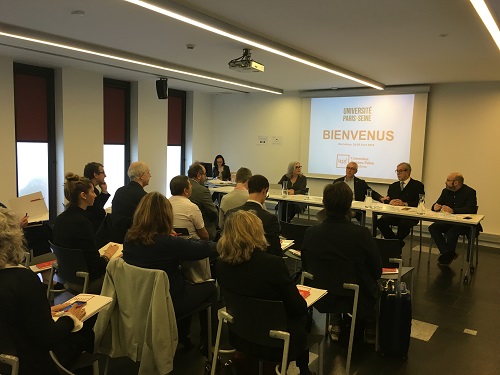
The meeting, part of the Eutopia project, was held so that the representatives of the two institutions could explore ways of working together. For this purpose, bilateral meetings were organized with the different fields of knowledge at UPF: political and social sciences, health and life sciences, communication, economics and business, engineering and information and communication technologies, humanities, and translation and language sciences.
Bilateral meetings were organized with the different fields of knowledge at UPF within the framework of the meeting with the delegation from Paris.
Visits to several unique spaces of the University were also scheduled, such as the Workshops Area of the Poblenou campus, which is undergoing transformation, and the Barcelona Biomedical Research Park (PRBB).
Finally, the visit also served to introduce to the delegation of University of Paris-Seine two strategic projects that UPF is currently developing. Josep Lluís Martí, vice-rector for innovation projects, explained EDvolució, the project to completely renovate and update UPF’s model of education; Pablo Pareja, commissioner for UPF student academic career, presented UPForward, the project that seeks to give order and coherence to every student’s passage through the University, from before their arrival until after graduation, when they become alumni.
EUTOPIA, a new generation of European alliance of universities
 The University of Paris-Seine, Vrije University Brussels, University of Warwick, University of Ljubljana, University of Gothenburg and Pompeu Fabra University are the six member institutions of the network.
Eutopia aims to boost its mission of operating as a network of European campuses facing global challenges through collaborative research, greater student and staff mobility, and shared innovations that serve a broader public than that of their regional communities.
The alliance unites more than 165,000 students and 30,000 staff members from six countries, with 90,000 international students associated through the partner universities. Together, the EUTOPIA universities have research centres in 760 different areas of knowledge.
The six partner universities are working together to modernize education and training, and provide the skills for the twenty-first century in all European regions. Hence, they have opted for the new competitive call “European Universities Initiative” launched by the European Commission to build a European Education Area.
Related Assets

Catalan government
Catalan development cooperation aims to help prevent and respond to emergency situations. This page explains how you can collaborate on the provision of foreign aid both in general and to specific regions.
European Commission
Through cooperation and assistance programmes, the European Commission offers humanitarian aid and coordinates efforts with other international actors to promote peace and stability in war-torn regions.
Oxfam Intermón
Oxfam Intermón works in 90 countries. They have launched a fundraising campaign, which is more necessary than ever, given the magnitude of today’s wars. The NGO is also sponsoring a campaign to collect signatures to call for a ceasefire in Gaza.
Doctors Without Borders (MSF) is a medical-humanitarian action organization that provides assistance in 70 countries to people threatened by armed conflicts, violence, epidemics or neglected diseases, natural disasters and exclusion from medical care. They have also promoted a campaign to collect signatures to ask for a ceasefire in Gaza.
Red Cross
The Red Cross also provides emergency humanitarian aid in regions in crisis.
Legal Clinic
The UPF Legal Clinic regularly holds talks and roundtables on the protection of human rights in crisis regions.
Libraries Without Borders
The Libraries Without Borders programme, sponsored by the Catalan Development Cooperation Agency (ACCD), offers Catalan public library patrons knowledge and insight into situations of human rights violations and provides resources to take action.
Council for At-Risk Academics
The Council for At-Risk Academics, in partnership with universities and higher education institutions, provides urgently-needed help to academics in immediate danger, those forced into exile, and many who choose to work on in their home countries despite serious risks.