
Beth Simone Noveck’s lecture on “Digital Innovation and Democratic Governance,”
Beth Simone Noveck’s lecture on “Digital Innovation and Democratic Governance,”
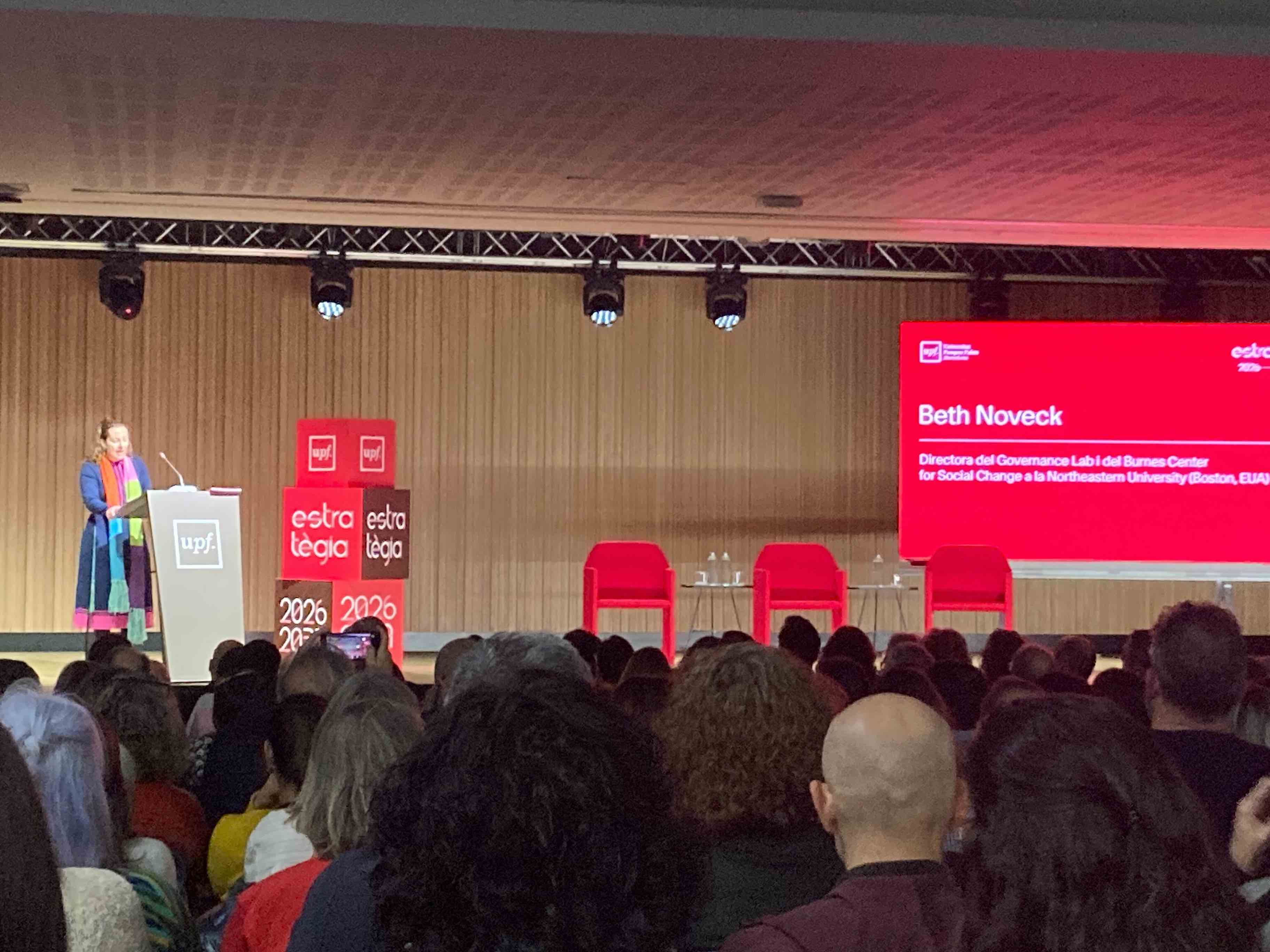
“We are not living in normal times; democracy is in decline.” Jurist Beth Noveck started her presentation at the launch of the new 2026-2037 UPF Strategy with a warning that has deep implications for the pluriversal and transformation approaches we explore at #DIVERSE. With cascading crises and profound deterioration of socio-ecological systems, her call to rethink the role of the university by questioning what societies we are helping build through the education system resonates deeply with us. She also urges universities to "study public problems and achieve real change." However, she also acknowledges that the link between research and positive societal impacts is not as effective as it should be.
Noveck’s approach is focused on making public administration more transparent, participatory, and collaborative. It directly connects with the need to understand transformation from multiple dimensions: political, organizational, and relational. Nonetheless, it is also crucial to point out a paradox that her thinking illuminates for us at #DIVERSE. The project does not have a central focus on Artificial Intelligence (AI), as we focus on the human, organizational, and discursive dynamics of social movements regarding digitalisation. But, as Noveck rightly points out, AI is already shaping the playing field. Today's technology, she tells us, is being shaped by actors with particular interests, and either we work to make it "useful for people and democracy," or we risk having institutions and public debate designed by others. This is already being confirmed by some of the grassroots movements we are talking to.
Thus, despite AI not being our main object of study, we are compelled to understand its implications. Technology is transforming the "institutional dimension" with which movements must interact (governments using AI for decision-making) and the "strategic dimension" (how participation and protest are organized). As rector Laia de Nadal rightly noted, AI can help us generate debate, but not replace it.
For us at #DIVERSE, Noveck's ideas remind us that today's complexity requires understanding all the forces that are redrawing the map of participation and contestation, including those that are quietly redefining the very meaning of governance and community. Thus, now that we have initiated the interview stage, we will watch the empirical signals carefully to understand grassroots transformative initiatives' views on the new institutional rules of the game.