
Publication of the monographic issue of the journal Atalante: “Displaced Images, Iconographic Survivals: Cinema and the Public Sphere”
Publication of the monographic issue of the journal Atalante: “Displaced Images, Iconographic Survivals: Cinema and the Public Sphere”
Publication of the monographic issue of the journal Atalante: “Displaced Images, Iconographic Survivals: Cinema and the Public Sphere”
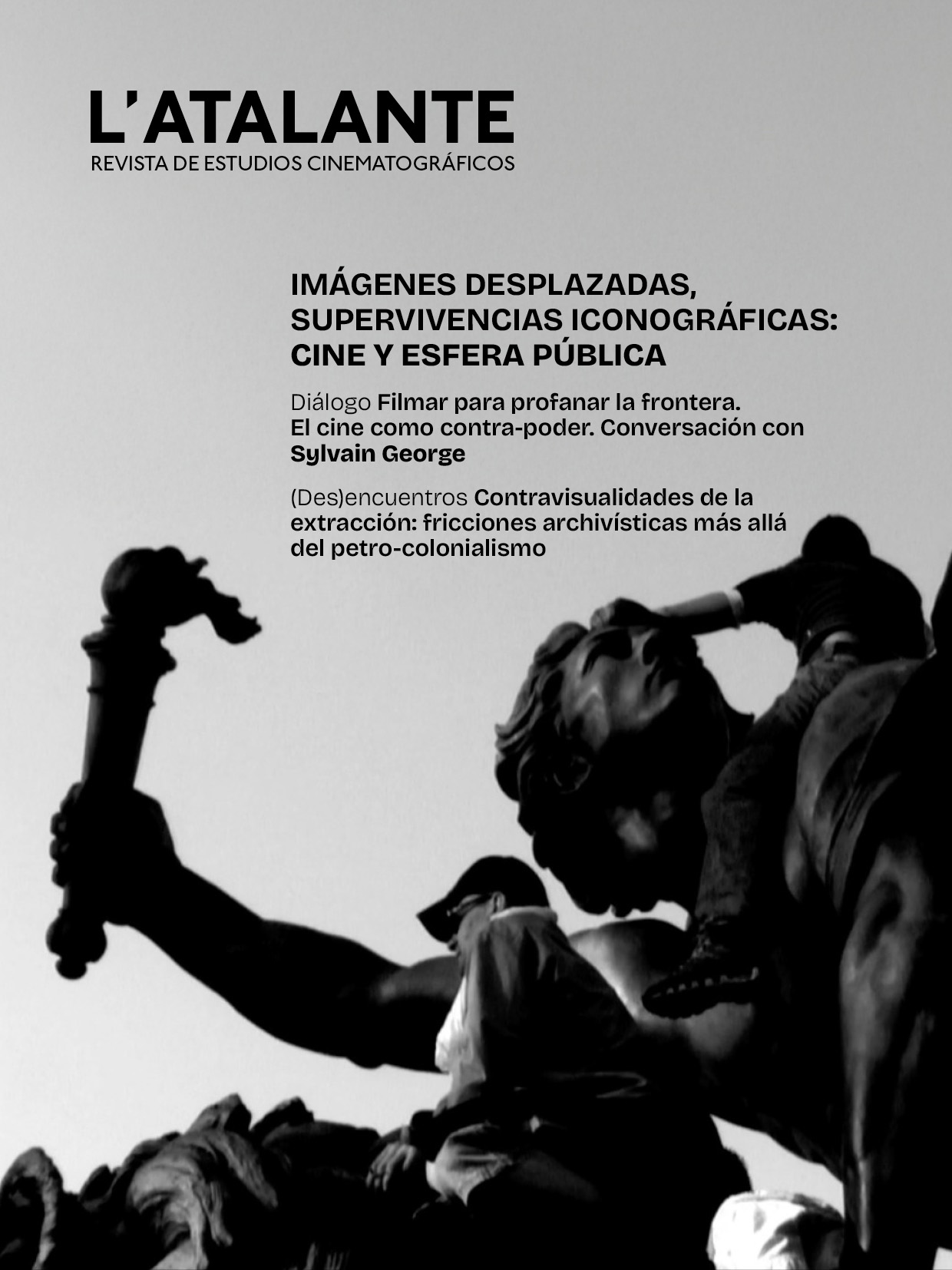
Publication of the monographic issue of the journal Atalante, entitled “Imágenes desplazadas, supervivencias iconográficas: cine y esfera pública” (no. 41), published on 2 March 2026.
This volume is part of the research project MUMOVEP (Mutations of Visual Motifs in the Public Sphere. Representations of Power in Spain 2017–2021: pandemic, climate change, gender identities and racial conflicts, REF: PID2021-126930OB-I00) and has been coordinated by Ivan Pintor Iranzo, Glòria Salvadó Corretger, Teresa Sorolla Romero and Jordi Montañana-Velilla.
These are uneasy and unsettling times. As Georges Didi-Huberman writes in his book Les anges de l'histoire. Images des temps inquiets (2025), we are living through a moment of change and transformation, marked by the activation of a new visual paradigm shaped by the geopolitical crisis and the consolidation of the alliance between technology, economy and war, within a politics of radical accelerationism of events (Patrick Boucheron, 2024) and their representations.
We are witnessing how one time is turning into another, and we are witnessing it live. Yet not only is something changing; something is also returning in unexpected ways, in the form of survivals and unresolved affects (Georges Didi-Huberman, 2025), embodied by authoritarian political leaders and techno-oligarchs who adopt the gestures and voices of dictators, praetors or even supervillains from fantasy and science fiction cinema.
While the twenty-first century has been characterised by a flow of apocalyptic images—where cinematic codes intertwine with the spam-image (Hito Steyerl, 2014) viralised through social media, and with an increasingly accelerated collision between the public and private spheres—the war in Ukraine, the genocide in Gaza and the second term of Donald Trump are forging a new visual regime. This regime is based on neuro-excitation, the cognitive colonisation of attention, and the invisibilisation of any discourse that falls outside the aims of post-liberal capitalism of finitude (Pierre Orain, 2025), grounded in the systematic hoarding of resources, from Venezuelan oil to rare earths or the ice of Greenland. The relegation to invisibility of other significant leaderships and conflicts, such as the war in Sudan, also reflects a progressive loss of nuance in the visual conception of the world.
As the philosopher Éric Sadin (2024) and the artist and researcher Hito Steyerl (2025) have pointed out in relation to the anthropological rupture introduced by AI, it is not only that citizens are exposed to an infinite scroll of “ghost images” (Sadin, 2025) or “mean”, random and “stochastic” images (Steyerl, 2025). We are also entering an “age of indistinction” in which it becomes increasingly difficult to determine the origin of images and texts, while the vast repository of the internet—whose energy consumption continues to grow exponentially—resembles a “dead internet”, where image production has been delegated to large-scale computation.
With this issue, we aim to affirm the centrality of the cinematic image as both a refuge and an active tool for thinking about the flow of images in the public sphere, and as a means of reappropriating a future denied by extractivist politics. With the reel on the “Gaza Riviera” published on the social network Truth Social by Donald Trump in February 2025, what emerged was not only an exercise in cynicism and colonial violence, but also the imposition of an apparently inexorable present. In the face of this, only the re-editing of other images—through repolarisation, cutting and recontextualisation—can enable a way of thinking that looks where the infinite scroll of social media seemingly prevents us from looking.
With articles on Berlusconi’s rise within populism, the iconography of the migrant body, multispecies perceptual forms in contemporary Ibero-American cinema, the pandemic, extractivism and violence, as well as interviews with filmmakers such as Sylvain George, Nariman Massoumi and Sanaz Sohrabi, this issue offers a contemporary diagnosis of the displacement of iconographies within the public sphere.