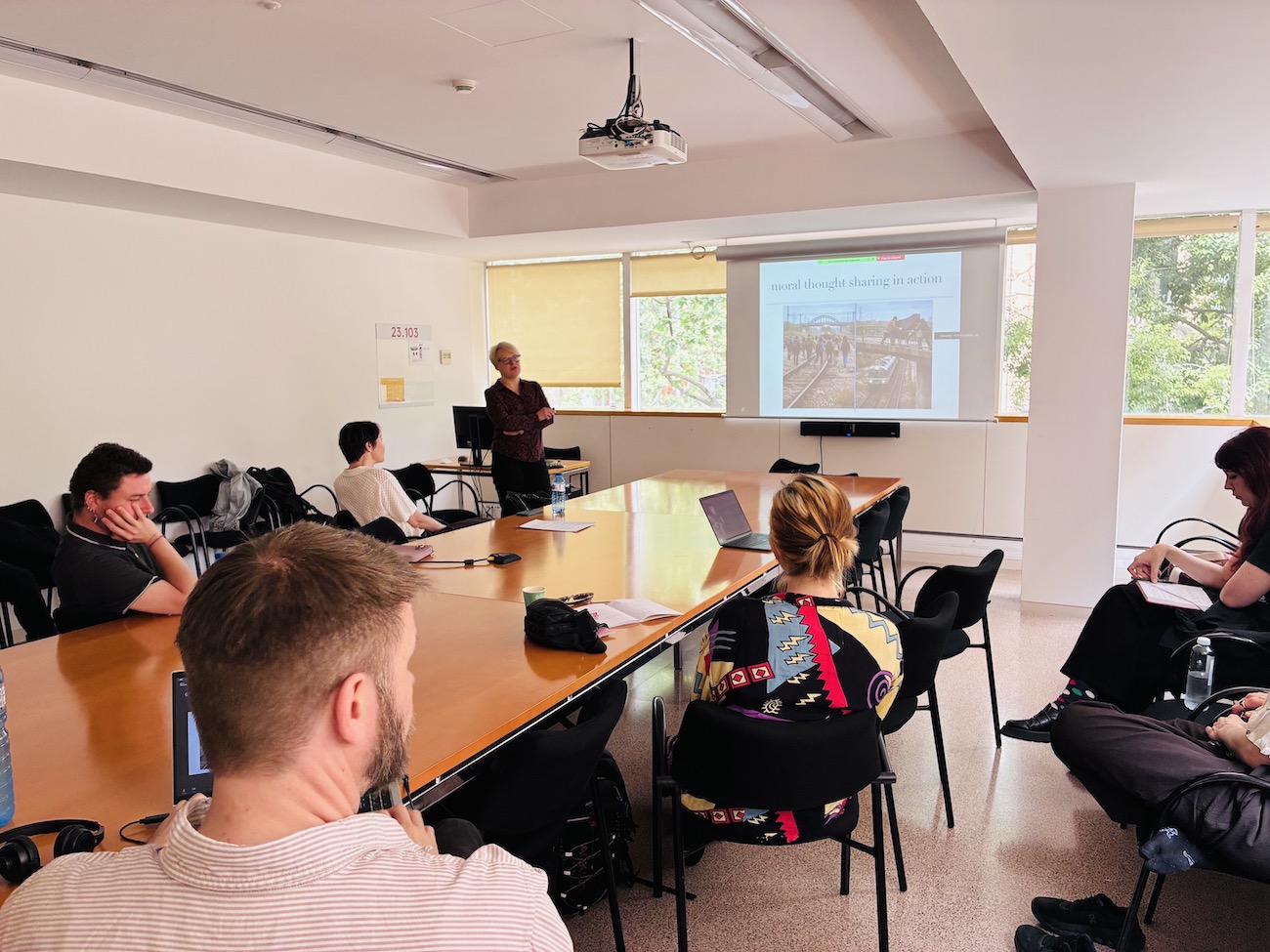
Ophelia's talk was an attempt to understand co-perception, the phenomenon whereby two or more people can perceive the same thing and thereby come to acquire mutual knowledge that they have done this, without necessarily engaging in the sort of coordination that is characteristic of joint attention.
In joint attention, there is communication and planning, an explicit effort to ensure that both parties perceive the object. Joint perception has been the focus of much theorizing, but it is demanding: It requires coordination of intentions, ostensive communicative behavior, and acknowledgment. This sort of costly behavior, Ophelia argued, is not necessary to explain how mutual knowledge is achieved by adults. In co-perception, by contrast, there is no coordination of intentions, no ostension and no acknowledgment, yet mutual knowledge is achieved. A typical example: Edmond is at a museum and looks at a piece at the same time as a stranger, Pedro. Afterwards, it is perfectly natural for Edmond to strike up a conversation with Pedro about the piece, although there has been no communication or planning between them. Ophelia's question was how this is possible; how does it work, conceptually and empirically?
In response to the first question, Ophelia began by canvassing and criticizing some possible views. One possibility is that Edmond and Pedro engage in a cognitive inference to common ground. However, Ophelia argued that though such inferences may occur, coperception is itself not a cognitive phenomenon, but a phenomenon on the level of perception. In defense of this claim, Ophelia appealed to research done on primates, which show behavioral sensitivity to coperception—and though these animals may be capable of cognitive inference to common ground, it is methodologically preferable not to have to posit this kind of mechanism.
Ophelia further argued that coperception is not to be equated with level 1 perspective-taking. This is a basic form of mindreading whereby the subject figures out what another can see from their spatial perspective. Coperception is not reducible to this phenomenon, since it is not just spatial: We can coperceive the smell of smoke or a loud sound that permeates the environment. To further substantiate this claim, Ophelia discussed a number of experiments in which subjects exhibit reaction time differences when counting the number of dots visible from, alternately, their own perspective and that of an avatar. These results, argued Ophelia, is explained by coperception.
Ophelia then went on to discuss experimental evidence suggesting that even when the other's perspective is not relevant to the task, subjects are constantly monitoring whether there's coperception: There is "social vigilance" going on at all times. Indeed, we can decode from brain activity whether something is seen privately or publicly.
By means of ending the talk, Ophelia briefly discussed the importance of coperception in understanding perception, how it differs between animal and human minds or between the minds of different social animals and how the distinction between public and private may break down (for instance in schizophrenia). Ophelia also briefly discussed what joint attention adds to coperception and its strategic character regarding social obligations and language learning.
Isidora's talk concerned the subjectivity of moral judgments, the extent to which moral judgments are perceived (by laypeople) as more subjective than factual judgments; how these perceptions are influenced by valence asymmetries, the well-documented fact that "bad is stronger than good"; and how such valence asymmetries might impact coordinated action.
Isidora began by discussing empirical evidence suggesting that people rank moral judgments intermediate in subjectivity: more subjective than factual judgments but more objective than matters of taste. This reflects a long-standing appreciation in metaethics of the puzzling nature of moral judgments, their in-between status that have generated a whole spectrum of metaethical views. Pioneering studies by Goodwin and Darley seem to bear this out: When people's responses to different judgments are composed into an "objectiveness score," ethical judgments rank below judgments of fact, but still significantly above judgments about social conventions or judgments of taste. Valence asymmetry may play a role here. In subsequent studies, Goodwin and Darley made an effort to explicitly distinguish positive from negative value judgments—endorsements from condemnations—and their results suggest that the latter are perceived as more objective than the former. Isidora, however, sees several problems with the study concerning consistency in the use of antonyms ("morally wrong" vs. "morally good"), and differences with respect to the vignette's valences.
In light of these shortcomings, Isidora and colleagues conducted their own pilot study using minimal pair vignettes and formulating the responses consistently in terms of "right"/"wrong" and "good"/"bad"". This study fails to reproduce G&D's asymmetry effect: To the contrary, in the "good"/"bad" case at least, it is the positive judgments that are ranked as more objective.
Having presented these results, Isidora then went on to discuss possible impacts of valence asymmetry on coordinated action. She began by discussing two well-documented valence asymmetries: The Knobe effect (people judge harmful side-effects as more intentional than helpful ones) and the phenomenon, documented by Willemsen and Reuter, that it is more difficult to deny the evaluative implications of a negative term than of a positive one.
These findings suggest that "bad is stronger than good." One failing is sufficient to be morally blameworthy, but "virtue requires all the virtues". A possible explanation is that our value-judgments serve to coordinate behavior, and here it is more efficient to sanction negative action than to reward positive ditto. Thus we seek to coordinate over what is bad, but what it's ok to diverge over what isn't bad. This would explain the greater consensus and greater sense of objectivity associated with negative judgments.
Some of the questions raised during the discussion concerned the nature of coordination in cases of co-perception, different manifestations of it in art, digital and graphic media and objects of public perception more generally, different sensory modalities, as well as the relation to perceptual and phenomenal content. Several factors affecting moral judgments were also discussed, including the stakes or consequential nature of scenarios considered, the cost of coordination, the relevant ethical theoretical frameworks (e.g. utilitarianism), cultural background and neurodiversity, logical framing, data from social psychology, and minimal forms of thought sharing in the perceptual and moral case.
Work produced with the support of a 2025 Leonardo Grant for Scientific Research and Cultural Creation, BBVA Foundation. The Foundation takes no responsibility for the opinions, statements and contents of this project, which are entirely the responsibility of its authors.
Usamos cookies para mostrar contenidos personalizados, analizar tendencias, administrar el sitio, llevar un seguimiento de los movimientos de los usuarios en el sitio y recopilar información demográfica sobre nuestra base de usuarios en su conjunto. Acepte todas las cookies para disfrutar de la mejor experiencia posible en nuestro sitio web, o bien administre sus preferencias.
Aviso legal