
UPF takes part in EUTOPIA Day with a lecture on the challenges of the ecological transition

Contra el genocidi i contra la violació dels drets humans, a Gaza i arreu del món

Peace comes when you talk to the person you most hate. And that’s where the courage of a leader comes.
Desmond Tutu (1931-2021), first recipient of an honorary doctorate from UPF
These words, spoken by Desmond Tutu, the first person ever to be awarded an honorary doctorate by UPF, are more applicable today than ever. The UPF condemns, and will always condemn, the use of violence to settle disputes. At UPF, we advocate approaching political or territorial conflicts based on dialogue and respect for all peoples and minorities.
As a university, we also want to show our support to the academic community in countries at war. Universities and scientific institutions are more necessary than ever in these regions. Access to education and the promotion of critical thinking, in the context of strong independent institutions, are the way to ensure the informed debate and reflection that can open the door to new avenues for finding solutions.
At UPF, we are aware of the university community’s concern for the human rights violations we are seeing in the conflicts around us. That is why on this website you will find information about campaigns and actions related to current conflicts, as well as opinion pieces and institutional statements. We also offer a dedicated e-mail address – [email protected] – to contact the university and let us know about your interests and concerns.
UPF takes part in EUTOPIA Day with a lecture on the challenges of the ecological transition
The lecture was delivered by Antonio Turiel, a CSIC researcher from the Institute of Marine Sciences, who believes that the transition to renewable energies should be done from the perspective of degrowth, taking into account the planet’s biophysical limits. His presentation was followed by a round table discussion with students, who asked him questions about current issues such as the drought.
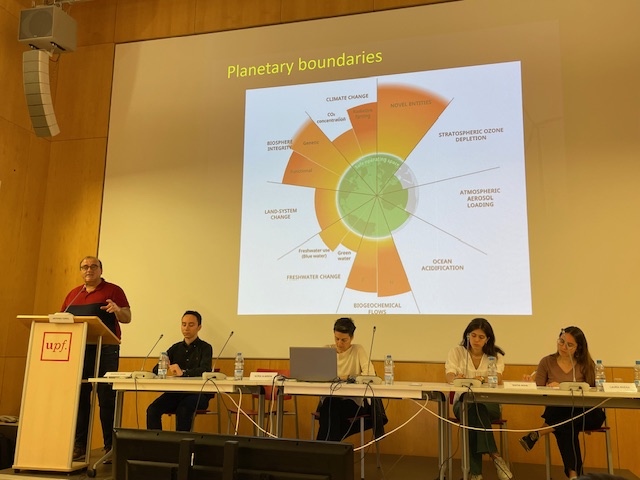
On Monday 13 May, the alliance of European universities, EUTOPIA, of which UPF is a member, celebrated EUTOPIA Day, which this year focused on the planet’s main challenges, particularly sustainability and climate change. UPF hosted the lecture “The challenges of the ecological transition”, by Antonio Turiel, a CSIC researcher at the Institute of Marine Sciences, who argued that the transition to renewable energies must be done from the perspective of degrowth, taking into account the planet’s biophysical limits. His presentation was followed by a round table discussion, in which three students from the EUTOPIA Ideas Club, a forum for multilingual debate aimed at raising awareness of European values among young people, took part.
The event, held in the multipurpose hall in the Mercè Rodoreda Building on UPF’s Ciutadella Campus and streamed live, featured the vice-rector for Internationalisation, Helena Ramalhinho, who took part in a meeting with students after the session. Both the event and speaker were presented by Carmen Pérez, representative of the EUTOPIA MORE Programme, and Carla Lancelotti, director of the Centre for Studies on Planetary Wellbeing (UPF). The round table was moderated by Núria Almirón, lecturer and researcher in the Department of Communication at UPF. The participating students included Laura Rivera, Sofia Roig and Eudald Sanz, all of whom were present at the most recent meeting of the Ideas Club on climate change, held at Ca' Foscari University in Venice this past April.

One of the main conclusions reached during the EUTOPIA Day session at UPF is that the transition to renewable energies “is no longer a question”, in the words of Antonio Turiel. The CSIC researcher explained that we are approaching or have already surpassed the “planet’s biophysical limits” in aspects such as temperature and non-renewable energy resource availability, among others.
Turiel warned attendees that the temperature limits set out in the 2015 Paris Agreement on climate change have already been exceeded. As a result, not only are “extreme temperatures” being seen in various parts of the planet, but there is also an increased risk of extreme weather conditions, such as major storms: one avenue for “releasing the large amount of water evaporated by the heat”.
Turiel dedicated a substantial portion of his lecture to the depletion of non-renewable energy sources, such as oil. “Non-renewable energies are at their limit; we have known about it for a long time, but we are now forced to make this transition”, asserted the CSIC researcher, who is also a mathematician and physicist and keeps one of the most recognised blogs in Spain on oil depletion, The Oil Crash.
He went on to explain that the transition to renewable energies will not be free from obstacles. On the one hand, the power produced at present by renewable energies is not enough to meet the current demands. On the other hand, their production cycle still depends, paradoxically, on fossil fuels: in terms of transport and the manufacturing and maintenance of the machinery involved in generating renewable energy, for example. There is also a shortage of certain minerals needed to produce the infrastructure required to generate this energy, and the current electrical supply network is not yet sufficient for handling renewable energies.
The CSIC researcher insisted on linking the transition to this type of energy with “more profound changes” in the capitalist system; changes aimed at reverting the current model of unlimited growth and promoting degrowth, an approach which runs counter to numerous economic interests: “We must be radical, yet also engage in dialogue (…) The aim should not be to destroy capitalism, but to evolve within the system, as undefined growth is unsustainable”.
The need for a new water management model
During the round table, the speaker answered several questions posed by the students. On the topic of drought, they asked about long-term solutions to this problem, whether it should be considered an emergency or an endemic situation and his opinion on interbasin transfers. According to Turiel, priority should go toward developing a new and efficient water management model that is suitable for a semi-arid country, with a proactive long-term approach, not simply reactive. The expert believes that the drought situation in Catalonia is now “endemic” and cannot be addressed with temporary and circumstantial measures. Nor does he support interbasin transfers, as extracting water from its original basin could alter the region’s biodiversity.
He was also asked whether fining countries with high CO2 emissions would be appropriate or feasible. For Muriel, demanding compensation is “logical”, but difficult to apply. In any case, he believes that it is “fundamental to put in place mechanisms that encourage a decrease in the carbon footprint”. The students’ questions also touched upon so-called energy communities, a “useful” alternative, as they make energy production less dependent on large companies, but have a “limited” scope at present, according to the CSIC researcher.
Since the three students recently took part in a climate change event in Venice, they also asked him about the phenomenon known as “acqua alta” (high water), which often causes parts of the city to flood. Turiel explained that both Venice and other parts of the Mediterranean will be increasingly affected by extreme weather conditions and that investments must be made in preventive and drainage systems.
Multimedia
Categories:
Contact
Related Assets

Catalan government
Catalan development cooperation aims to help prevent and respond to emergency situations. This page explains how you can collaborate on the provision of foreign aid both in general and to specific regions.
European Commission
Through cooperation and assistance programmes, the European Commission offers humanitarian aid and coordinates efforts with other international actors to promote peace and stability in war-torn regions.
Oxfam Intermón
Oxfam Intermón works in 90 countries. They have launched a fundraising campaign, which is more necessary than ever, given the magnitude of today’s wars. The NGO is also sponsoring a campaign to collect signatures to call for a ceasefire in Gaza.

Doctors Without Borders (MSF) is a medical-humanitarian action organization that provides assistance in 70 countries to people threatened by armed conflicts, violence, epidemics or neglected diseases, natural disasters and exclusion from medical care. They have also promoted a campaign to collect signatures to ask for a ceasefire in Gaza.

Red Cross
The Red Cross also provides emergency humanitarian aid in regions in crisis.

Legal Clinic
The UPF Legal Clinic regularly holds talks and roundtables on the protection of human rights in crisis regions.

Libraries Without Borders
The Libraries Without Borders programme, sponsored by the Catalan Development Cooperation Agency (ACCD), offers Catalan public library patrons knowledge and insight into situations of human rights violations and provides resources to take action.
Council for At-Risk Academics
The Council for At-Risk Academics, in partnership with universities and higher education institutions, provides urgently-needed help to academics in immediate danger, those forced into exile, and many who choose to work on in their home countries despite serious risks.