UPF launches the Glocal Challenges course, within the EUTOPIA project

Contra el genocidi i contra la violació dels drets humans, a Gaza i arreu del món

Peace comes when you talk to the person you most hate. And that’s where the courage of a leader comes.
Desmond Tutu (1931-2021), first recipient of an honorary doctorate from UPF
These words, spoken by Desmond Tutu, the first person ever to be awarded an honorary doctorate by UPF, are more applicable today than ever. The UPF condemns, and will always condemn, the use of violence to settle disputes. At UPF, we advocate approaching political or territorial conflicts based on dialogue and respect for all peoples and minorities.
As a university, we also want to show our support to the academic community in countries at war. Universities and scientific institutions are more necessary than ever in these regions. Access to education and the promotion of critical thinking, in the context of strong independent institutions, are the way to ensure the informed debate and reflection that can open the door to new avenues for finding solutions.
At UPF, we are aware of the university community’s concern for the human rights violations we are seeing in the conflicts around us. That is why on this website you will find information about campaigns and actions related to current conflicts, as well as opinion pieces and institutional statements. We also offer a dedicated e-mail address – [email protected] – to contact the university and let us know about your interests and concerns.
UPF launches the Glocal Challenges course, within the EUTOPIA project
The subject will be taught during the third term and is part of the second phase of the Open Innovation Challenge, within which several projects will be developed to solve local and global problems.
UPF has launched the subject Glocal Challenges, which is included in the EUTOPIA project. The call was opened to all students who were interested, as an optional subject on their syllabus. The course will be taught during the third term by professors Miquel Oliver and Elisabet Ducocastella, of the Department of Information and Communication Technologies (DTIC).
The course will be taught by professors Miquel Oliver and Elisabet Ducocastella, of the Department of Information and Communication Technologies.
Glocal Challenges is the second phase of the Open Innovation Challenge, within which several projects will be developed to solve local and global problems. The Open Innovation Challenge is the embodiment of EUTOPIA’s desire to transform universities into actors for social change, welcoming regional and international collaboration with private and public partners.
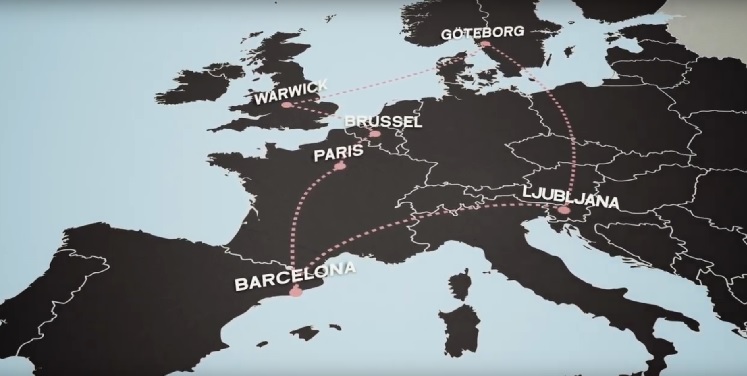
The initiative has been structured according to two phases. The first consisted of identifying the challenges for addressing, which revolved around five Sustainable Development Goals (SDGs): climate emergency, sustainable mobility, healthy eating, reducing inequality, and safe and sustainable cities and communities. Students from the six universities of the alliance – Warwick, Ljubljana, CY Cergy Paris, Göteborg, VUB Brussels and Pompeu Fabra – picked up on these problems through some of the events organized by EUTOPIA, such as the WeDiscover Days Barcelona and EUTOPIA Week.
The EUTOPIA project is divided into seven Working Packages, each with its own specific goal. The Open Innovation Challenge, led by UPF, is part of Working Package 4. In this stage, in teams, the selected students will carry out a project with the aim of thinking and finding solutions to real problems and casuistries of our society. The problems the projects will deal with will be at both local and European Union level.
The two final challenges were, first, ‘People’, aimed at ending poverty and hunger, and ‘Partnership’, aimed at strengthening global solidarity.
UPF will develop this goal through the subject Glocal Challenges, a fusion of ‘local’ and ‘global’. At the last WeDiscover Week BXLS two major final and joint challenges were chosen for all the universities of the Alliance around which they would develop their projects. The two final challenges were, first, ‘People’, aimed at ending poverty and hunger, ensuring that humankind can live in dignity and equality, and ‘Partnership’, aimed at strengthening global solidarity.
The projects that will be worked on at UPF are CatAjut and Mobility in university cities, with regard to ‘People’, and Analysis of the relationship between the delay in youth emancipation and socioeconomic status in Barcelona and LIVBA Liveable Barcelona, with regard to ‘Partnership’.
Now, through the newly created subject, which is integrated into the Barcelona Program for Interdisciplinary Studies (BaPis), these four projects will be developed. The purpose of the course is to show how students and current generations are the ones who will be able to address the challenges of the present and the future. To achieve this, participants will make a series of inspirational visits, with different agents from economic, business, humanistic and artistic spheres. The students will thus become agents for change, promoters of the solution to a real problem of today’s society, precisely through projects that they themselves will develop.
Of the four projects that will be developed between March and October 2021 at UPF, one will be chosen to go to the Hackathon organized by the University of Göteborg. There, the teams of the six universities of the Alliance that have developed the winning projects will compete against each other. Three of these will be selected to go on to the final at the University of Warwick in June 2022.
Of the four projects that will be developed between March and October 2021 at UPF, one will be chosen to go to the Hackathon organized by the University of Göteborg.
Finally, a jury made up of representatives of the EUTOPIA Pool of Partners (PoP), consisting of the organizations, institutions and companies affiliated to the project, and of international experts and EUTOPIA staff, will evaluate the projects of the finalists and choose the winner. The winning team will receive the resources to develop it.
Related Assets

Catalan government
Catalan development cooperation aims to help prevent and respond to emergency situations. This page explains how you can collaborate on the provision of foreign aid both in general and to specific regions.
European Commission
Through cooperation and assistance programmes, the European Commission offers humanitarian aid and coordinates efforts with other international actors to promote peace and stability in war-torn regions.
Oxfam Intermón
Oxfam Intermón works in 90 countries. They have launched a fundraising campaign, which is more necessary than ever, given the magnitude of today’s wars. The NGO is also sponsoring a campaign to collect signatures to call for a ceasefire in Gaza.
Doctors Without Borders (MSF) is a medical-humanitarian action organization that provides assistance in 70 countries to people threatened by armed conflicts, violence, epidemics or neglected diseases, natural disasters and exclusion from medical care. They have also promoted a campaign to collect signatures to ask for a ceasefire in Gaza.
Red Cross
The Red Cross also provides emergency humanitarian aid in regions in crisis.

Legal Clinic
The UPF Legal Clinic regularly holds talks and roundtables on the protection of human rights in crisis regions.
Libraries Without Borders
The Libraries Without Borders programme, sponsored by the Catalan Development Cooperation Agency (ACCD), offers Catalan public library patrons knowledge and insight into situations of human rights violations and provides resources to take action.
Council for At-Risk Academics
The Council for At-Risk Academics, in partnership with universities and higher education institutions, provides urgently-needed help to academics in immediate danger, those forced into exile, and many who choose to work on in their home countries despite serious risks.