The YERUN network demands that the 9th Framework Programme of the European Commission should deal with global challenges in research and innovation

Contra el genocidi i contra la violació dels drets humans, a Gaza i arreu del món

Peace comes when you talk to the person you most hate. And that’s where the courage of a leader comes.
Desmond Tutu (1931-2021), first recipient of an honorary doctorate from UPF
These words, spoken by Desmond Tutu, the first person ever to be awarded an honorary doctorate by UPF, are more applicable today than ever. The UPF condemns, and will always condemn, the use of violence to settle disputes. At UPF, we advocate approaching political or territorial conflicts based on dialogue and respect for all peoples and minorities.
As a university, we also want to show our support to the academic community in countries at war. Universities and scientific institutions are more necessary than ever in these regions. Access to education and the promotion of critical thinking, in the context of strong independent institutions, are the way to ensure the informed debate and reflection that can open the door to new avenues for finding solutions.
At UPF, we are aware of the university community’s concern for the human rights violations we are seeing in the conflicts around us. That is why on this website you will find information about campaigns and actions related to current conflicts, as well as opinion pieces and institutional statements. We also offer a dedicated e-mail address – [email protected] – to contact the university and let us know about your interests and concerns.
The YERUN network demands that the 9th Framework Programme of the European Commission should deal with global challenges in research and innovation
The YERUN network demands that the 9th Framework Programme of the European Commission should deal with global challenges in research and innovation
The meeting has served to present the association’s key demands in relation to the European Commission’s 9th Framework Programme (FP9), which will replace the current Horizon 2020 research programme when it finishes.
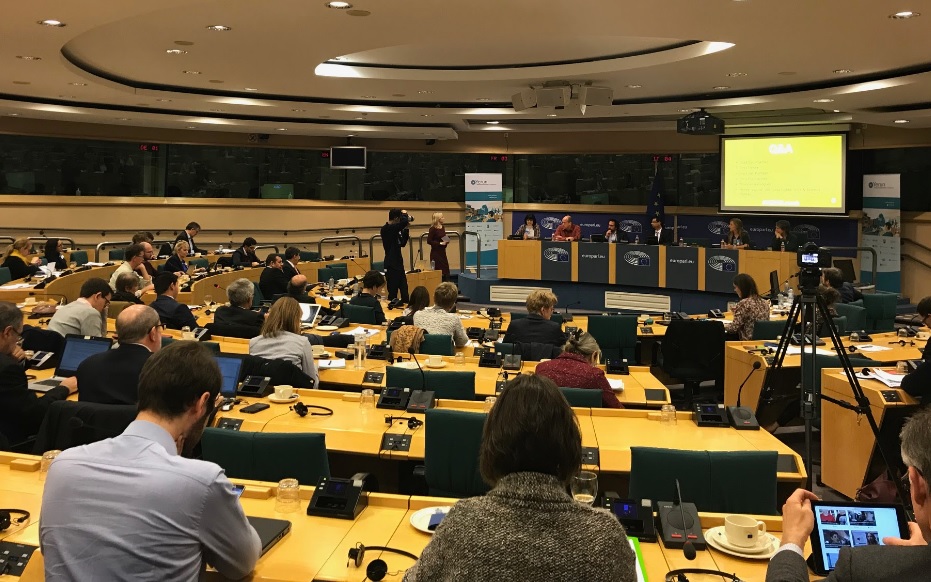
Yesterday, 7 November, the young European research universities network (YERUN) held its first meeting of the academic year at the headquarters of the European Parliament in Brussels. Some twenty representatives of the different network member universities, including Enric Vallduví, vice-rector for research at UPF, met with representatives of the Parliament, of the European Commission and numerous people interested in the world of higher education and research.
The meeting has served to present the association’s key demands in relation to the European Commission’s 9th Framework Programme (FP9), which will replace the current Horizon 2020 research programme when it finishes.
YERUN is asking that the general aim of FP9 should be to create and implement a European Agenda of Research and Innovation inspired by global challenges and missions. In this line, six main elements to be taken into account have been highlighted:
- Sustainable funding in research and innovation to maintain Europe’s ambition to progress.
- To involve the society in the creation of knowledge and innovation.
- To promote and reward the full implementation of the open access to science.
- To establish a more understandable definition of the concept of “impact”.
- To improve support to young researchers starting their research careers.
- To review the processes of the presentation and evaluation of projects to improve efficiency, transparency, equity and impact.
Presentation of research projects
During the meeting, research projects funded by the European Commission that have been coordinated by a member of YERUN were presented. This is the case of the project KRISTINA, coordinated by UPF, which was presented by Mónica Domínguez, a PhD student with the Department of Information and Communication Technologies (DTIC).
It is a three-year project (until 2018) that belongs to the Leadership in enabling and industrial technologies initiative of the EU’s Horizon 2020 programme. KRISTINA is coordinated by Leo Wanner, ICREA researcher of the DTIC and director of the Natural Language Processing research group (TALN).
Its main aim is to study and develop technologies that help immigrants to become socially competent and be communicative in the language of their country of residence by means of mobile communication devices. The idea was especially designed so that these people can overcome the language and cultural barriers of their host country, especially with regard to issues related to basic and health-related information.
The project especially affects the research into dialogue management, the analysis of spoken, facial and gestural communication, and multi-modal communication.
Related Assets

Catalan government
Catalan development cooperation aims to help prevent and respond to emergency situations. This page explains how you can collaborate on the provision of foreign aid both in general and to specific regions.

European Commission
Through cooperation and assistance programmes, the European Commission offers humanitarian aid and coordinates efforts with other international actors to promote peace and stability in war-torn regions.
Oxfam Intermón
Oxfam Intermón works in 90 countries. They have launched a fundraising campaign, which is more necessary than ever, given the magnitude of today’s wars. The NGO is also sponsoring a campaign to collect signatures to call for a ceasefire in Gaza.
Doctors Without Borders (MSF) is a medical-humanitarian action organization that provides assistance in 70 countries to people threatened by armed conflicts, violence, epidemics or neglected diseases, natural disasters and exclusion from medical care. They have also promoted a campaign to collect signatures to ask for a ceasefire in Gaza.
Red Cross
The Red Cross also provides emergency humanitarian aid in regions in crisis.
Legal Clinic
The UPF Legal Clinic regularly holds talks and roundtables on the protection of human rights in crisis regions.
Libraries Without Borders
The Libraries Without Borders programme, sponsored by the Catalan Development Cooperation Agency (ACCD), offers Catalan public library patrons knowledge and insight into situations of human rights violations and provides resources to take action.
Council for At-Risk Academics
The Council for At-Risk Academics, in partnership with universities and higher education institutions, provides urgently-needed help to academics in immediate danger, those forced into exile, and many who choose to work on in their home countries despite serious risks.