
The spinoff Voctro Labs launches an app to help choir singers rehearse with the help of artificial voices

Contra el genocidi i contra la violació dels drets humans, a Gaza i arreu del món

Peace comes when you talk to the person you most hate. And that’s where the courage of a leader comes.
Desmond Tutu (1931-2021), first recipient of an honorary doctorate from UPF
These words, spoken by Desmond Tutu, the first person ever to be awarded an honorary doctorate by UPF, are more applicable today than ever. The UPF condemns, and will always condemn, the use of violence to settle disputes. At UPF, we advocate approaching political or territorial conflicts based on dialogue and respect for all peoples and minorities.
As a university, we also want to show our support to the academic community in countries at war. Universities and scientific institutions are more necessary than ever in these regions. Access to education and the promotion of critical thinking, in the context of strong independent institutions, are the way to ensure the informed debate and reflection that can open the door to new avenues for finding solutions.
At UPF, we are aware of the university community’s concern for the human rights violations we are seeing in the conflicts around us. That is why on this website you will find information about campaigns and actions related to current conflicts, as well as opinion pieces and institutional statements. We also offer a dedicated e-mail address – [email protected] – to contact the university and let us know about your interests and concerns.
The spinoff Voctro Labs launches an app to help choir singers rehearse with the help of artificial voices
The spinoff Voctro Labs launches an app to help choir singers rehearse with the help of artificial voices
The program, called Cantāmus, is able to read a score and automatically generate the voices of the entire choir to help performers practise
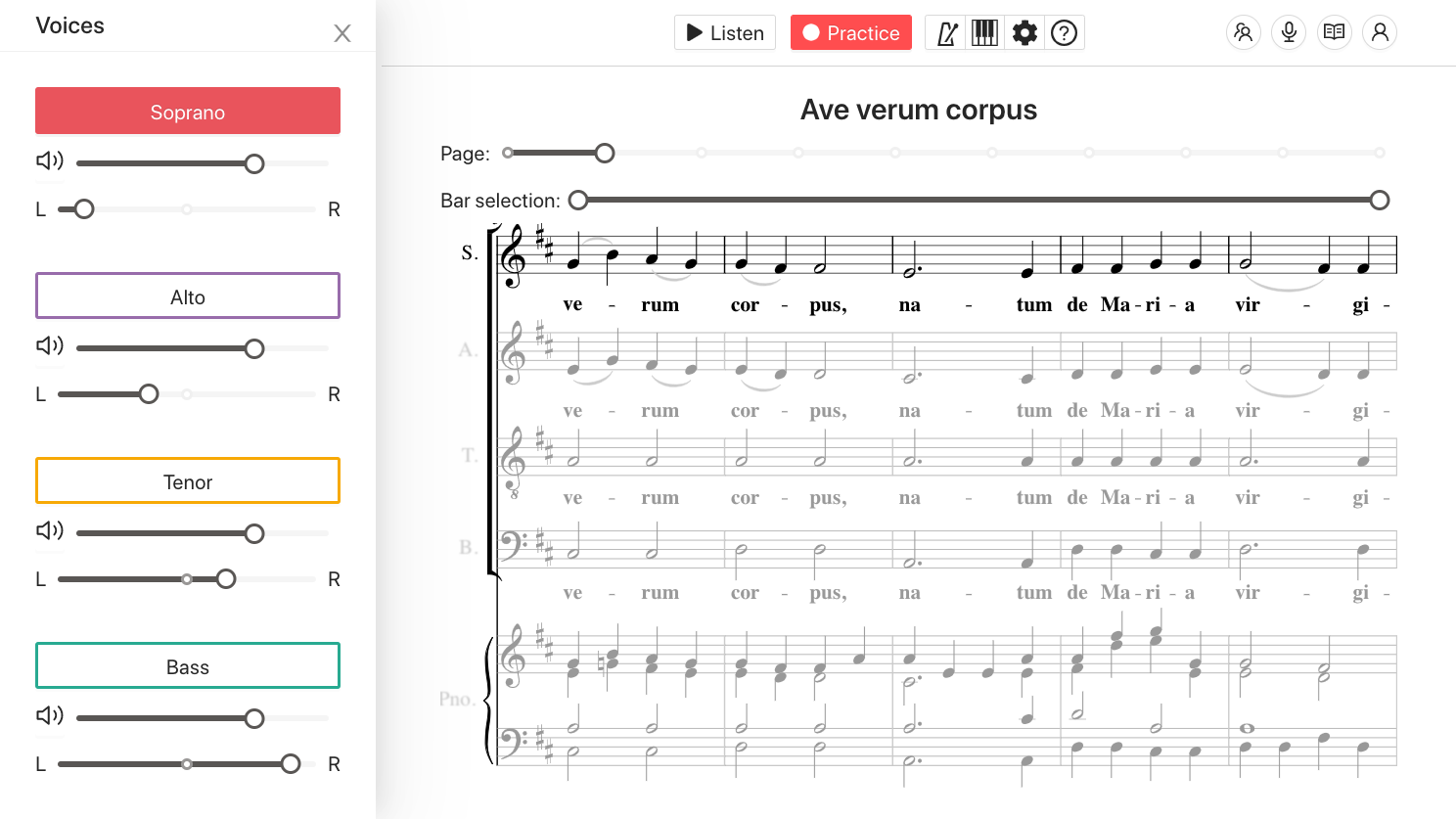
The UPF spinoff Voctro Labs has launched a new app, named Cantāmus, a tool for choir singers to rehearse. The program uses machine learning algorithms that generate artificial voices based on the features of real voices. So, it is able to read a score and automatically generate the voices of the entire choir to help performers practise.
Thus, users can upload their own scores or select a piece from the catalogue, consisting of more than 50 popular works by composers such as Bach, Mozart, Haydn, Schubert, Mendelssohn, Brahms and Bruckner. In addition, the app can display the score while playing the music, record the singer’s voice and offer an automatic assessment of their tuning.
“We want to help define what choirs will be like in the near future; they may also be virtual and located anywhere in the world”
“One very important advantage of Cantāmus is that the choirs can have their digital repertoire uploaded to the platform, and each singer can generate their own recordings to share with the conductor”, explains Voctro Labs director, Jordi Janer. In fact, the first version of the program offers a subscription for choirs, but “the next step will be to open it up to individual users, so that any singer can use it individually or in groups, creating choirs among friends or among people who share a liking for the same repertoire”, he adds.
The company wishes to offer a product in keeping with the times: “we are doing more and more online activities, especially young people, and with Cantāmus we want to help define what choirs will be like in the near future; they may also be virtual and located anywhere in the world”, Janer reflects. Hence, the company aims to develop its technology to get users to be able to sing in groups and in real time, “like a virtual choir”, but from different locations.
From research to market
Cantāmus technology emerged from a research project led by UPF researcher Emilia Gómez, from the Music Technology Research Group (MTG), part of the UPF Department of Information and Communication Technologies. This group, from which the spinoff Voctro Labs was hatched, coordinated an R&D project of the European Commission called TROMPA, dedicated to developing solutions to make digital music resources more accessible.
As part of this project, Voctro Labs was commissioned to create synthetic voices in several languages and developed a prototype to evaluate the technology with performers. “When we saw that the singers’ response was very positive, we realized that there could be a market for our solution”, says the company director.
Before launching its product, Voctro Labs has tested it with different choirs, such as Messies Participatiu, Cantoría, Coral Sant Medir and Igualada Gospel Choir, in Catalonia, Margaret's Choir, from Canada, and Denmark’s Chorus Soranus.
About Voctro Labs
Voctro Labs is a company that emerged from UPF research that develops audio technologies based on artificial intelligence to create spoken or sung artificial voices taken from texts or scores.
The company, through the trademark Voiceful, offers its voice generation products to video game, music, virtual reality, film or mobile applications companies to integrate them in their products. Thus, one of the technologies they have developed is capable of making video game users talk using the voices of the characters. Now, with Cantāmus, the spinoff is expanding its repertoire.
Multimedia
Categories:
Contact
Related Assets

Catalan government
Catalan development cooperation aims to help prevent and respond to emergency situations. This page explains how you can collaborate on the provision of foreign aid both in general and to specific regions.

European Commission
Through cooperation and assistance programmes, the European Commission offers humanitarian aid and coordinates efforts with other international actors to promote peace and stability in war-torn regions.

Oxfam Intermón
Oxfam Intermón works in 90 countries. They have launched a fundraising campaign, which is more necessary than ever, given the magnitude of today’s wars. The NGO is also sponsoring a campaign to collect signatures to call for a ceasefire in Gaza.

Doctors Without Borders (MSF) is a medical-humanitarian action organization that provides assistance in 70 countries to people threatened by armed conflicts, violence, epidemics or neglected diseases, natural disasters and exclusion from medical care. They have also promoted a campaign to collect signatures to ask for a ceasefire in Gaza.

Red Cross
The Red Cross also provides emergency humanitarian aid in regions in crisis.

Legal Clinic
The UPF Legal Clinic regularly holds talks and roundtables on the protection of human rights in crisis regions.

Libraries Without Borders
The Libraries Without Borders programme, sponsored by the Catalan Development Cooperation Agency (ACCD), offers Catalan public library patrons knowledge and insight into situations of human rights violations and provides resources to take action.

Council for At-Risk Academics
The Council for At-Risk Academics, in partnership with universities and higher education institutions, provides urgently-needed help to academics in immediate danger, those forced into exile, and many who choose to work on in their home countries despite serious risks.