The Severo Ochoa Centres and Maria de Maeztu Units Alliance aims at promoting Spanish science of excellence, and safeguarding its competitiveness
Contra el genocidi i contra la violació dels drets humans, a Gaza i arreu del món

Peace comes when you talk to the person you most hate. And that’s where the courage of a leader comes.
Desmond Tutu (1931-2021), first recipient of an honorary doctorate from UPF
These words, spoken by Desmond Tutu, the first person ever to be awarded an honorary doctorate by UPF, are more applicable today than ever. The UPF condemns, and will always condemn, the use of violence to settle disputes. At UPF, we advocate approaching political or territorial conflicts based on dialogue and respect for all peoples and minorities.
As a university, we also want to show our support to the academic community in countries at war. Universities and scientific institutions are more necessary than ever in these regions. Access to education and the promotion of critical thinking, in the context of strong independent institutions, are the way to ensure the informed debate and reflection that can open the door to new avenues for finding solutions.
At UPF, we are aware of the university community’s concern for the human rights violations we are seeing in the conflicts around us. That is why on this website you will find information about campaigns and actions related to current conflicts, as well as opinion pieces and institutional statements. We also offer a dedicated e-mail address – [email protected] – to contact the university and let us know about your interests and concerns.
The Severo Ochoa Centres and Maria de Maeztu Units Alliance aims at promoting Spanish science of excellence, and safeguarding its competitiveness
The Severo Ochoa Centres and Maria de Maeztu Units Alliance aims at promoting Spanish science of excellence, and safeguarding its competitiveness
The creation of SOMMa will allow research centres and units to increase their impact, foster their cooperation and work as a network, and enrich the R+D system as a whole.
The Severo Ochoa Centres and Maria de Maeztu Units Alliance (SOMMa) gathers research centres and units that received the Spanish Severo Ochoa and María de Maeztu excellence awards respectively. Thanks to the support of the Spanish State Secretariat for Research, Development and Innovation, these centres and units have joined efforts to promote, strengthen and maximise at the national and international level both the value of science of excellence produced by research centres and units, as well as its economic and social impact.
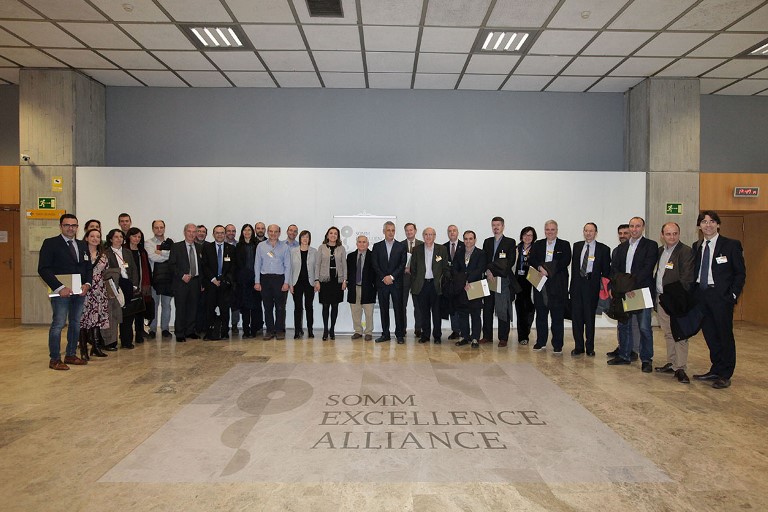
In an event held in Madrid on Monday, March 12th, representatives of SOMMa, together with the Spanish State Secretary for R+D+i, Carmen Vela, presented the new SOMMa alliance. “Spanish science comprises centres and research units of excellence that compete successfully at an international level. Uniting into this alliance allows us to join efforts, increase our impact and promote collaboration and networking. In summary, to enrich the R+D system of our country on the long run," expressed Teresa Garcia-Milà, vice-chair of SOMMa, and director of the Barcelona Graduate School of Economics (Barcelona GSE), during the presentation.
Among the objectives of the Alliance stand out: to increase the national and international visibility of Spanish research, as well as its scientific, economic and social impact; to promote the exchange of scientific knowledge and good practice between the different actors of the Spanish R+D system; to establish a dialogue with society and contribute to the nurturing of scientific culture; and to have a voice in scientific policy both in Spain and in Europe.
The full body of SOMMa centres and units gathers more than 7,000 staff dedicated to research, graduates every year more than 500 PhD candidates, and perceives funding for European projects representing an approximate turnover of 530 million Euro over a five-year period. In 2016 alone, research produced in SOMMa centres and units has been published in more than 5,800 papers in the best scientific journals, has given rise to 8 new spin-off companies, has yielded more than 100 patent applications and approximately 350 collaborations and contracts with companies. "These figures prove that the Severo Ochoa and María de Maeztu program has boosted the impact, international scientific leadership and competitiveness of these centres and units. The alliance will be very beneficial because it will allow the best centres to work together in a coordinated manner, which will contribute to expand their impact," declared the Spanish State Secretary for R+D+i, Carmen Vela.
Likewise, with the support of other organizations of the science and innovation sectors, SOMMa representatives stated their concern regarding the decrease of the R+D public funding, as well as the administrative issues constraining Spanish science. In particular, these organizations concur in highlighting the necessity to have specific, adequate regulations within the framework of European legislation safeguarding the competitiveness of the sector, as it happens in other countries.
“We acknowledge the efforts of the Spanish State Secreatariat for R+D+i to create and preserve the Severo Ochoa and María de Maeztu program despite the economic crisis and the public budget adjustments. Even so, we must insist in the importance of the investment in science, which requires a long-run State agreement,” affirmed Luis Serrano, SOMMa hair and director of the Centre for Genomic Regulation (CRG).
Apart from requesting a firm commitment to uphold funding levels, SOMMa also exposes the existence of certain administrative particularities severely compromising the R+D system, which require of political will to be solved. During the event, the document “SOMMa Position Paper: Actions required to safeguarding science competitiveness” was presented, which intends to draw the attention of politicians to tackle the aforementioned issues urgently and sustainably.
In summary, the three administrative issues exposed in the report refer to the criteria for VAT deduction, the personnel hiring regulations, and the new public-tenders law. These three subjects are currently causing serious problems to a number of research centres, and can potentially affect all other research institutions of the Spanish R+D system.
Related Assets

Catalan government
Catalan development cooperation aims to help prevent and respond to emergency situations. This page explains how you can collaborate on the provision of foreign aid both in general and to specific regions.
European Commission
Through cooperation and assistance programmes, the European Commission offers humanitarian aid and coordinates efforts with other international actors to promote peace and stability in war-torn regions.
Oxfam Intermón
Oxfam Intermón works in 90 countries. They have launched a fundraising campaign, which is more necessary than ever, given the magnitude of today’s wars. The NGO is also sponsoring a campaign to collect signatures to call for a ceasefire in Gaza.
Doctors Without Borders (MSF) is a medical-humanitarian action organization that provides assistance in 70 countries to people threatened by armed conflicts, violence, epidemics or neglected diseases, natural disasters and exclusion from medical care. They have also promoted a campaign to collect signatures to ask for a ceasefire in Gaza.
Red Cross
The Red Cross also provides emergency humanitarian aid in regions in crisis.
Legal Clinic
The UPF Legal Clinic regularly holds talks and roundtables on the protection of human rights in crisis regions.
Libraries Without Borders
The Libraries Without Borders programme, sponsored by the Catalan Development Cooperation Agency (ACCD), offers Catalan public library patrons knowledge and insight into situations of human rights violations and provides resources to take action.
Council for At-Risk Academics
The Council for At-Risk Academics, in partnership with universities and higher education institutions, provides urgently-needed help to academics in immediate danger, those forced into exile, and many who choose to work on in their home countries despite serious risks.