The “Petites grans idees” (Small great ideas) crowdfunding campaign begins

Contra el genocidi i contra la violació dels drets humans, a Gaza i arreu del món

Peace comes when you talk to the person you most hate. And that’s where the courage of a leader comes.
Desmond Tutu (1931-2021), first recipient of an honorary doctorate from UPF
These words, spoken by Desmond Tutu, the first person ever to be awarded an honorary doctorate by UPF, are more applicable today than ever. The UPF condemns, and will always condemn, the use of violence to settle disputes. At UPF, we advocate approaching political or territorial conflicts based on dialogue and respect for all peoples and minorities.
As a university, we also want to show our support to the academic community in countries at war. Universities and scientific institutions are more necessary than ever in these regions. Access to education and the promotion of critical thinking, in the context of strong independent institutions, are the way to ensure the informed debate and reflection that can open the door to new avenues for finding solutions.
At UPF, we are aware of the university community’s concern for the human rights violations we are seeing in the conflicts around us. That is why on this website you will find information about campaigns and actions related to current conflicts, as well as opinion pieces and institutional statements. We also offer a dedicated e-mail address – [email protected] – to contact the university and let us know about your interests and concerns.
The “Petites grans idees” (Small great ideas) crowdfunding campaign begins
The University’s sponsorship and patronage programme, UPFund, is starting its campaign this Friday with the aim of achieving collective funding for innovative projects in their fields and, at the same time, project UPF’s commitment to the society through scientific and technological development.
 The University’s sponsorship and patronage programme, UPFund, is starting its crowdfunding campaign entitled “Petites grans idees” with the aim of achieving collective funding for innovative projects in their fields and, at the same time, project UPF’s commitment to the society through scientific and technological development.
The initiative is to start on 10 November and is scheduled to finish before the Christmas holidays. Each week one of the six chosen ideas will be presented through a video and a fact sheet that includes the main goals, the benefits of taking the idea ahead and the main end beneficiaries.
This is a pilot project that will serve to assess the feasibility of establishing the campaign annually through an open call for the submission of ideas. In this first edition, ideas will be promoted in the fields of information and communication technologies, experimental and health sciences, translation and language sciences, and communication.
The campaign’s six ideas
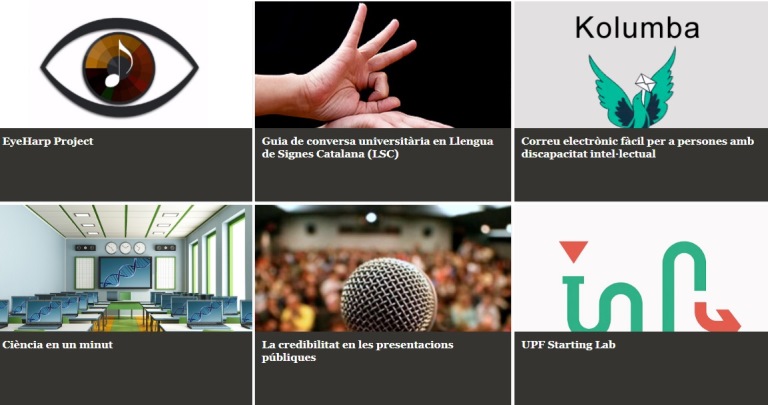
EyeHarp project
The EyeHarp is a digital musical instrument designed to allow playing music with eye or head movements. This instrument enables people with severe motor disabilities to learn, play and compose music. It is currently in its prototype phase and is already being used by people with disabilities in different countries of the world. The realization of this project will allow continuing to develop the EyeHarp and make its implementation more solid, thus allowing more people to be able to use it.
Catalan Sign Language (CSL) university conversation guide
The idea is to create a basic CSL conversation guide with translations into written Catalan, Spanish and English consisting of approximately 400 common expressions of communication in various areas of life. The goal is to make available to the university community and the general public a product that exists for spoken languages, but does not exist in CSL.
Kolumba
This is an e-mail wizard designed especially for people with intellectual disabilities. It incorporates text simplification technology, the translation of texts into pictograms, and voice synthesis, facilitating access to information for people with intellectual disabilities. This technology fills a gap in the field of accessibility. The project aims to transform it into a robust and well-tested program so that it can become the e-mail client for people with intellectual disabilities. It can also become an option for other types of target public, such as the elderly.
Science in 1 minute
This project seeks to boost the relationship between science and society through the design, development and distribution of didactic audiovisual resources that explain basic concepts and current developments in the area of health and life sciences. The aim is to produce a series of 8 short videos (maximum 5 minutes per video) that reflect the reality of modern science, improve the learning processes in education centres, promote an interest in science and, at the same time, stimulate reflection on the opportunities and challenges facing science today.
Effective communication
Today public communication is the key to professional decision making. However, most of the professionals in our country state that they feel uncomfortable or unprepared to face the public stage, even though it is part of their daily professional activity. The ability to catch people’s attention, relate, excite and convey information is critical in today’s professional world. To date there are no scientific studies that analyse which factors and strategies influence the effectiveness and the credibility of a public presentation. Hence, this is the aim of the project: to provide reliable and tested strategies to professionals to communicate their messages effectively in their presentations.
UPF Starting Lab
This is an incubation programme of digital creation projects by students at UPF, promoted by UPF’s Audiovisual Communication studies with the support of the Canòdrom (Creative Research Park) and the Catalan Government’s Catalan Institute of Cultural Enterprises. The first edition, in the 2016-2017 academic year awarded scholarships to 15 UPF students on the bachelor’s degrees in Communication, Engineering and Business and Economics. It is the first such project in the State and one of the pioneers in Europe. The students work in the professional development of projects that were presented as a Final Year Project in a space at the Canòdrom, getting professional advice, professional mentoring and follow-up of the project in order to go from being a good idea on paper to becoming a product with its niche in the market.
Related Assets

Catalan government
Catalan development cooperation aims to help prevent and respond to emergency situations. This page explains how you can collaborate on the provision of foreign aid both in general and to specific regions.

European Commission
Through cooperation and assistance programmes, the European Commission offers humanitarian aid and coordinates efforts with other international actors to promote peace and stability in war-torn regions.
Oxfam Intermón
Oxfam Intermón works in 90 countries. They have launched a fundraising campaign, which is more necessary than ever, given the magnitude of today’s wars. The NGO is also sponsoring a campaign to collect signatures to call for a ceasefire in Gaza.
Doctors Without Borders (MSF) is a medical-humanitarian action organization that provides assistance in 70 countries to people threatened by armed conflicts, violence, epidemics or neglected diseases, natural disasters and exclusion from medical care. They have also promoted a campaign to collect signatures to ask for a ceasefire in Gaza.
Red Cross
The Red Cross also provides emergency humanitarian aid in regions in crisis.
Legal Clinic
The UPF Legal Clinic regularly holds talks and roundtables on the protection of human rights in crisis regions.
Libraries Without Borders
The Libraries Without Borders programme, sponsored by the Catalan Development Cooperation Agency (ACCD), offers Catalan public library patrons knowledge and insight into situations of human rights violations and provides resources to take action.
Council for At-Risk Academics
The Council for At-Risk Academics, in partnership with universities and higher education institutions, provides urgently-needed help to academics in immediate danger, those forced into exile, and many who choose to work on in their home countries despite serious risks.